Esta Soler is a domestic violence activist. This article is based on a moving and powerful TED talk she gave some years ago in the US.
I lived in the US at that time. Besides my fulltime job, I was an interpreter for the Fijians in the Superior Courts in the SF Bay Area.
One day, one of the judges asked me to go to his chambers and made a startling observation. He said there were immigrants from many third world countries in California, but domestic violence among Fijians was very high.
And he wondered why. And so did I.
When my wife and I moved back to Fiji in 2010, I read that two thirds (67 per cent) of women and children were victims of domestic violence.
Since then, there have been many meetings, seminars and workshops.
And yet, in 2020, another grim statistic was announced – 70 per cent of women and children were subjected to domestic violence – one of the highest in the world.
Apparently, all the methods to reduce this scourge were ineffective.
Soler believes that domestic violence is not inevitable, that it is learned, and if it’s learned, it can be un-learned, and hence prevented.
She believes this because between 1993 and 2010, domestic violence among adult women in the US has gone down by 64 per cent. So why has it worsened in Fiji?
About 30 years ago, women were beaten, stalked and raped, and no one talked about it.
There was no justice. So, she suggested a four-step plan to eliminate it.
Step 1 — she organised and created a network of women who opened shelters, and if they didn’t open a shelter, they opened their homes so that women and children could be safe.
And they did everything they could do to fundraise, and then went to the federal government and asked them to pay for these extraordinary services that were saving people’s lives.
Step 2 — she had the laws changed. She went to Washington, and lobbied for the first piece of legislation.
About 10 years later, after lots of hard work, she finally passed the Violence Against Women Act (VAWA), which has saved so many lives.
She also collected data to make sure that the program works, and if it doesn’t work, she should change the plan. She feels that we are not going to solve this problem by building more shelters, but by economic empowerment for women, by healing children who are hurt.
Step 3 — she engaged the public. She went to the Advertising Council, and asked them to help build a public education campaign called There’s No Excuse for Domestic Violence.
As Esta Soler was in the process of releasing this campaign, O.J. Simpson was arrested for the murder of his wife and her friend. O.J had a long history of domestic violence.
The media became fixated. The story of domestic violence went from the back page to the front page.
Her ads flooded the airwaves, and women, for the first time, started to tell their stories.
Before 1980, there were 158 articles in The New York Times on domestic violence.
And in the 2000s, there were more than 7000. She was making a difference. But she was missing a critical element.
Step 4 — She needed to engage men. She couldn’t solve this problem with 50 per cent of the population on the sidelines. So, she wondered how she can include men.
How can she get men to talk about violence against women and girls?
A male friend of hers said, “you want men to talk about violence against women and girls. Men don’t talk”.
But he said, “they do talk to their kids. They talk to their kids as parents, as coaches”.
So, Soler met with men and built a program.
She had this one event where a basketball coach was talking to male athletes and men from all walks of life.
He was talking about giving men the tools to have healthy relationships.
He looked at the back of the room, and saw his daughter.
He said, “Michaela, come up here”.
Michaela was nine years old. She got up there, and he said, “sit down next to me”.
Then he said, “people ask me why I do this work. I do this work because I’m her dad, and I don’t want anyone ever to hurt her”.
Soler concluded her speech by saying, “I am convinced in the capacity of human beings to change.
“I believe we can bend the arc of human history toward compassion and equality, and I also passionately believe that this violence does not have to be part of the human condition.
“And I ask you, stand with us as we create futures without violence for women everywhere”.
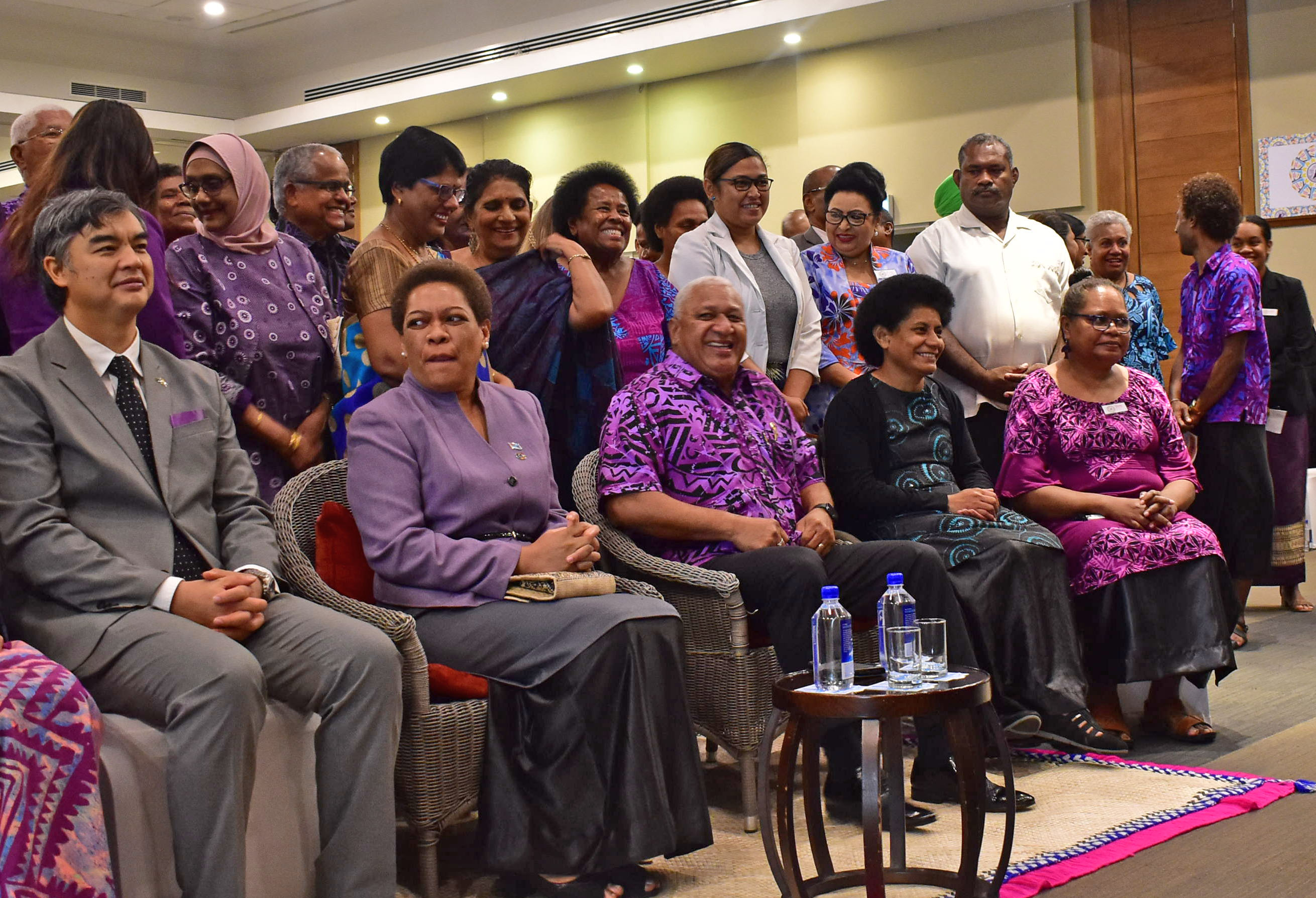
Late last year Minister for Women Mereseini Vuniwaqa invited my wife and me to the launch of Fiji National Action Plan at the GPH to eliminate domestic violence against women and children in Fiji.
The event was officially opened by Prime Minister. It was an honor for us to meet him
We were very touched and humbled by the invite as we are passionately interested in making a difference in people’s lives.
We considered how we could help. Like Soler, I knew that if we do not involve men, the program will not work. So, this is my humble contribution.
It is called Domestic Violence Perpetrators 52-week Intervention Program.
The content includes cognitive behavioural techniques and has been compiled from the most renowned domestic violence authors in the US.
It contains 52 weeks of curriculum necessary for providing a domestic violence intervention program.
There is also a stop program (with handouts and homework) that has innovative skills, techniques, options and plans for better relationships. If any counselor is interested, I will be happy to give him/her a copy of both programs.
Let’s all of us, especially men, pledge to eliminate this curse that afflicts us. I am convinced beyond a reasonable doubt that together we can.
- Arvind Mani is a former teacher who is passionate about quality education. He lived in the US for 35 years and was actively involved in training youths to improve their speaking skills. The views expressed are the author’s and do not necessarily reflect the views of this newspaper. He can be reached at theinspiredteacher9@gmail.com