
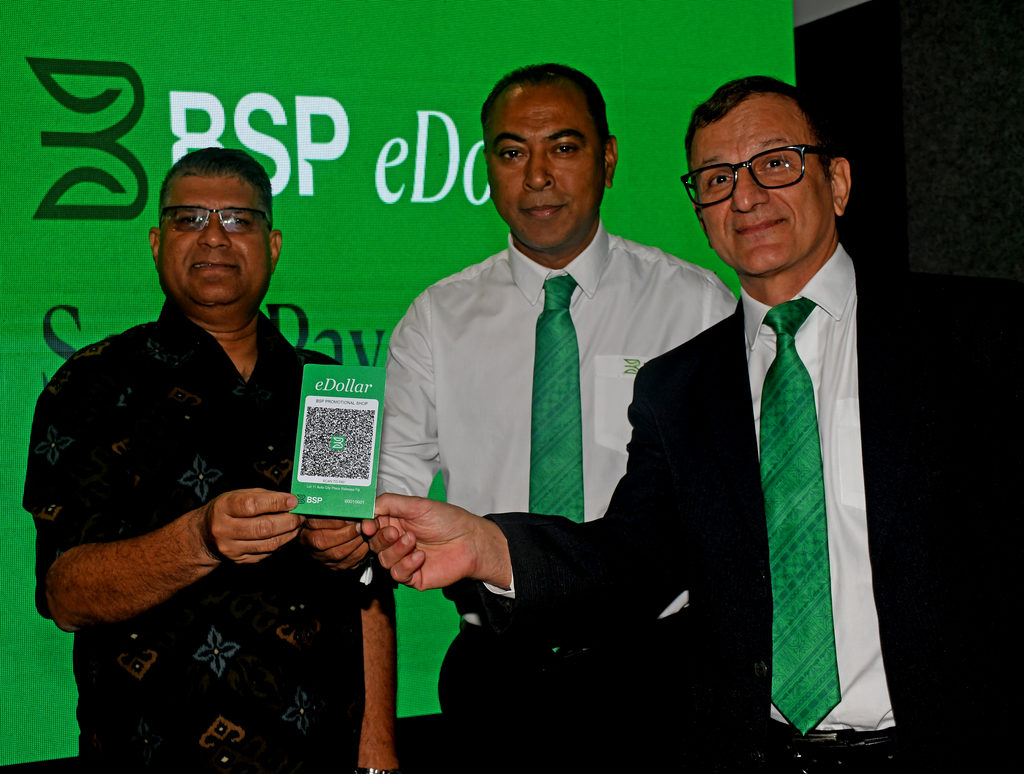
LAST week, Bank South Pacific (BSP) Fiji launched its mobile wallet eDollar – becoming the first commercial bank in Fiji and the Pacific to have a bank-backed electronic wallet.
BSP eDollar will bring the reach of its banking network directly to its customers through their mobile phones, and will allow them greater choice, control and convenience in how they manage and move their money.
The Fiji Times has established that this multi-million-dollar investment was fully funded by the bank, and the application took more than a year to build.
BSP Fiji relieving country head Maikash Ali said as banking became more digital, they were committed to ensuring no customer was left behind.
“BSP eDollar empowers our valued customers with greater access to manage their own accounts more flexibility in how they move funds plus the ability to pay by other people or businesses via QR code,” Mr Ali said.
eDollar app
Through the app, customers can create and manage up to five electronic wallets, each with its own unique account number and the option of domestic or international access.
Customers can move funds between their BSP accounts and e-wallets, transfer funds to other BSP customers, and transact across participating banks and mobile wallets.
“You can create five different wallets and the purpose of that is, if you want to save for travel or for your children’s school fees, food expenses, transport, etc, you can create a wallet for each, and for every fortnight or every week as you get paid, move money into each wallet,” Mr Ali said in an interview.
However, he said what made eDollar particularly meaningful was what it changed for their customers.
He said services that once required a visit to a branch, time spent in a queue, or a call to the bank’s customer service centre could increasingly be managed directly by customers from their own mobile devices.
A standout feature as well is QR payments, allowing customers to generate their own QR code for each e-wallet, enabling instant transfers between individuals and instant payments at any BSP QR merchant location.
Mr Ali said the BSP eDollar is aligned with the Reserve Bank of Fiji’s (RBF) National QR Code Standard.
“I find that the most amazing feature. For example, if you were to pay me, you’ll go straight on your e-wallet, create a QR code, and either send it to me if we are in different towns, or if we are together, you can just show it to me and I can scan it straight away, and funds can be transferred instantly between people.
“And this is also enabling or having Fiji move closer to a cashless society.”
Customers can start using this bank-backed wallet by downloading the eDollar app from Google Play Store or the App Store for Apple devices.
Interoperability
RBF governor Ariff Ali said the launch of BSP’s eDollar e-wallet closely aligned with the central bank’s payment system modernisation agenda that sought to build a payment system that was safe, efficient, inclusive and resilient.
He said in an increasingly digital and interconnected world, the ability to send and receive funds instantly was not a luxury but a necessity.
“Hence, modern payment infrastructure is no longer simply a convenience, it is the cornerstone of the financial sector and an essential component of economic development,” the governor said.
He said a key part of the modernisation journey was interoperability where customers and businesses could transact more easily across providers, platforms and channels.
“Interoperability creates a level playing field, rather than building separate and closed payment ecosystems.
“In support of this, the RBF recently introduced a National QR Code Standard, developed with industry input to promote consistency and interoperability across QR payment solutions.”
He said eDollar incorporated Fiji’s National QR Standard, making it interoperable with other participating payment service providers.
“This is a major milestone because interoperability lies at the heart of an efficient payment ecosystem.
“It enables customers to make payments seamlessly, regardless of the institution or payment application they use, while giving merchants confidence that they can accept payments from multiple providers through a single QR code.
“This is exactly the type of open, connected and competitive payments ecosystem that Fiji has been working towards.”
Shared responsibility
With the convenience in banking now accessible via this mobile wallet, the bank has advised came with a shared responsibility.
The bank’s relieving country head said they had advised every customer to treat their eDollar wallets with the same care they would give their bank account.
He urged customers to stay alert to unsolicited calls or messages asking for personal or account details, and to contact the bank immediately if anything ever felt out of place.
“An e-wallet should feel effortless to use and safe to trust. That is a standard we hold ourselves to every day,” Mr Ali said.
He said as there was more and more offerings, criminals were trying to steal customer credentials by creating fake sites.
He said there were features within the app that safeguarded customers, such as OTP numbers that are only sent to customers.
Building block for the future
The central bank governor congratulated BSP Fiji for demonstrating leadership by becoming the first commercial bank in Fiji to launch an interoperable e-wallet built on the National QR Standard.
He said this was an achievement that reflected both innovation and a commitment to supporting the country’s broader digital economy aspirations.
“As Fiji’s payment ecosystem continues to mature, today’s e-wallet should also be viewed as an important building block for the future.
“As we celebrate today’s milestone, we should also remember that this is not the destination and I invite other financial institutions to embrace interoperable innovation.
“I look forward to seeing the positive impact it will have on customers, businesses and the continued development of Fiji’s digital economy.”

