SIXTY-FOUR per cent.
That is Fiji’s national prevalence rate for violence against women — almost twice the global average, according to the Fiji Country Gender Assessment.
For Minister for Women, Children and Social Protection Sashi Kiran, the figure is more than a statistic.
It is a warning.
Speaking at the Pacific Islands Health Research Symposium High-Level Dialogue at Fiji National University’s Nasinu Campus last week, Ms Kiran said gender-based violence remained a severe human rights, public health and development crisis.
“The evidence is clear and alarming,” she said.
The 64 per cent figure provides a sobering backdrop to the cases being handled every day by frontline services.
In the first five months of this year, 829 new cases of violence were reported to the Fiji Women’s Crisis Centre (FWCC) and its branches.
Of those, 558 involved domestic violence.
That means almost seven in every 10 new cases reported to the FWCC between January and May were linked to violence within the home.
But the numbers tell only part of the story.
Behind every case is a woman, child or family dealing with fear, trauma, uncertainty and, often, the difficult decision to seek help.
And for many survivors, seeking help is not the end of the ordeal.
It is the beginning of a long journey towards safety and recovery.
When violence follows survivors home
The FWCC figures show the continuing demand for support services.
During the same five-month period, survivors attended 1023 repeat counselling sessions for domestic violence.
That figure is significant because it demonstrates that violence does not simply end when an incident is over.
The effects can remain long after a survivor has left an abusive relationship.
There may be fear of retaliation, financial insecurity, pressure from family members, concerns for children and uncertainty about where to live.
For a mother, leaving an abusive partner may mean finding somewhere safe for herself and her children while trying to rebuild an income and a support network.
For others, years of psychological trauma can make recovery a slow process.
The figures recorded by crisis services also cannot be assumed to represent the full scale of violence.
Not every survivor reports abuse.
Fear, shame, financial dependence, concern for children and a lack of confidence in available support can prevent people from seeking assistance.
The 64 per cent national prevalence figure therefore provides a wider context for the hundreds of cases reaching crisis services.
A safe place to go
The opening of a new National Shelter for Domestic Violence in Lautoka on August 28 represents one response to that crisis.
The shelter provides emergency accommodation for survivors of gender-based violence, together with trauma-informed counselling, social work support, case management and referrals to other services.
Its location is being kept confidential to protect the safety and privacy of women and girls using the facility.
At its launch, Ms Kiran said no woman fleeing violence should have to choose between returning to an unsafe home and having nowhere else to go.
“A woman escaping violence should never have to choose between remaining in an unsafe situation and having nowhere to go,” she said.
“A safe shelter gives her the protection, support and space she needs to begin rebuilding her life with dignity.”
But the significance of the facility goes beyond providing accommodation.
A shelter can provide immediate safety, but recovery requires longer-term support.
It can involve counselling, social services, assistance with children, legal processes, financial independence and eventually reintegration into the community.
The warning involving girls
While the shelter is intended primarily to support women and children escaping violence, Ms Kiran used its launch to raise another concern — the growing vulnerability of girls to drugs, trafficking, homelessness and teenage pregnancy.
She said authorities were seeing girls as young as 13, 14 and 15 becoming pregnant and being drawn into situations involving drugs and trafficking.
During a recent street sweep in the Western Division, authorities found a 16-year-old pregnant girl living on the streets.
The girl was close to giving birth and was placed in the ministry’s care but was unable to return to her family.
For Ms Kiran, the case was a warning about children who fall through gaps in family and community protection.
“Today as I was coming here, there is something that has been wrenching my heart in the last few months, and the more I see it, the more I am worried,” she said.
The situation also highlights how different forms of vulnerability can overlap.
A child experiencing violence at home may become homeless.
A child living on the streets may become vulnerable to exploitation.
A teenager exposed to drugs may become vulnerable to trafficking.
Pregnancy at a young age can create additional barriers to education, family support and economic independence.
These problems cannot always be treated separately because, for some children, they are part of the same cycle.
A Western Division concern
Ms Kiran said Fiji could no longer view the drug problem as primarily a Nadi issue.
Lautoka and Ba, she said, were also seeing vulnerable people becoming trapped in situations involving drugs and exploitation.
“We often think of it as a Nadi challenge, but these areas, Ba and Lautoka, these are the vulnerable that are unsuspectingly trapped into this world.”
Her warning is particularly significant in light of her more recent comments about the national prevalence of violence against women and the vulnerability of young girls.
At the health research dialogue, Ms Kiran said gender-based sexual violence in Fiji was deeply concentrated within the home, with girls aged 13 to 17 facing the highest statistical risk of sexual offences among demographic groups.
She also cited a June 2025 Nadi study by Dr Lice Vaniqi that found high levels of lifetime domestic violence among pregnant women attending antenatal clinics in Nadi.
Together, the findings point to a problem that begins much earlier than the point at which a survivor reaches a shelter.
Intervention before crisis
For Ms Kiran, prevention must begin before a child reaches crisis point.
She has stressed the importance of parenting and the responsibility of families and communities to protect children.
Government services are increasingly encountering children affected by drugs, parents using drugs and young people being pushed or lured into harmful situations, she said.
That means the response to violence cannot be limited to what happens after an offence.
It requires early identification of vulnerable children, stronger family support, counselling, rehabilitation, education, child protection and safe accommodation.
The challenge is to intervene while there is still an opportunity to prevent a child from reaching the streets or becoming trapped in exploitation.
Recovery does not end at the shelter
Empower Pacific operations manager Mereisi Tavaiqia said the support provided through the Lautoka shelter would go beyond accommodation.
Women would be assisted to recover from trauma, rebuild confidence and work towards independence.
The aim is to help survivors move from immediate crisis to recovery and, eventually, reintegration into their communities.
That support is important because leaving an abusive relationship does not automatically resolve the problems created by violence.
A woman may still have no income.
She may have children to care for.
She may have nowhere permanent to live.
She may fear retaliation.
She may also be dealing with years of psychological trauma.
The 1023 repeat counselling sessions recorded in the first five months of the year demonstrate why recovery cannot be measured simply by whether someone has escaped an abusive home.
More than a women’s issue
Ms Kiran has described gender-based violence as a human rights, public health and development crisis.
That distinction matters.
Violence affects more than the person experiencing it.
Children who witness violence can carry its effects into their own lives.
Families must deal with its consequences.
Health, justice and social protection services must respond.
Workplaces can also be affected when survivors are unable to work or must take time away to deal with the consequences of abuse.
The 64 per cent prevalence rate therefore represents more than the experiences of individual women.
It represents a national challenge. And if Fiji is to reduce that figure, the response cannot rely solely on shelters and crisis services.
Breaking the cycle
The new Lautoka shelter provides an important safety net for women and children who have already reached crisis.
Ms Kiran acknowledged the work of Empower Pacific and urged the organisation to pay attention to girls affected by drugs and trafficking.
“I hope you will also pay attention to the girls who are getting into the trap,” she said.
She also acknowledged the assistance of Soroptimist International Lautoka Club, which helped bring the facility up to occupational health and safety compliance and assisted with fencing, as well as support from LDS Charities.
But the shelter is only one part of the answer.
The harder task is preventing violence before a survivor needs somewhere to escape to.
It means strengthening families, identifying vulnerable children earlier, addressing drug-related harm, preventing trafficking and ensuring women have the economic and social support needed to leave violence safely.
The figures are stark.
Sixty-four per cent is the national prevalence rate.
Eight hundred twenty-nine (829) is the number of new violence cases reported to the FWCC and its branches in five months.
Five hundred fifty-eight (558) of those cases involved domestic violence.
And 1023 repeat counselling sessions show that the effects of violence can continue long after the immediate incident.
But behind every number is a person.
A woman trying to escape.
A mother trying to protect her children. A child trying to understand violence.
A teenage girl facing pregnancy, drugs or exploitation.
The 64 per cent figure should therefore not simply be read as a statistic.
It should be read as a measure of the work still ahead.
The Lautoka shelter gives survivors somewhere safe to go.
The greater challenge is making sure fewer women and girls ever need to use it.
Because the ultimate measure of progress will not be how many survivors Fiji can shelter.
It will be whether Fiji can break the cycle of violence early enough that another generation does not become part of the numbers.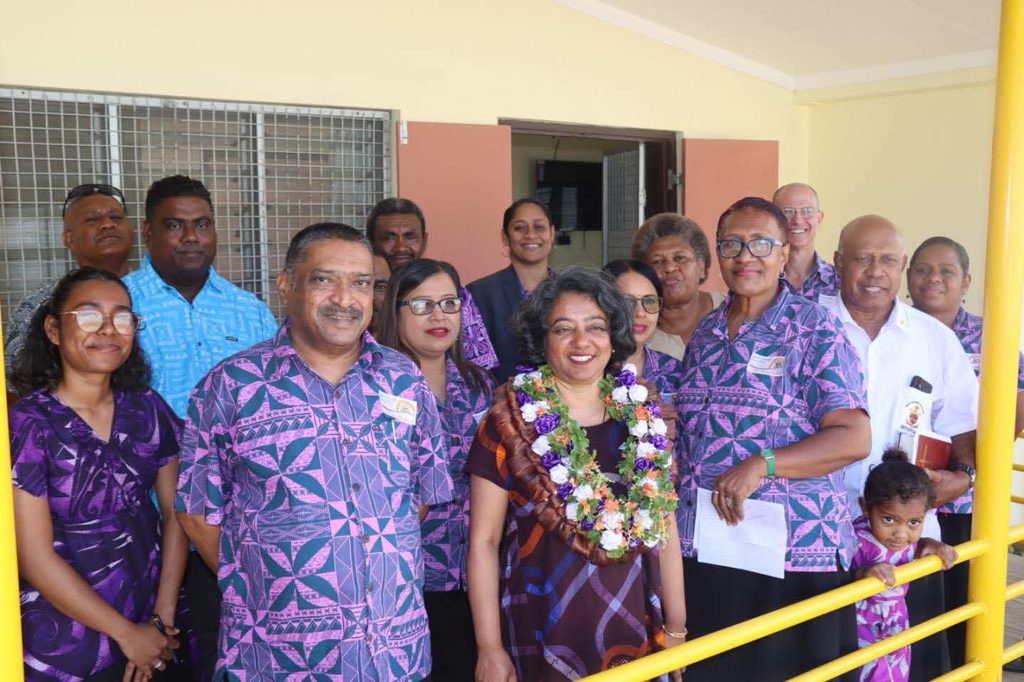
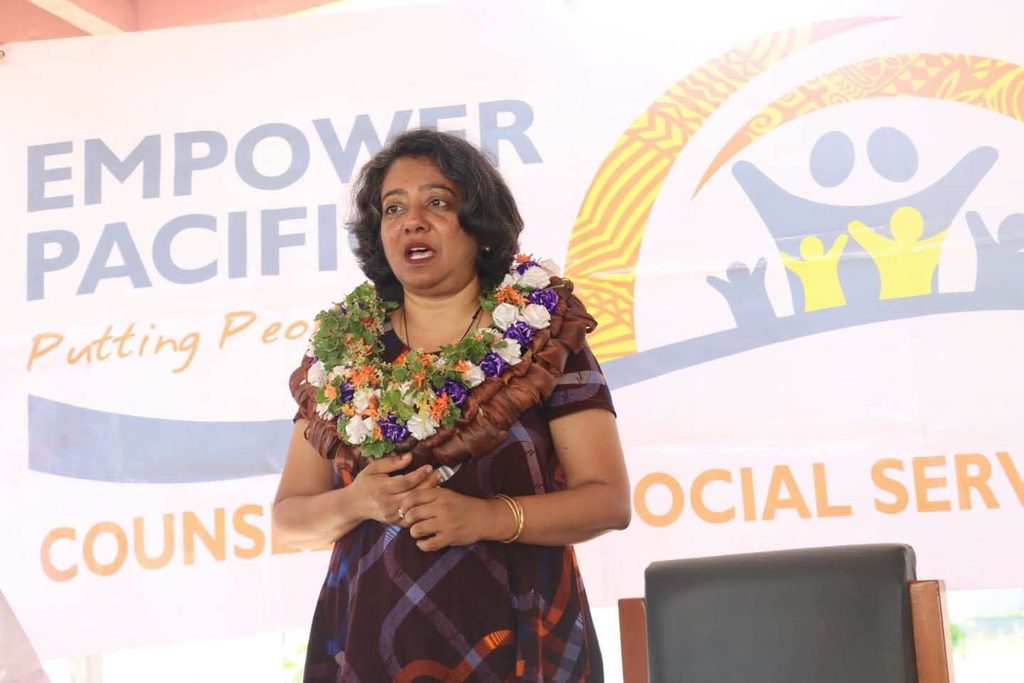
Minister for Women, Children and Social Protection Sashi Kiran with staff members of Empower Pacific at the soft launch of the National Domestic Violence Shelter in Lautoka on August 28,2026. Picture:SUPPLIED