
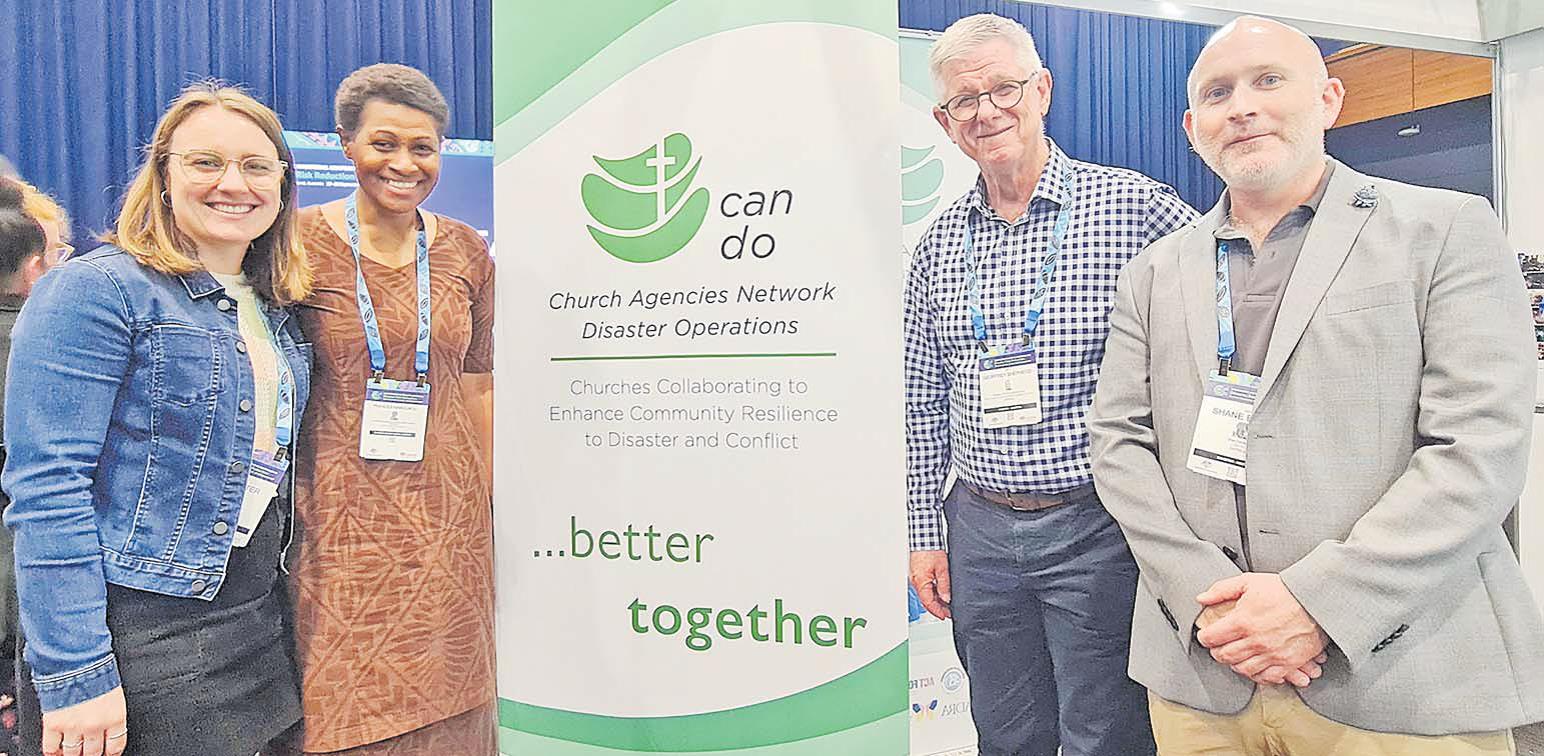
The Church Agency Network Disaster Operations (CAN DO) had the opportunity to share about the Theology of Disaster Resilience in a Changing Climate (TDRCC) following the opening of the Asia-Pacific Ministerial Conference on Disaster Risk Reduction in Brisbane, Australia yesterday.
Presenting on behalf of CAN DO was Frances Namoumou from the Pacific Conference of Churches based in Fiji.
She said at a critical time when churches in the Pacific were trying to co-ordinate themselves in responding to and managing disasters, CAN DO extended the much-needed support to the Pacific to assist in strengthening the co-ordination and collaborations of churches’ network in this area.
“In the process CAN DO really immersed itself and established meaningful engagement with local churches, national and regional church agencies in the Pacific such as the Pacific Conference of Churches; and expanding further the scope of work with the national and international NGOs and, most importantly, the various government machineries or sectors,” Ms Namoumou said.
TDRCC was implemented in the Solomon Islands, Vanuatu, Fiji and Papua New Guinea and was recognised as a pan-Pacific and ecumenical effort as the project did not just work with one church but co-ordination with a number of denominations/ churches.
“For example in Fiji – CAN DO was based at the Adventist Development and Relief Agency (ADRA) office – the humanitarian arm of the Seventh-day Adventist Church but it was working together with the Methodist Church in Fiji, Anglican Diocese of Polynesia, Roman Catholic Church and the Fiji Council of Churches that works with other churches in Fiji,” she shared.
Ms Namoumou said the three key priorities of the project included developing and contextualising theology framework and bible studies; training of trainers; and rolling out of community education.
“A big part of the church’s active discipleship and custodianship of creation and the resources available to us, is our responsibility to be prepared and respond to and mitigate impacts of disaster.
“Preparedness does not mean lack of faith, because (James 2:17) ‘faith by itself, if it has no work is dead’. Preparedness embodies prayer, discernment and action that accompanies the four-stage cycle of the Disaster Risk Management process – mitigation, preparation, response and recovery.
“God’s intention is for humanity to enjoy the fullness of life. The fullness of life could describe one’s means of support, life or existence in general, and even one’s way of life. Practically speaking, for us to continue living we depend on food, accessing clean water, shelter and safety (or a place to call home), – and the additional education, fulfilling job, and so forth.”
These, she said, are the very necessities of existence that are often affected, damaged, or destroyed when disasters occur.
“Churches engagement in this space is most important ensuring as much as possible within their capacities that potential risks and threats to our existence are minimised and addressed as effectively as possible. This accompaniment of churches continues beyond the project period as what is key in this accompaniment is an ecological conversion and faith,” she added.
CAN DO is one of the six AHP consortiums. In Fiji, CAN DO is led by ADRA Fiji as a secretariat to 10 faith-based organisations.
- LOSALINI BOLATAGICI is the communications and visibility officer for ADRA Fiji. She provides technical support to the Fiji Australian Humanitarian Partnership.

