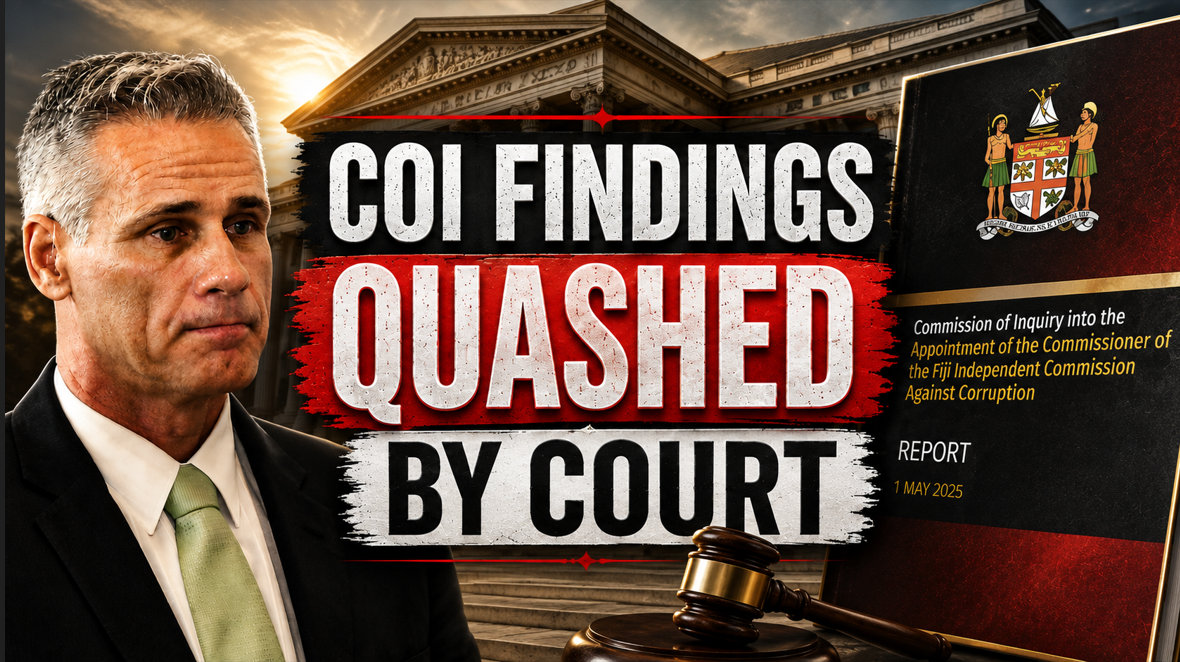
The High Court has criticised comments made by Commission of Inquiry Commissioner Justice David Ashton-Lewis about former FICAC Commissioner Barbara Malimali, finding they were inappropriate and could be viewed as demonstrating apparent bias against her.
Justice Dane Tuiqereqere highlighted the remarks in his judgment quashing the COI findings and declaring the report null and void.
The comments were made by Justice Ashton-Lewis during a radio interview on May 29, 2025, after the COI report had been completed but before it was released publicly.
Justice Tuiqereqere said remarks made about Malimali during the interview “were not appropriate and may be construed, by a fair-minded fully informed observer, as an apparent bias against Ms Malimali”.
During the interview, Justice Ashton-Lewis made a series of strongly worded claims about Malimali, including that she had been “universally seen as corrupt” and as someone who would protect high-ranking people.
He also questioned why Malimali had been so important to those who wanted her appointed.
“Now the question then arises why was she so important?” Justice Ashton-Lewis said during the interview.
“Well, the rest of the evidence shows she was so important because she would do evil people’s designs…”
Justice Tuiqereqere highlighted the comments while considering whether the Commissioner’s conduct met the legal test for apparent bias.
Justice Ashton-Lewis had also said during the interview that Malimali was “unsuitable for the job” and “unqualified for the job by dint of her background”, and claimed that “no one trusts her”.
The High Court did not find sufficient evidence to establish actual bias by the Commissioner.
However, Justice Tuiqereqere found that the test for apparent bias was clearly satisfied when the Commissioner’s conduct, the COI report and his subsequent statements were considered.
The court’s distinction means it did not conclude Justice Ashton-Lewis was personally or actually biased, but found the circumstances were sufficient for a fair-minded and fully informed observer to reasonably apprehend a lack of impartiality.
The apparent bias finding was among the significant problems identified by the High Court with the conduct of the inquiry and its report.