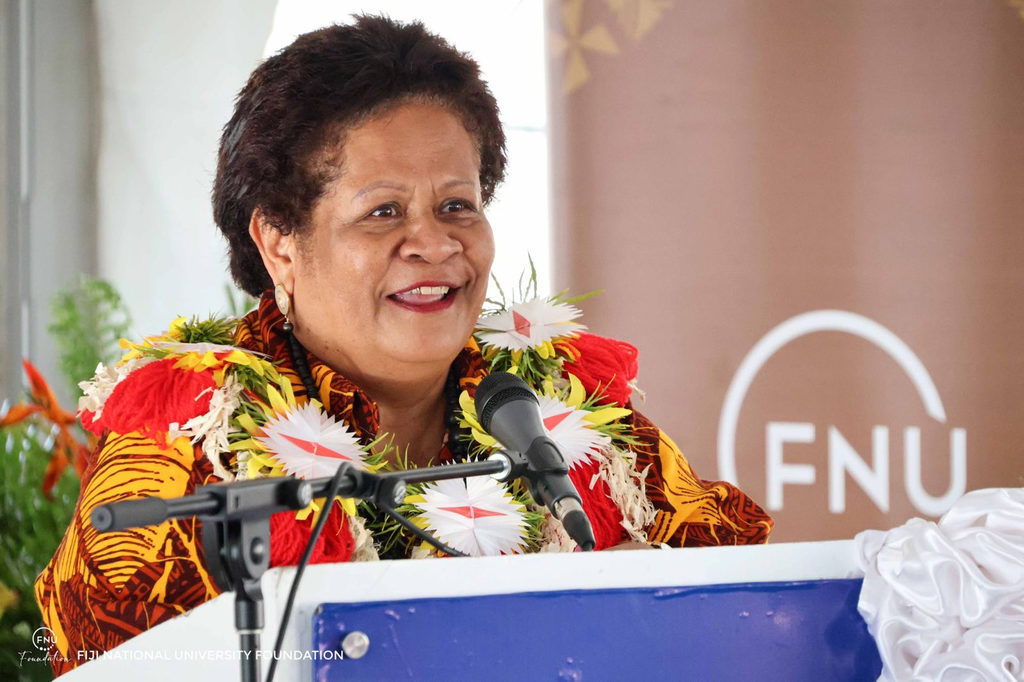
THE Fiji National University’s Ratu Wiliame Maivalili Katonivere Campus site in Labasa was “nothing but a rubbish dump site” when Vice-Chancellor Professor Unaisi Nabobo-Baba visited in 2023.
Professor Nabobo-Baba said the site was heavily overgrown, with grass twice her height and rubbish scattered across the land that had been gifted to the university for education.
“Not so long ago, this was like wild grass, higher than me by two times, rubbish everywhere,” she said.
For Prof Nabobo-Baba, the condition of the site was particularly hurtful because of the significance of the land and the purpose for which it had been entrusted to Fiji National University.
“For a leader who was trying to learn about a new place, it was really hurtful. Why? Land gifted to us for education should be revered.”
She acknowledged the lengthy delay in developing the campus and apologised to the landowners of the yavusa o Wasavulu.
The development has been in the making for about 15 to 16 years, with the project experiencing delays under successive university leaderships and further setbacks during the COVID-19 pandemic.
She said FNU had returned to the site rather late.
“It’s gone through 15 years of different leaderships, but we are here today to tell you that we are committing all over again.
“I apologise for that today. That we left it to grow in 15 years, and we came back rather late.”
She said the university’s senior staff had worked hard to clean up the site, with assistance from the Fiji Corrections Service.
When she first visited the site in 2023, she said she realised the university needed the support of the local community.
She recalled travelling to a village where she knew her late husband was related and asking for 10 men to accompany her.
“I felt like we needed to walk with the people here. It just felt that we needed support, quite in the spiritual realm.
Prof Nabobo-Baba said the university had a responsibility to respect the land and the people who had entrusted it to FNU.
“As I stand here, I’d like to say that the donors put up with us big time. While we are celebrating, we also say sorry. From now on, you will see that it was worth the long wait.”
The comments come as the university renews its commitment to developing its presence in the Northern Division, following years of uncertainty surrounding the Naiyaca site.
Tui Macuata Ratu Wiliame Katonivere said the delay had tested the patience of the people of Macuata.
Speaking during the second groundbreaking ceremony in Labasa, Ratu Wiliame said the project represented a vision first discussed about 15 years ago.
“As time passed, many quietly wondered whether the vision that had brought us together would ever be realised,” he said.
He recalled standing on the site in 2013 with then Education Minister Filipe Bole and sharing the excitement of seeing it eventually developed into a university campus.
The COVID-19 pandemic further delayed the project, he said, but the purpose for which the land was entrusted to FNU never changed.
“Our elders had viewed education as the greatest legacy they could leave for future generations,” he said.
Ratu Wiliame said the land was entrusted to FNU as an act of faith and trust.
He urged the university to honour the land, its people and the trust placed in its hands.
The campus, he said, would provide knowledge, opportunity and education for generations to come.
The renewed development also comes amid questions over the alleged misuse of at least $12million linked to the incomplete campus.
Prime Minister Sitiveni Rabuka said he would establish the status of an investigation into the alleged misuse of funds.
The matter was reportedly investigated and referred to the Fiji Independent Commission Against Corruption, but no one has been charged to date.
Mr Rabuka said three former board members and three former leaders were part of the investigation.
He stressed that those involved were former board members and former leaders, rather than members of the current leadership.
Asked whether he would push for further action and whether more people should be charged, Mr Rabuka said he needed to establish what had happened first.
“I have to. That is at the operational level, not at the policy level. I’ll have to find out what’s happening.”
He said the matter was an operational issue and he would need to establish the status of the investigation before determining what further action could be taken.
He said the issue predated his decision to take a closer look at tertiary education, particularly human resource development.
“It was before I decided to take a closer look at tertiary education, particularly in the area of human resource development for the nation, as part of our national plan.”
He did not say whether additional people should face charges, but indicated that he would seek information on the progress of the matter.
While the financial allegations remain a matter for investigation, FNU is now seeking to turn the page on the campus’s troubled history.
Prof Nabobo-Baba said the university’s responsibility extended beyond simply providing classrooms and facilities.
She said FNU had to play a greater role in developing the people and skills needed to drive the future of the Melanesian region.
“It means that FNU is the university that must function within to lead the Pacific’s Melanesian subgrouping to their future,” she said.
She said FNU’s focus on education, equitable access and developing people was directly linked to national and regional development.
Small island states had limited funding and resources, she said, making investment in people particularly important.
“The work of national development, the work of university philanthropy, they meet at some point,” she said.
FNU’s growing presence in five other Pacific countries, she said, demonstrated the university’s expanding regional role.
She said geography and financial circumstances should not prevent people from accessing education and developing the skills needed for the future.
For Macuata, the development of the campus is therefore about more than a building project.
It represents a long-standing promise made to landowners, students and the wider community.
The land was gifted for education, and the expectation was that it would become a place where future generations could gain knowledge and skills without having to leave the North.
After years of delay, the university now faces the responsibility of ensuring the site does not return to the condition Prof Nabobo-Baba encountered in 2023.
The challenge is to turn the renewed commitment into a functioning institution that honours the land and the people who waited for it.
Ratu Wiliame said the elders had viewed education as the greatest legacy they could leave for future generations.
That legacy, he said, must now be honoured.