
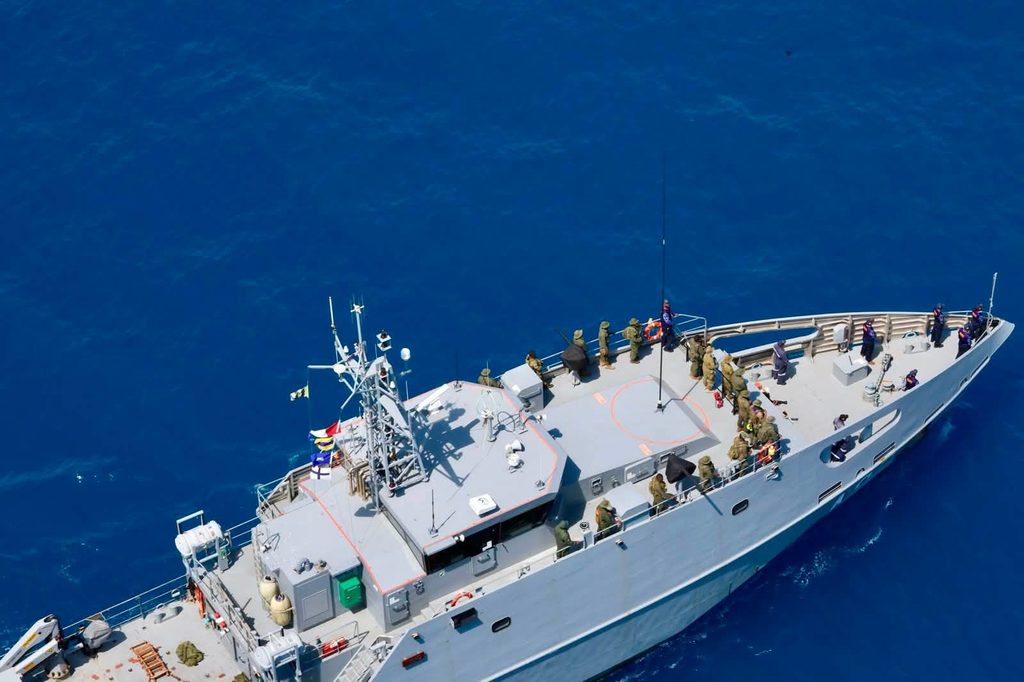
THE Republic of Fiji Navy has tested its ability to detect, coordinate and respond to a simulated maritime threat during the Maritime Phase of Exercise Bougainville 2026.
This was through a recent exercise that brought together national agencies, patrol vessels, small boats, naval divers, air assets and uncrewed systems in a scenario focused on potential illicit activity in Fiji’s maritime approaches.
The scenario began when the Fiji Maritime Surveillance and Rescue Coordination Centre (FMSRCC), based at the Vuvale Maritime Essential Services Centre, received and validated information indicating potential illicit activity.
Working with partner agencies, the centre combined available information and shared updates through the IORIS platform, providing participating agencies with a common view of the developing situation.
The RFN said the exercise demonstrated the importance of connecting information, decision-making and operational action across agencies.
As the scenario developed, RFNS Timo provided the primary surface presence, supported by the Small Boat Squadron’s rigid-hulled inflatable boats and inshore patrol vessels.
The vessels took part in rapid interdiction and amphibious assault drills involving land forces from the 3 FIR RRICG.
Naval divers also conducted underwater inspections to support the approach of 3 FIR personnel to an island of interest.
The exercise provided another test: how uncrewed technology could be incorporated into Fiji’s maritime operations.
Two uncrewed surface vessels from the Royal New Zealand Navy were used in a proof-of-concept trial and incorporated into the shared operational picture.
The RFN said the trial provided an opportunity to practise integrating uncrewed surface vessels with crewed platforms and to explore how emerging technologies could support maritime surveillance and coordinated operations.
Throughout the exercise, air and uncrewed assets were coordinated alongside maritime forces, helping maintain situational awareness across participating agencies.
The RFN said the exercise reinforced its role in supporting other national agencies as part of a coordinated government response to maritime threats and in protecting Fiji’s maritime borders.
But the exercise also exposed areas where further work is required.
The Navy said Bougainville 2026 identified capability gaps and areas requiring further development. These findings will inform its near-term priorities as it works to strengthen operational readiness, interagency cooperation and the RFMF’s contribution to national maritime security.
The exercise ultimately showed that maritime security depends on more than individual vessels or capabilities. It requires information to move quickly between agencies, decisions to be coordinated and operational forces to act as one.

