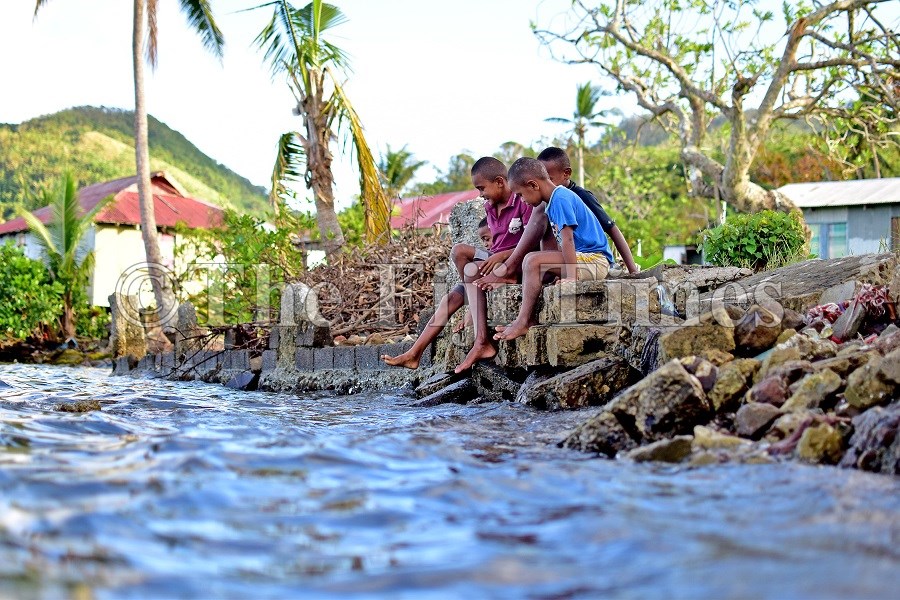
Fiji set an example for the world to be the first country to sign and ratify the Paris agreement.
December 11 2020 became a moment of pride for the Fiji Islands.
The archipelago has been recognised in the international platform for its commitment to fight against the issue of climatic change in the Pacific Islands.
The credit of this appreciation goes to Prime Minister Voreqe Bainimarama’s leadership in advocating and raising the alarm about the dangerous effects of climatic change and the vulnerability of the Pacific countries.
His vision is that Fiji cannot pursue sustainable development without building resilience and adapting to climatic change, and also raised the alarm about the climatic emergency worldwide.
Mr Bainimarama has been awarded UN Environment Programme (UNEP)’s Champions of the Earth award for Policy Leadership which is the UN’s highest environmental honour.
The supremo’s path-breaking work includes highlighting the impact of climatic change and rising sea levels; pursuing a national strategy to reach net-zero carbon emission by 2050; advocated the importance of a healthy and functioning ocean; drawing global attention towards rising global temperature; protecting Fiji’s ecosystem, waterways and reefs; implying renewable energy programs and committed to having zero carbon emission by 2050.
Therefore, besides having euphoria, it becomes imperative to learn more about this prestigious award and other laureates’ contribution towards safeguarding the environment.
Earth award
This is the highest environmental honour given to outstanding figures from the public and private sectors and from civil society whose actions have made a positive transformative impact on the environment within their country or internationally.
The laureates are selected by a global jury following a public nomination process.
It began in 2005 and has been awarded to various individuals/organisations for their exemplary contribution that has inspired critical actions on behalf of the global environment.
There are five to seven laureates selected every year and this award program is a successor to UNEP’s Global 500 Roll of Honour.
These world leaders are chosen for their extraordinary contribution in various fields, i.e. political leadership, grassroots action, scientific innovation, or entrepreneurial vision.
The policy leadership award category recognises contributions that transform our society toward safeguarding the environment through the phasing out of ozone-depleting chemicals, the removal of lead from petrol, the banning of single-use plastic, the protection of endangered species and the increasing use of renewable energy stem from people’s determination, commitment, collaboration and innovation”.
Past laureates of Champion of the Award for Policy leadership were Costa Rica (2019) for ‘of its pioneering role in the protection of nature and its commitment to ambitious policies to combat climate change’.
Costa Rica made in-depth National Decarbonization Plan to decarbonise its economy by 2050 and shown motivation to other nations to implement policies to fight against climatic change.
This central American nation’s endeavour to change the paradigm of development, envisioning a consumption and production system that generates an environmental surplus rather than a deficit.
The 2018, this UN’s flagship award was given to India’s PM Narendra Modi for his “pioneering work in championing the International Solar Alliance and promoting new areas of levels of co-operation on environmental action, including Macron’s work on the Global Pact for the Environment and Modi’s unprecedented pledge to eliminate all single-use plastic in India’s PM narendra Modi for his “pioneering work in championing the International Solar Alliance and promoting new areas of levels of cooperation on environmental action, including Macron’s work on the Global Pact for the Environment and Modi’s unprecedented pledge to eliminate all single-use plastic in India by 2022”.
Mr Modi launched International Solar Alliance in 2015 that aims at addressing “obstacles to deployment at scale of better harmonisation and aggregation of demand from solar rich countries lying fully or partially between the Tropics of Cancer and Capricorn”.
Similarly, Emmanuel Marcon, the President of France, was also awarded this prestigious award (2018) in the policy leadership category for bringing the climactic action as a topmost priority of his foreign agenda.
He was awarded for championing the International Solar Alliance and promoting international co-operation on environmental action.
Conclusion
These Champions of Earth awardees have inspired, mobilise, defend and acted to count the environmental challenges and set an example for others to learn.
It is an honour for Fiji to be recognised on an international platform for its efforts and strong determination to fight against the climatic change.
I hope other Pacific Islands and developed countries may also learn from Fiji’s dedication and support each other for this common cause of saving the planet against climatic change.
Dr Sakul Kundra is an assistant professor in history at Fiji National University. He has a PhD in History from Jawaharlal Nehru University and a gold medalist in PGD in Education, USP. The views expressed are his own and not of this newspaper or his employer. For comments or suggestions, email. dr.sakulkundra@gmail.com