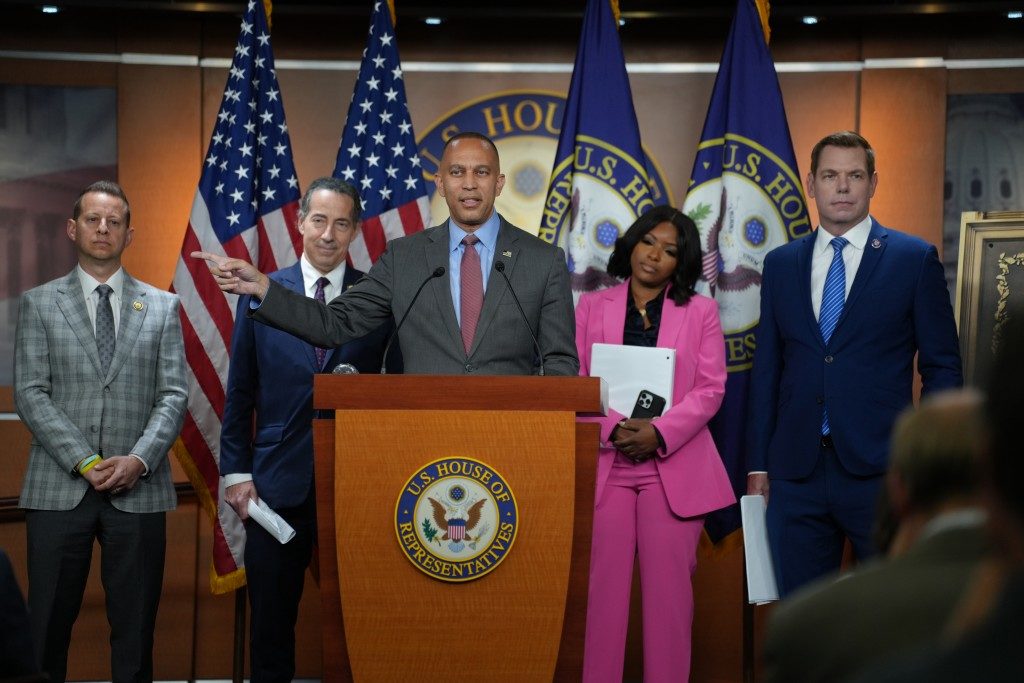
The Democrats’ historic midterm victory presents an opportunity to challenge Donald Trump’s administration and reshape the final two years of his presidency.
Implications of this could extend beyond Washington, influencing American investment, regional security and development assistance in regions like the Pacific.
With Democrats winning control of both the Senate and House of Representatives, the 2026 United States midterm results present an major political setback for President Trump.
For the first time in his second presidency, Mr Trump is set to face a Congress controlled by his political opponents and the shift is likely to constrain his ability to govern during the final two years of his term.
But the most consequential development may not be what Democrats can pass into law but what they can investigate, expose and challenge.
As outlined in an analysis by The Guardian, Democrats, among other matters, intend to scrutinise the Trump administration’s family business interests, the handling of the Jeffrey Epstein files and defence contracts involving companies connected to the President’s family.
A presidency facing greater scrutiny
The US Congress is a principal constitutional check on presidential power, responsible for passing legislation, approving government spending and overseeing the executive branch.
With control of the House, Democrats will command its committees, determine investigative priorities and use subpoena powers to compel witnesses to testify and produce documents.
Hakeem Jeffries is expected to lead the House majority, potentially becoming the first African-American Speaker, while the Democratic-controlled Senate can delay or reject presidential nominations, including Cabinet appointments, ambassadors and federal judges.
However, Mr Trump remains President and retains the authority to veto legislation.
Overriding a veto requires a two-thirds majority in both chambers.
The immediate consequence is likely to be a more confrontational political environment, with congressional investigations becoming central features of American politics.
The Epstein files and accountability
One of the most politically sensitive issues awaiting the new Congress is the continuing controversy surrounding files relating to convicted sex offender Jeffrey Epstein.
As reported by The Guardian, the Department of Justice was required to release millions of pages of Epstein-related records following bipartisan efforts involving Democratic congressman Ro Khanna and Republican congressman Thomas Massie.
However, the department missed its legally mandated deadline.
Of approximately six million pages in its possession, only about 3.5 million were released, with officials attributing the remainder to duplication. Concerns have also emerged over extensive redactions and the apparent accidental disclosure of victims’ identities.
Democrats can now demand further explanations, subpoena officials and investigate whether information has been withheld without sufficient justification.
The investigation should not become one of guilt by association. The appearance of someone’s name in Epstein-related records does not establish criminal involvement.
Rather, the central question is whether the public has received a complete and properly handled disclosure.
Continued scrutiny presents a considerable political challenge for Mr Trump.
The greater test for American democracy will be whether accountability applies equally, regardless of wealth or political influence.
The Trump family business and the Pentagon
Another potentially explosive area of scrutiny concerns allegations that businesses and investment ventures connected to members of the Trump family have benefited from federal contracts and defence spending.
The Guardian identifies Democratic congressman Jason Crow as intending to investigate reports of defence funding directed towards companies linked to the Trump family.
At the centre of the controversy is Donald Trump Jr’s involvement with 1789 Capital, a venture capital firm that has invested in companies seeking government business.
One notable case involves Vulcan Elements, a company backed by 1789 Capital, which received a reported $US620 million ($F1400.86m) loan from the Department of Defense.
Democratic lawmakers, including Senator Elizabeth Warren and Mr Crow, have questioned whether the company’s connections to the President’s family created a conflict of interest.
There is no established finding that the Trump brothers improperly influenced the awarding of these contracts or loans. Nevertheless, the potential for conflicts of interest warrants examination, particularly when public money is involved.
Democrats can demand procurement records, correspondence and explanations of how government contracts and loans were approved.
Such investigations could expose weaknesses in federal procurement practices and strengthen transparency requirements.
They also carry implications for America’s international credibility. Washington frequently advocates good governance and accountability in other countries. Its ability to maintain that authority depends partly on demonstrating those principles at home.
What does this mean for Fiji and the Pacific?
The political contest in Washington should not be viewed as exclusively an American domestic affair.
The United States remains one of the Pacific’s most influential economic, diplomatic and security partners. Its engagement affects regional development, maritime security, climate policy, trade and infrastructure investment.
The change in congressional control presents opportunities as well as uncertainties for Fiji and the region.
Fiji and the United States have advanced discussions on developing a Millennium Challenge Corporation (MCC) compact intended to support private sector-led growth and strengthen economic relations.
Fiji has also engaged Washington on American support for port development through the Quad, alongside discussions on defence cooperation and the Status of Forces Agreement.
A Democratic Congress could scrutinise foreign assistance and defence-related funding, placing greater emphasis on transparency and development outcomes.
This creates an opportunity to strengthen Fiji’s case for partnerships that deliver tangible economic benefits rather than being driven predominantly by geopolitical competition.
There is scope for cooperation in renewable energy, maritime infrastructure, education, healthcare, agriculture and climate resilience.
However, a Democratic-controlled Congress does not automatically guarantee increased American assistance.
Domestic political considerations, budgetary constraints and national security interests will continue to shape Washington’s priorities.
Fiji’s immediate opportunity is to engage both political parties and build bipartisan support for Pacific development.
The Pacific’s strategic position
Another important consideration is how the Democratic victory could influence Washington’s approach to China and the wider Indo-Pacific.
Democrats are unlikely to abandon America’s regional security interests, given bipartisan support for maintaining an American presence in the Pacific.
However, congressional control could introduce greater scrutiny of how that strategy is implemented.
Pacific Island countries do not want the region to become an arena where competing powers measure their influence through military agreements, diplomatic pressure and economic inducements.
Regional priorities remain sovereignty, development, climate security and the right of island countries to determine their own relationships.
Fiji’s foreign policy, which seeks constructive relationships with traditional partners while expanding engagement with emerging powers, requires a stable international environment.
A more active Congress could provide additional opportunities for Pacific governments to engage American lawmakers on climate financing, development assistance, maritime security and regional infrastructure.
Fiji should use this changing political environment to strengthen partnerships while ensuring its national interests remain central.
The following sources were consulted for this commentary: The Guardian, ‘What can Democrats actually do now they have won Congress?’, November 4, 2026; Joseph Gedeon, The Guardian, ‘Targeting Trump: How Democrats plan to investigate the president if they win Congress’, October 9, 2026; The Washington Post, reporting on congressional calls for an investigation into defence contracts involving Trump family-linked companies, August 2026; Fiji Government, ‘Fiji and US strengthen economic partnership through MCC compact development’, February 2026; Fiji Ministry of Foreign Affairs, ‘Fiji and US reaffirm relations’, 2026.