
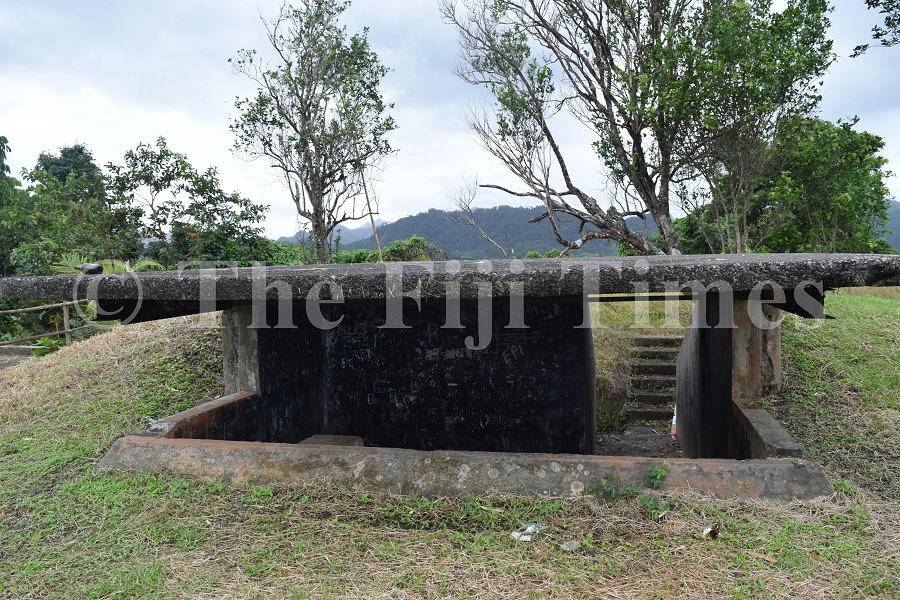
Ruins — whether they are wooden, stone or concrete, are expressive structures.
They may seem dilapidated, strange and forgotten but they have value and can be aesthetically appreciated.
What they symbolize and the era they represent make up historic and compelling stories that can stand the test of swiftly changing times.
A few Fiji ruins and derelict structures relate to the WWII and speak volumes of the impacts of war on life in the South Pacific.
Some of them have been neglected for years and are in desperate need of proper caring and protection.
If we do nothing to conserve these historical structures, we may lose important aspects of our historical and cultural heritage.
Some eight kilometres from the capital, along the Queen’s Road, a turn toward the coast at Bilo will take you on a winding gravelly ride past towering trees and meandering hills blessed with a unique abundance of nature.
Somewhere down this snaking road, where the picturesque view of the Suva Harbour becomes subtly divine and ethereal, sits the unkept Bilo Gun Battery.
Today, this place is largely desolate and ghostly.
But in the 1940s it teemed with activities and life, when brave foreign soldiers were stationed there, in anticipation of a possible Japanese invasion of the British Colony.
Fiji Museum literature contends that the Bilo Gun Battery was constructed in early 1941 as part of efforts to bolster the defence of Suva Harbour and its passage.
In the 1940s, the views from the battery site must have been spectacular on a clear sunny day.
However, now, the same seascape is hazy and glutted by high-rise buildings and the flotilla of ships in the harbour.
Like other Fiji battery sites, the one at Bilo, were made up of permanent structures used primarily as artillery forts from which to defend the country, its people and property.
It showed the great length Britain went to protect its territories.
Republic of Fiji Military Forces (RFMF) historical accounts note that “the first two 4.7-inch guns were brought into the country on board the HMS Leander”, a British warship that was commissioned in 1933 but later made part of the Royal New Zealand Navy’s fleet in 1941.
The barracks of the Bilo battery were completed in January of 1940 and the first test shot from the 4.7-inch guns was fired in March of 1940.
The feeling that you get at Bilo contrasts greatly with the popular Momi Bay Gun Battery in Nadi.
The latter is well maintained with manicured lawns largely because of its value as a tourist attraction and public landmark.
However, Bilo is mostly forgotten and somewhat scorned.
Nestled amid the peace and quiet of the forest, the site exudes an uneasy feeling that intensifies as you approach the dark and creepy stillness of underground bunkers and soapstone burrows.
Wet and cold mould-covered walls plus the subtle scent of unventilated spaces add to eeriness of place.
Outside, steel remains of two rusting gun mounts within concrete emplacements remind visitors of Bilo’s place in world war history and the military threat that once haunted Fiji during British colonial rule.
During WWII, as many as six gun batteries were set up around Suva, Nadi and Lautoka on Viti Levu.
It was felt by the powers that were, that the three districts were the most likely points for a coastal invasion from the Japanese.
While there are no guns at the Bilo site, what remains are the underground ammunition storage rooms, a command post and steel parts of the bulky artillery used in those days.
Different parts of the site are connected by underground trenches, tunnels and a network of walkways which can be tricky to access during or after a downpour.
Though no war was physically fought in Fiji, battery sites such as the one at Bilo stand as a reminder of Fiji’s role in military defence during the first half of the 20th century.
This was at a time when the country had no previous modern military tradition.
According to historical records, shortly after being built, the Bilo Battery withstood a devastating cyclone during February of 1941 which damaged most of the infrastructure in the Suva peninsula.
Reports say the tropical cyclone moved west-southwest over eastern Viti Levu and caused severe damage as it passed over Suva.
The system was subsequently classified as one of Fiji’s worst tropical cyclones on record.
Damages to the newly completed Bilo Battery were fixed, however, and military training and planning continued.
The Bilo battery was one of only four gun positions protecting Suva.
The others were located near the former Parliament House in Veiuto, at the Pacific Islands Forum Secretariat grounds (Nasonini) and at the Flagstaff Reservoir Hill.
Another two gun batteries were set up on the western side of Viti Levu, at Momi and Vuda.
During WWII the New Zealand Army replaced the Fiji Defense Force.
They were in turn replaced by the United States Army before the U.S. Army pulled out of Fiji in 1944, to head to the Solomon Islands and Papua New Guinea as the battle continued raged in the northern Pacific.
Today, though different from its former days, the Bilo Battery stands as a physical reminder of World War II in the Pacific and Fiji’s role in promoting world peace.
The historical site could be turned into a viable tourist attraction if finances allow it, political will exist and preservation and conservation ideals are followed.
Furthermore, there needs to be active participation from key stakeholders and resource owners.
While efforts during times of war resulted in Fiji’s gun batteries, perils to cultural and historical landmarks, such as negligence and oversight by authorities, will result in their deterioration and disappearance from the public conscience.
The Bilo site is looked after by the Fiji Museum in conjunction with landowners.
History being the subject it is, a group’s version of events may not be the same as that held by another group. When publishing one account, it is not our intention to cause division or to disrespect other oral traditions. Those with a different version can contact us so we can publish your account of history too — Editor.

