
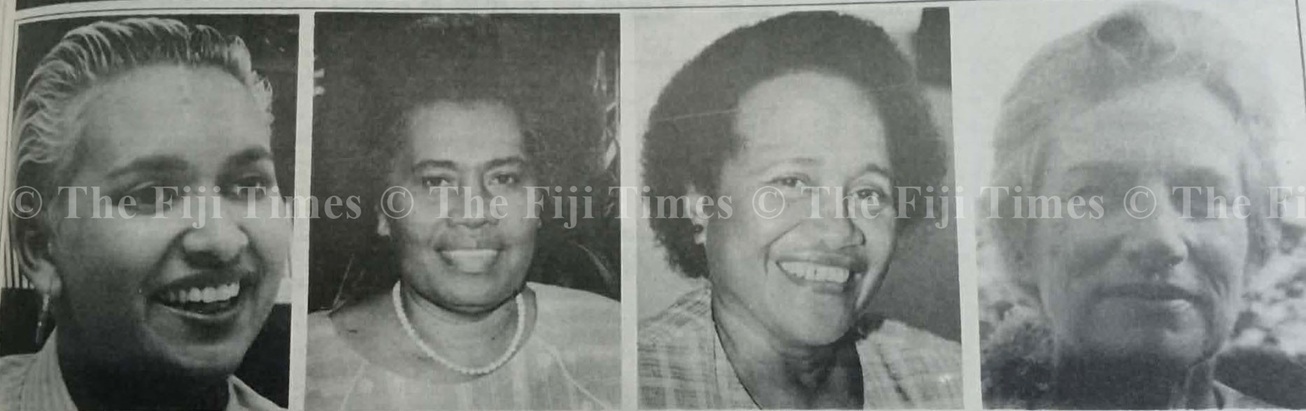
As the Young Women’s Christian Association (YWCA) approached its centenary, leaders gathered to honour past achievements, recall early struggles, and discuss how the organisation would serve Fijian women in the coming century.
According to a The Fiji Times article published on May 5, 1994, past and present leaders of the local ‘Y’ took time to reminisce the organisation’s beginnings and discussed how its role had changed as its headed towards a new century.
The article reported that the YWCA was one of the earliest women’s organisations established in Fiji to undertake community work. It was also among the first to highlight issues concerning women and children.
By then, the YWCA’s priorities had expanded to five major areas — health, energy and environment, peace education, refugees and migrants, and human rights. The organisation had also placed emphasis on developing leadership opportunities for women between the ages of 18 and 30.
The centenary of the YWCA was scheduled for October that year, to be celebrated under the theme ‘Forward with Vision’.
Esiteri Kamikamica, a founding member of the YWCA, recalled the early days when the Suva branch was the only YWCA in Fiji. She said the group included women who had belonged to other NGOs in the 1960s.
The creation of the organisation coincided with the arrival of two staff members, Ruth Letche and Anne Walker. The early leaders included Susan Parkinson, Lorini Tevi, and Marama Sovaki. Taufa Vakatale and Suliana Siwatibau later joined after completing studies overseas.
Ms Kamikamica told The Fiji Times that the annual meetings were interesting because women of all age groups and backgrounds attended.
“I found the public affairs group very stimulating, and it helped us make the community aware of what women could do to be part of total development,” she said.
She said the vision then was to create a forum of women from different professions and ethnic groups who could work together for the community.
Susan Parkinson, an executive member at the time, said the needs in the early days were different. The article noted that the YWCA initially focused on unemployed youths, teaching typing, sewing, artwork, and housework.
Later, it addressed women’s health, environment, gardening, and nutrition in rural areas. Ms Parkinson said the organisation spread beyond Suva to Lautoka, Bua, Levuka and Nadarivatu, and helped rural women with income-earning opportunities.
Acting Prime Minister and Education Minister Taufa Vakatale, a former national president and world vice-president of the YWCA, said the organisation pioneered women’s work, established hostels for working girls, and paved the way for other women’s groups.
“I found that as a YWCA member, I was able to take my role seriously and with confidence among my male colleagues,” she said.
Sharon Rolls, a member of the Young Women’s National Executive committee, said she joined in 1986 and was given leadership responsibility at a young age.
“You were not sidelined because of your age, everybody was given a chance,” she said.
Ecelini Weleilakeba, principal of Laucala Bay Secondary School and a former member, said the centennial theme challenged members to learn from past achievements and prepare for the next 100 years.
Cherie Whiteside, the association’s national president, said despite national upheavals, the organisation remained stable due to its strong Christian foundation.
She noted financial difficulties caused by the world recession but said staff and members had responded with renewed effort.
As the YWCA marked its centenary, leaders agreed the organisation needed to clarify its vision and focus on where it would best serve women in Fiji.

