
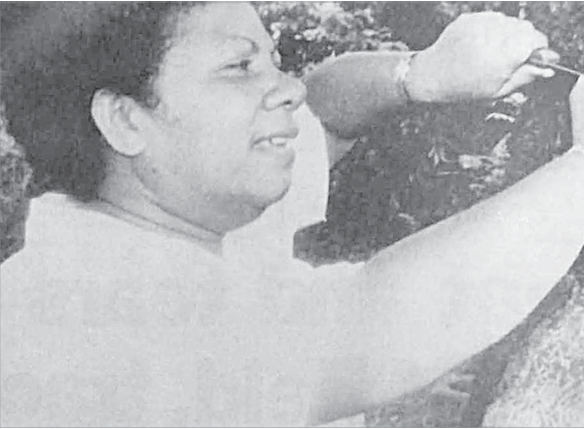
A report on how a 52-year-old village woman relied on ‘bush medicine’ to care for her family after the death of her husband was published in The Fiji Times on Saturday, May 1, 1999.
It stated that while many people were only beginning to hear about herbal medicines, Salote Koroi was already steadfast in her belief in the land, the environment and its natural resources.
Mrs Koroi looked to the environment as a source of life, food, water, shelter, clothing, and life-saving plants and herbs. From an early age, she had lived close to the land.
“It was from the days of my fathers and forefathers that I had love for my land, and the wonderful gifts it has to offer us,” she said.
“It was only a matter of going to the bushes and picking them from here and there, a pound, a squash, a bit of heat, and there you have it — a natural medicine as good, even better than the ones prescribed in the pharmacies.”
Mrs Koroi agreed with the South Pacific Action Committee for Human Ecology and Environment which said that women’s extensive knowledge was often overlooked by Western science.
“People are more concerned about what we do at home; they don’t really come into our homes and see what we are actually doing.”
“They only look at women washing dishes, women looking after children and women cleaning the house.”
She said women were the masters of the home because they carried out most of the work around the house.
“It is easy to get into a pair of jeans and shirt, go out and work in a factory or something.”
Her knowledge of traditional medicine helped her overcome many challenges after her husband died in 1980. Although she initially believed she would not be able to raise her children alone, she succeeded in sending her three sons to school.
“Life is not easy when you live in a village. Travelling to the hospital is rather hard during nights and in times of misfortune.”
“Natural medicines that can be made from guava leaves, wee barks and roots and other herbs are amazing because first they are free and secondly, they work,” Mrs Koroi said.
The article highlighted the use of guava leaves for stomach aches, constipation and bronchial infections, while scraped and pounded wee bark was used to treat flu, fever and chest pains. It concluded that Mrs Koroi’s experience demonstrated that traditional remedies continued to provide effective, free healthcare for village families.

