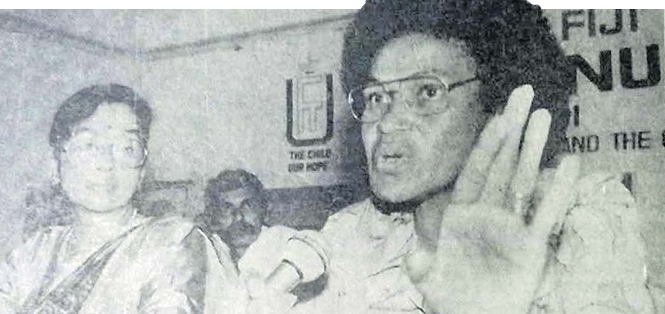
THE Fiji Teachers Union Women’s Wing was officially launched by more than 250 teachers at the 61st FTU conference in Rakiraki, The Fiji Times reported on May 3, 1991.
Tavua teacher Shanti Govardhan was elected the first chairperson of the FTU women’s management board while Lautoka’s Rukamma Lal was elected secretary.
Committee members included Vilomena Koroi of Nadroga, Janki Reddy and Usha Kahyap of Ba, and Noor Jalil of Nadi.
In one of the three resolutions passed at the inaugural meeting, the women’s wing called for more leadership roles for women in the FTU.
Mrs Koroi was the only committee member in the FTU executive team.
The women’s wing also called on the union to organise more seminars within its 14 branches to promote female participation in FTU. It also called for school committees to include women members, enabling women teachers to deal with the committees more effectively.
The six-member management board were expected to prepare a policy paper with the help of FTU secretary general, Pratap Chand.
It would work closely with Mr Chand to promote FTU activities for women and present an update on the women’s wing at next year’s conference.
In a paper presented during the Rakiraki conference, the FTU executive committee said women made up 50 per cent of union members, but this was not reflected in union activities and leadership.
“The FTU has taken special initiative to allocate funds for additional programs for women members,” the FTU executive committee said.
“There is some improvement in women’s participation in the union.
“Women, like men, join trade unions not only to improve their working conditions but also their living conditions, that is to protect and defend their interests as working women in the broadest sense.
“The aspirations and demands of women workers must be an integral part of the trade union policies and programs.”
The entire trade union movement, both men and women, must respond to their aspirations and fight to satisfy their demands.
To train women trade unionists and have them take up duties at all levels of the trade union organisation, they must have equal access to trade union training, the paper added. Trade union training, including training in economic and social policy, was to include the study of women workers’ questions and equal rights.