THE death of Jone Vakarisi has become a turning point for Fiji’s military, the Government and joint police-military operations, forcing clearer roles, better training and a stronger focus on soldiers following the law.
Minister for Defence and Veteran Affairs Pio Tikoduadua said the Republic of Fiji Military Forces was now better informed about its role in joint operations with the Fiji Police Force.
Speaking on The Fiji Times’ online portal The Lens@177 Mr Tikoduadua said he felt more secure about the operations now than when they first began.
“Because now RFMF is better trained, soldiers now are better informed about their role in this joint operation with the police,” he said.
“And the role is clear. The RFMF is in support. The police are in the front.”
Mr Tikoduadua said soldiers involved in joint operations were expected to take direction from police when called upon to assist.
“That’s becoming much more clear now and no one needs to die anywhere. Nobody needs to die.”
Mr Tikoduadua said the death of Mr Vakarisi was now the subject of an active police investigation, and he would not comment further on the case.
“Unfortunately, people do die. And in the case of Jone Vakarisi, that case is now before the police.
“What I’m glad to mention is that it has become a turning point and a learning curve for me, for RFMF and the Government in general going forward in how to make this whole operation work become better.”
Mr Tikoduadua said his responsibility as Defence Minister was to ensure the welfare of soldiers deployed on the front line, while also ensuring they carried out their duties within the law.
“That is what I’ve been tasked to do. Allow them to do their work, look after their welfare, and most importantly is that they should follow the law when they carry out their work.”
Use of force must follow rules – Pio
IT is becoming increasingly difficult for the police and military to control how force is used during joint operations, as criminals are becoming resistant and situations escalate.
Defence and Veteran Affairs Minister Pio Tikoduadua said police and military officers were guided by rules, professional standards and the law when force had to be used during operations.
“By the very nature of the police and the military, the police force, the military force, these are forces they need,” he said.
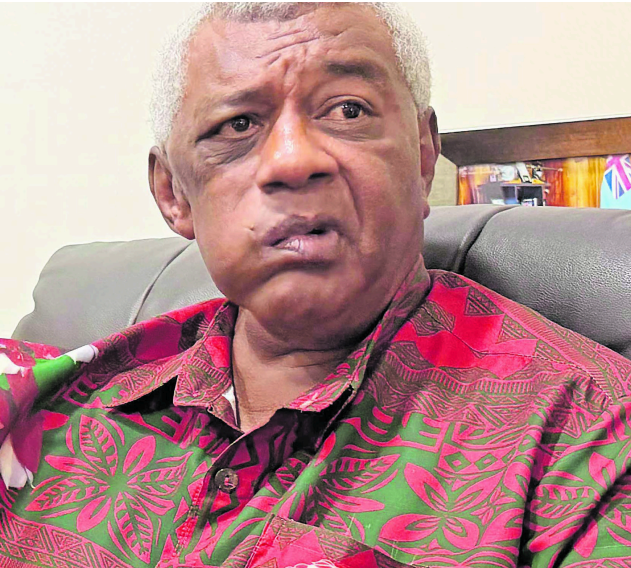
Minister for Defence and Veteran Affairs Pio Tikoduadua stresses a point during The Fiji Times’ online portal The Lens@177 interview in Suva on Wednesday.
“Part of their work is the employment of force to carry out, to protect the law as they see fit. There are rules that guide that.”
Mr Tikoduadua said it was unfortunate that a person had lost his life in a recent case, but said the matter had to be handled according to the law and established procedures.
He said when a person resisted officers, there were processes and standard operating procedures to guide how police and soldiers should respond.
“And if force has to be used, there is a degree of an escalation of force of what they can do, guided
by the law.
“But people react differently to that.”
Mr Tikoduadua said any future death during joint operations had to be avoided as much as possible.
“It’s a hypothetical situation. It has not happened.”
He said soldiers carried arms ready for use, while police officers also carried batons, but the use of those weapons had to be guided by law.
“Well, the soldiers are carrying arms ready for use. The police carry batons as well.
“What I’m saying is that we will all have to be guided by the law when we use them.”
Pocket cards guide soldiers
SOLDIERS deployed in public as part of the Joint Police-RFMF operations carry pocket cards outlining their rules of engagement (ROE), orders for opening fire and how to behave in particular situations.
Minister for Defence and Veteran Affairs Pio Tikoduadua said the cards were being used to guide soldiers deployed in support of police operations.
Mr Tikoduadua while on The Fiji Times’ online portal The Lens@177 said he had spoken to the RFMF Commander (Major General Ro Jone Kalouniwai) and was pleased the military had better worked out how it was operating with police.
“For the soldiers, they’ve got rules of engagement that are now, orders for opening fire, and how to behave in a particular situation, all put out in a card,” he said.
“It’s a pocket card now that soldiers have in their pocket.”
Mr Tikoduadua said soldiers deployed in support of police were now trained for that role and had the cards to guide them while carrying out their duties.
He said the use of pocket cards was not new to the military.
“I remember when I joined the military back in 1988, we had these cards also.
“Because those were active times, remember.
But we also do the same for all of our missions, peacekeeping missions.”
Mr Tikoduadua said the cards provided soldiers with clear instructions on how to respond in particular situations.
“They present to you your orders in a small card that has essentially two things we call ROE, rules of engagement, how to tackle a situation, and the orders for opening fire.”