
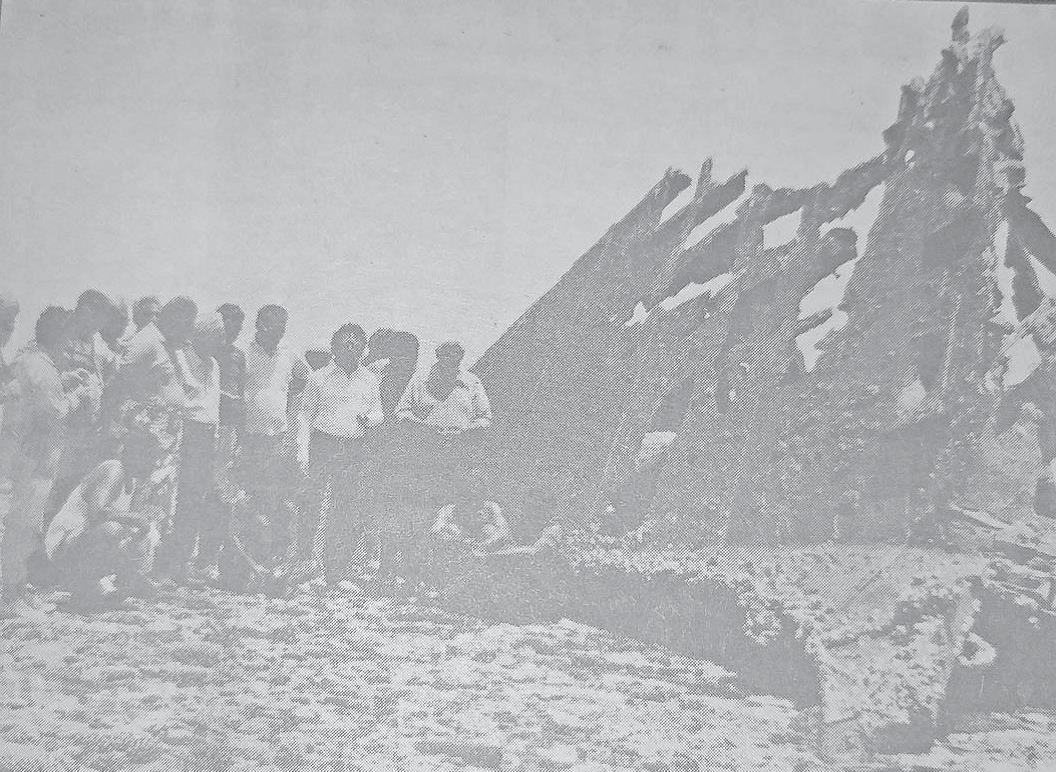
This week we continue our series on Fiji’s sea disasters by going back 135 years ago to the year 1884.
On March 13, the 1010-tonne ship Syria departed Calcutta, India, with 439 passengers and a crew of 47, destined for the British colony of Fiji.
Its passengers were recruited to work on established plantations scattered throughout the Fiji Islands following on Governor Sir Arthur Gordon’s recommendation that they were an economical alternative to Polynesian labourers.
Sir Arthur argued that in order to address an anticipated shortage of labour in 1878 and 1879, 400 or 500 Indian labourers should be introduced as a “precautionary measure”.
As a consequence, for 37 years between 1879 and 1916, some 60,537 Indian indentured labourers were brought to Fiji. Among them were the passengers of Syria.
Launched in 1868, the 16-year-old grey and white sailing ship, was the fifth in a fleet belonging to James Nourse, one of the shipping companies contracted alongside British Indian Steam Navigation Company by the Fiji government.
Like many Nourse ships, Syria was designed and fitted for labour traffic and had been sailing to Trinidad and Nevis (in the West Indies) for some years before her maiden voyage to Fiji.
She was built by William Pile of Sunderland, England, and supposedly named after the Syria River in Karnataka, south-western India.
Note that the route taken by Syria on her maiden voyage to Fiji was the same taken by other ships involved in transporting emigrants from the Indian subcontinent.
Filled to capacity with passengers and sometimes animals, they would depart Calcutta, sail down across the Indian Ocean to the South of Australia and then finally to Fiji.
Syria’s voyage was considerably pleasant except for persistent seasickness and the death of four infants, two of the boys, on board. A baby girl was born during the voyage.
After two months of traversing the world’s ocean, on Sunday, May 11, 1844, at about 9am the crew spotted the island of Kadavu.
Captain Charles Belson, took his bearings. By this time the wind had begun to gather momentum and the sea got rougher. He adjusted his course.
The ship was reportedly travelling at about seven or eight knots and around 2.30pm it was near Bulia Island on the eastern tip of Kadavu. By 5pm the Syria had cleared the Astrolabe reef and was on its way to Suva.
There was no lighthouse at the time to guide ships approaching the rough Nasilai Passage. This, plus a strong gust, pushed the Syria to the reef and struck it after 8pm.
According to personal accounts of Dr William MacGregor, then Chief Medical Officer of Fiji, the ship was handicapped by an inexperienced crew and the lack of navigational aids.
“… those officers responsible for navigation and sailing were novices in their jobs. Charles Belson, William Henry Hurford Henson and WaIter George Johnson were holding the positions of captain, first mate and second mate respectively for the first time,” Dr MacGregor noted.
“In addition, they were making their first trip to Fiji. Unfortunately, inexperience was not the only handicap as the ship was poorly equipped with navigational aids as well.”
Sailing directions for the Fiji waters were dangerously outdated as well.
Records from the Fiji Museum reveal that lascars were the first Indians to arrive in Fiji, at least 70 years before the arrival of the first group of indentured labourers. They even worked on the ships that brought Indians to Fiji, but none of them was on the Syria.
According to The Fiji Times records, Captain Belson and crew did the best they could to help passengers on that tragic evening, but help from the land would not arrive until much later. No one in Fiji knew that the Syria was in dire straits.
At about 11.30pm, three hours after the ship ran aground, the only available boat was lowered and in her, the mate, the engineer, the carpenter, another European and three lascars (Indian crewmen) sailed to Levuka to report the disaster and get help.
At the old capital, after the disaster was reported, the Penguin, owned by Union Steam Ship Company left to rescue the Syria, its passengers and crew.
The Penguin later found that the heavy sea had smashed all the Syria’s lifeboats and was sweeping the decks. The mainmast had gone overboard too, most likely through the rolling of the vessels.
Skipper Captain Cromarty then decided to go to Nukulau to see if he could tow a small steamer or boat to help stricken the Syria.
By then the SS Clyde, five Government vessels, two other boats and a Colonial Sugar Refinery steam launch had set off from Suva for Nasilai Reef.
By the time the rescuers arrived at Nasilai Reef around noon, the sea was tame and the tide had fallen considerably. Dr MacGregor was in charge of the rescue operation.
When the wreckage finally became visible to Fijian villages on the coast the word of the shipwreck spread like fire and soon canoes came with villagers, who helped the passengers to safety. The rescue efforts continued for two days.
Most of the helpers did not rest until all the indentured labourers were safely rescued.
“On May 14, 1884, the final count of immigrants was taken at Nukulau. After all the survivors had arrived they revealed that 57 people had lost their lives on Nasilai Reef,” The Fiji Times noted.
“Perhaps the most moving scene was that of 10 men who were left to their fate on a sandbank as the last boat already too full of people left the shipwreck in encroaching darkness.”
Later, attempts to find the men in the night failed. They were believed to have drowned.
Among those who perished were 32 men, 15 women, five girls, three boys and two babies.
Summarising his rescue experience, Dr MacGregor said the scene was simply indescribable.
“…pictures of it haunt me still like a horrid dream. People falling, fainting, drowning all around, the cries for instant help, uttered in an unknown tongue, but emphasised by looks of agony and the horror of impending death, depicted on dark faces rendered ashy grey by terror…,” he said.
“One of these lascar seamen I took out of the wreck paralysed with terror; afterwards by brute force, I threw him twice out of a boat to make room for drowning children … in spite of everything that could be done the loss of life was fearful. At 2pm I was almost faint with despair, and I did not then think that a hundred or so could be saved”.
The Syria’s deceased were buried near the village of Naivilaca, Nakelo in Tailevu. Villagers there continue to maintain the site today.
After the Syria shipwrecked, authorities discussed the possibility of erecting a lighthouse on Nasilai Reef. This became a reality in 1886.
The original lighthouse, described as being on piles, was located at the south-eastern extremity of the reef.
Fiji Museum records say in 1885, medals were presented by the British Government to thank the people of Kiuva, Vadrai, Muana-i-Ra, Nasilai and Naivuaga for their assistance during the sea tragedy.
A monument at Syria Park in Nausori was erected in 1983 and unveiled on May 11 by Ratu Sir George Cakobau in honour of those who died.
In 2017, the descendants of those Indian indentured labourers who survived the 1884 wreck were traditionally recognised as luvedra na Ratu or children of the chief by the people of Rewa.

