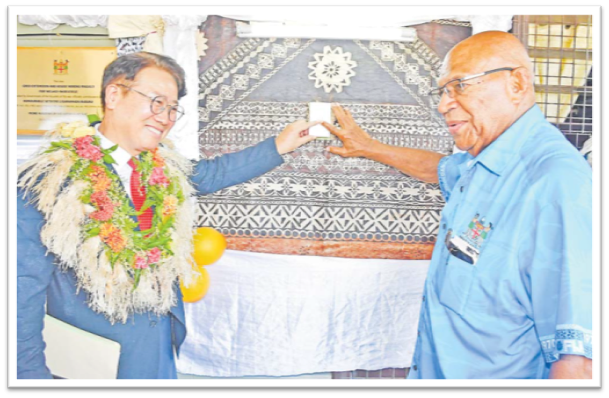
RESIDENTS of Northern Taveuni this week celebrated the commissioning of the Mua Solar Photovoltaic (PV) Power Station and Welagi-Naselesele Grid Extension and house-wiring projects.
The renewable energy infrastructure projects collectively cost $11.04 million, funded mainly by aid from Korea and Japan.
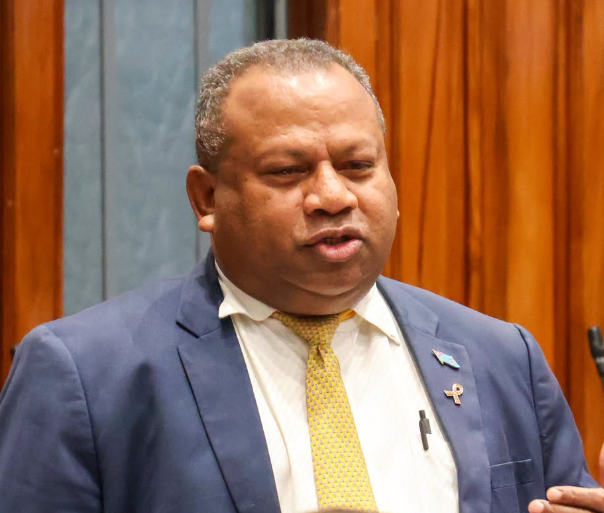
In his address at the commissioning, Prime Minister Sitiveni Rabuka said the projects are aligned to Fiji’s global commitments for a 30 percent reduction in carbondioxide emissions (CO2) by 2030 as outlined in our National Determined Contribution (NDC) 2017-2030.
“The Coalition Government is committed to ensuring equitable and sustainable development in Fiji and that is the very reason we are all here today in the Garden Island of Fiji, Taveuni,” Mr Rabuka said.
The Korean government, through the Korea International Cooperation Agency (KOICA), funded the Mua Solar PV Project, with additional technical support, as part of an ongoing partnership with Korea in different sectors of Fiji’s economy.
The project has a total installed capacity of 1.065Mega Watt (MW) of Solar PV panels with a 0.5MW/1MWhr battery energy storage system at a total project design and construction cost of $6.75m.
Of this, Mr Rabuka said a total of $5.8m was funded by KOICA for the construction of the plant, with the Coalition Government contributing an additional $0.95m towards the design and construction of the project.
“The Mua Solar PV Power Station Project will supplement the Somosomo Hydro Project and will elevate Taveuni to be the first island in Fiji that will have access to 100 percent renewable and clean energy supply.”
Further, the Weilagi-Naselesele Grid extension and house wiring project was another transformative project in Taveuni, with a total investment of $4.29m.
This extension project now connects 130 residential houses, a school and a number of small businesses, benefiting approximately 650 residents.
“The Coalition Government plans to extend the grid from Wairiki to Taveuni South, right up to Navakawau and to Lavena and Bouma,” Mr Rabuka said.
Also at the event, Korea’s Ambassador to Fiji Kim Jin Hyung expressed similar sentiments, saying the project will serve as a crucial turning point in further “brightening the relations between Korea and Fiji”.
Ambassador Kim also reaffirmed Korea’s commitment to supporting Fiji in its development plans.
Mr Rabuka also acknowledged the support from Global Green Growth Institute (GGGI) for conducting the feasibility study for the Mua Solar Photovoltaic (PV) Power Station.
NOTE: This article was first published in the print edition of the Fiji Times dated January 25, 2025.