
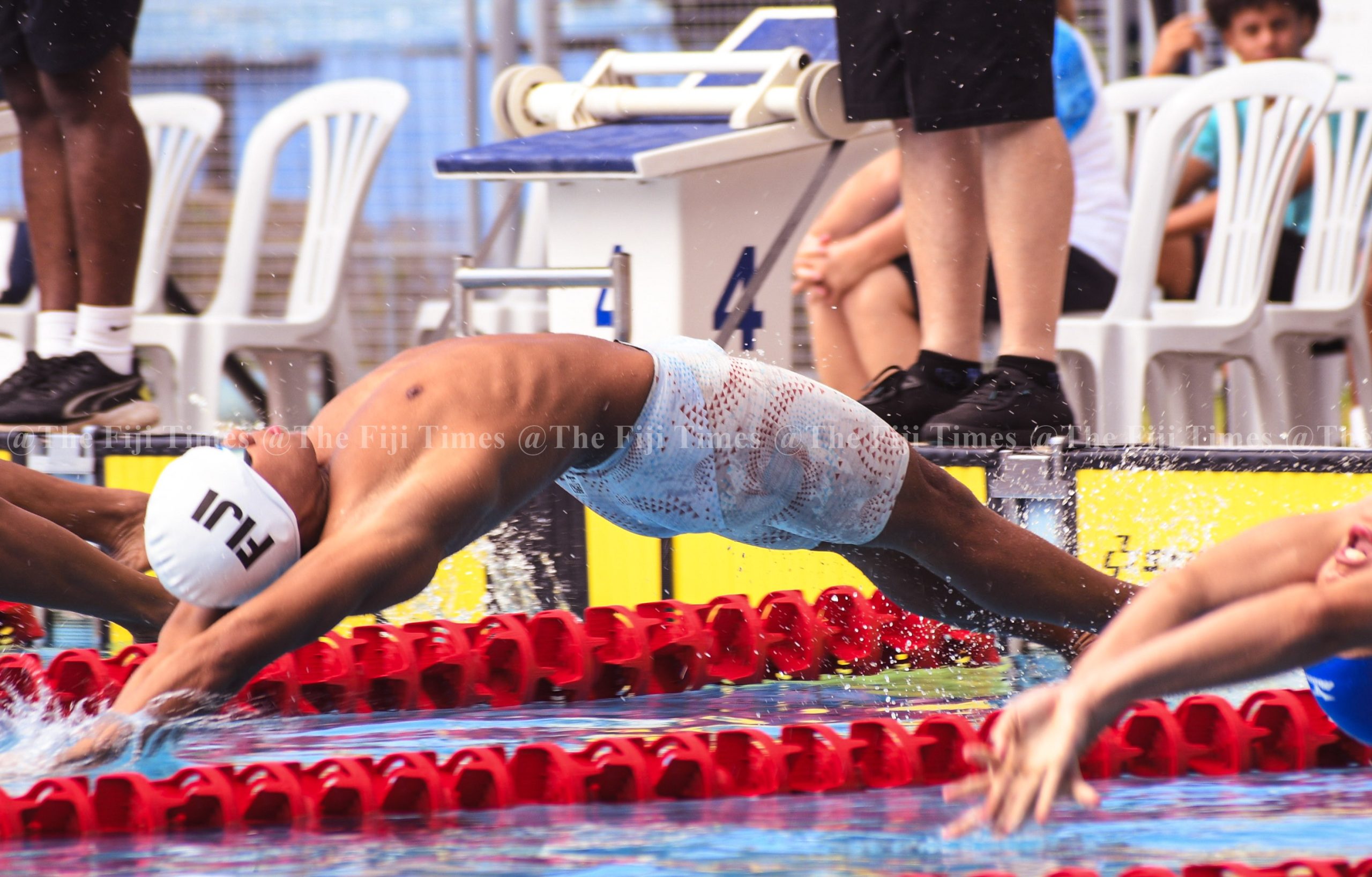
ELEVEN gold and six bronze medals were the spoils of hard-fought victory Fiji’s swimmers walked away with at the end of the 14th Oceania Swimming Championships 2026 in Suva recently.
And for Team Fiji’s manager at the meet, former national rep and Fiji Aquatics’ performance coach Sharon Smith, bagging all those medals led her and her fellow officials to end their campaign on a high note.
It was more than what was expected; Fiji aimed to win 10 gold medals, and the extra medal was the icing on the cake after weeks and months of preparation and competitions that led to that result.
Times Sport spoke to Smith following the championship on how Team Fiji fared as they set their sights on the next task – the 2026 Commonwealth Games in July in Glasgow, Scotland.
Times: The championship ended with Team Fiji taking 17 medals home. What are your thoughts on how they did?
Smith: I’m very proud of everybody; we finished overall behind Australia and they had finished with 14 gold. We had 11 gold, and if you had asked me a few years ago, I wouldn’t even think we would actually be in the top three. We’ve performed very well.
What wrapped us up and (what we were) very proud of is our open water (4 x 1.5km mixed relay), we finished that yesterday (Wednesday). We won a bronze medal and we’ve never won a medal ever in the Oceania Open Water event.
We finished with two Oceania records and the highlight of it was the fact that my prediction was 10 gold and we actually finished with 11.
But I think the whole 23 swimmers performed extremely well in everything they swam and we finished with so many personal best times and just very proud of the whole team as well as our five coaches from different clubs.
Times: We saw standout performers such as David ‘Tolu’ Young, Anahira McCutcheon, Samuel Yalimaiwai, Grace Khelan and other swimmers who performed really well. Is it testament to how much growth and development has been pumped in by coaches to enhance the sport further in Fiji?
Smith: Definitely. It didn’t happen overnight; the swimmers have been working extremely hard over the years. After COVID, we had a bit of a lapse, and we’ve definitely lifted up in the five years that we’re heading, going back to the drawing board, how do we do this, how do we do that. Tolu (David ‘Tolu’ Young) has had the opportunity of getting into the program in the States now on a scholarship fund; all he does is focus on his schoolwork and training.
Kelera (Mudunasoko) just moved to Australia so that takes a while to adjust but she’s definitely going to be another household name; she’s our breaststroker, she did really well last year in Palau.
And then we have Samuel (Yalimaiwai) still dominating the breaststroke event, especially in the 50m breaststroke – he broke a record as well.
And Grace Khelan just turned 14 so she’s definitely our up-and-coming youngster who we are hoping to keep on our pathway and aiming towards the next Olympics for her.
Our biggest challenge is trying to keep swimmers in the sport after the age of 20 and we have a group of swimmers who are over 21 including David ‘Tolu’ (Young) so just trying to keep them in the sport is important.
Times: What were some of the areas identified to work on as we look toward the Commonwealth Games?
Smith: Looking towards the Commonwealth Games, I think we are going to have a very strong team and the selection will happen this week. The qualifying criteria is simple enough for us to just name a few, but we have to wait for the selection.
Moving forward, we really locked in on our distance events from 200m to the 1500m freestyle so I think our main challenge would be definitely trying to fill those gaps to Tahiti for the next Commonwealth Games.
That is something we coaches will probably have to relook at on how to improve on those events and filling them up for Tahiti and hopefully reaching the Olympics.
Times: During the championship, some finals which Fiji competed in saw its swimmers placed on the outer lanes due to slow times recorded in the heats. Is this something being worked on?
Smith: Those are the events we may have to focus on a bit more and trying to get the swimmers and coaches to start specialising in these events. We had the 200m breaststroke; we have no one in that. We have the 1500m, we fell right behind. But if we can start focusing on specialising some of the swimmers then I think moving forward, we’ll definitely have better chance of reaching the podium on these events.
Times: We are now competing fiercely against nations such as Australia and New Zealand. Before, we would not have been as close to them, but the medal tally shows how closer we are getting. Is it (the championship) a vital platform to strengthen the stamina and endurance of Fiji’s swimmers?
Smith: We beat New Zealand which had brought over a 28-member squad, we were quite surprised with the number of swimmers that swam but that is their development as well and also something to think about.
We also have development with our Fiji team; we have a few that are elite, and then the majority who are development. This is our phase of trying to keep everybody, having a look at which event they should be swimming in and focusing on it.
Australia sent a small but very strong team. They are always going to be a challenge for us but the fact that we did really well with our Pacific countries: with Tahiti, New Caledonia and Samoa.
I think Fiji is, if anything, on the right track and hopefully we can stay on that track for the next few years.
Times: With this competition done, does it become easier or tougher to determine the final squad that will head to Glasgow in July?
Smith: This is the last competition; that is our window of selection. The selectors will get the results and then start selecting the eight swimmers. After we select, then the team will definitely regroup, look at events and start specialising on what they are going to actually swim.
The overseas swimmers will obviously have their program they will be doing. Basically, from now until July, when they select the team, it’s refining everything they have done and if anything, improve on what they need to.
Times: On a personal note, you opened the Triton Swimming Club in 1994, competed in three Olympic Games, two Commonwealth Games and lent a lifetime of service to coaching swimmers who have become household names. What has been the most rewarding aspect of this journey for you, in light of the championship being completed and Fiji winning more medals than expected?
Smith: I learned how to swim 50 years ago. I think the highlight would be, like you said, I swam competitively in three Olympics, but I continued with the sport. I ended up coaching, being a head coach, working on my qualification so (I’m) still very involved. I had a two-year break where I was living in Vanuatu and Samoa. I was still there helping their national swimming team.
I think the highlight was taking swimmers to the Olympics; we had Matelita Buadromo, Cheyenne (Rova) and Taichi (Vakasama) so getting them to that level. It was very rewarding.
Then the Pacific Games, the Mini Games in Palau. There’s all these competitions and when you take swimmers away and they achieve what their goals are, it’s very rewarding as a coach.
And for Oceania, we knew we would come in strong with Samuel, Hansel (McCaig) and Anahira (McCutcheon) and Grace Khelan came in all of a sudden to help with the mixed plays.
But the fact they did 11 (gold medals) is one of the best achievements I’ve witnessed as a coach.
Smith thanked the media for covering the event and helping boost the competition’s reach to wider audiences, as well the families, friends and supporters of Team Fiji for their unwavering support.
“I walk around the shops now and everyone is congratulating the team and it helps to promote the sport, which is a very minor sport,” Smith said.
“But I think after this, we get a bit more recognition of the hard work and all that we go through as coaches from the morning to the afternoon and the swimmers themselves; they have to manage work, study and training and like I said, it does not happen overnight, you plan it out.”

