
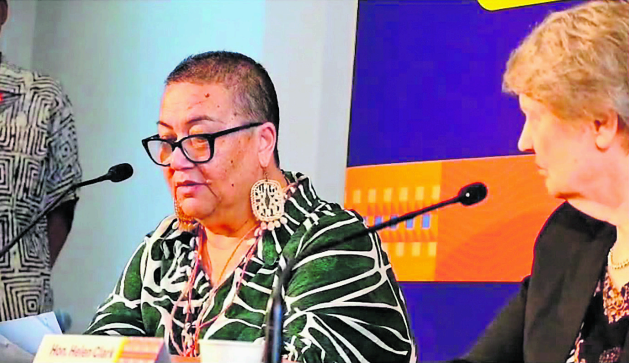
From the Melbourne Declaration to frontline activism, the DIVA for Equality leader is pushing governments to match commitments with action and to centre Pacific women in global gender justice.
In a packed conference hall at the Melbourne Convention and Exhibition Centre, where more than 6,000 delegates have gathered for the Women Deliver 2026 Conference, Noelene Nabulivou is clear about one thing.
Words are no longer enough.
As executive director of DIVA for Equality and Chair of the regional steering committee for the global gathering, she is using the moment to press for something more tangible – accountability.
At the centre of her message is the proposed Melbourne Declaration, a document emerging from the conference that she says governments, civil society and institutions alike must urgently endorse.
The Melbourne Declaration is intended to be more than just a statement of intent.
It is a collective commitment that captures the priorities of the conference – advancing gender justice, protecting human rights, and pushing for concrete action on the issues affecting women and girls globally. It builds on existing legal and human rights frameworks, but goes a step further by asking those who support it to demonstrate what they are actually doing in practice.
“This declaration is about saying – sign on,” she explains.
“Be part of this.
“There is nothing in it that contradicts our laws or our rights frameworks. What it does is ask: what are you actually doing to deliver gender justice and human rights?”
For Ms Nabulivou, the strength of the declaration will depend on how many are willing to stand behind it.
Organisers are deliberately seeking “as many sign-ons as possible”, not just from governments, but from civil society groups, technical institutions, development partners and others across sectors.
A global gathering, a Pacific push
The Women Deliver conference – one of the world’s largest forums on gender equality is being held for the first time in Australia.
According to official WD2026 information, it brings together governments, grassroots activists, multilateral agencies and youth leaders to accelerate progress on gender equality, with a strong emphasis on intersectionality and locally led solutions.
For Pacific advocates like Ms Nabulivou, that scale matters but only if it translates into outcomes.
“What we’re trying to do as a conference is get as many sign-ons as possible.
“Not just governments, but civil society, technical institutions – everyone.”
Governments bring the power to shape policy and law, civil society brings community voices and advocacy, while technical institutions contribute research and expertise. Together, their backing signals that the commitments outlined are not isolated ambitions, but widely recognised priorities.
The goal is to build a coalition that goes beyond rhetoric. The declaration, she argues, is designed to hold states accountable as duty-bearers under human rights frameworks — a principle often acknowledged, but rarely enforced.
“Our governments sign on to so many international norms and standards,” she says. “But we want to make sure that it really means something.”
In that sense, the push for sign-ons is about legitimacy and momentum. It is about ensuring the declaration reflects a collective voice and creates pressure for follow-through long after the conference ends.
The accountability gap
For the Pacific, that gap between commitment and implementation is particularly stark.
Ms Nabulivou points to the need for layered accountability – systems that operate from the local level right through to regional and global mechanisms.
“We have to make sure we’re doing it from the local, to the national, to the regional, and then to the global.
“Because there are so many differences between our states.”
She highlights the role of regional frameworks, including those coordinated by the Pacific Islands Forum Secretariat, as critical in aligning Pacific priorities.
But even with frameworks in place, she warns that without political will, progress stalls.
“It’s about asking governments – what are you actually doing?
“Not what you’ve signed, but what you’ve delivered.”
Why Pacific voices matter
For Ms Nabulivou, ensuring Pacific representation at global forums like Women Deliver is not just symbolic – it is essential.
“We fall off so many international engagements.
“Whether it’s New York, Geneva, or Bonn – we are far away, and sometimes that distance shows in how our issues are prioritised.”
While some Pacific governments work hard to stay engaged, she notes that others do not invest the same level of effort with real consequences for women.
Those consequences are most visible in areas like sexual and reproductive health and rights – an issue she insists must be central to any gender equality agenda.
“You can do work on climate change or economic justice.
“But if you don’t address sexual and reproductive health and rights, then women’s bodies are directly impacted.”
A crisis closer to home
Nowhere is that impact more urgent than in the Pacific’s escalating HIV crisis.
Ms Nabulivou points to data showing the region has one of the fastest-growing rates of HIV infections globally – a trend she says is deeply intertwined with gender inequality.
“We now have the highest rate of increase of HIV in the world.
“And that tells you something about vulnerability.”
That vulnerability, she explains, is not confined to traditionally marginalised groups.
“Women as a whole – half the population, are affected..
“Especially in contexts where gender-based violence is high.”
In many Pacific communities, she adds, women do not have full control over their sexual and reproductive lives, with coercion, violence and limited access to services compounding the risk.
“When you know that women aren’t automatically in charge of their sexual lives, then you have to make sure laws and policies are there to protect them,” she says.
When Systems Fall Short
Even where legal protections exist, Ms Nabulivou says implementation often fails women at the most critical moments.
That is where grassroots organisations step in.
Through DIVA for Equality’s “Just Fixes” programme, women are supported to navigate reporting processes – including accompaniment to police and other services.
“Even when women are brave enough to go to the police, sometimes they’re worried they won’t be treated properly,” she says.
The program works alongside organisations like the Fiji Women’s Crisis Centre to create what she describes as an “ecosystem” of support.
“It’s about making sure those links are real.
“Because the state will never be enough for women.”
That statement underscores a core principle of feminist movements in the Pacific – that collective action is not just complementary to government systems, but essential.
“We have to be with each other.
“And work out how we’re going to solve these issues of justice and human rights.”
Leadership Still Out of Reach
While the conference focuses heavily on global leadership including ongoing discussions about women in top roles at the United Nations, Ms Nabulivou is quick to bring the conversation back home.
In many Pacific countries, women remain underrepresented in political leadership.
“We are half the population. But we are nowhere near half of Parliament.”
For her, the case for women’s leadership is not just political – it is social and generational.
“If little girls cannot see leaders who look like them, it becomes harder for them to imagine themselves there,” she says.
But she adds that representation matters just as much for boys.
“Boys need to see women in leadership too,” she says. “It shapes how they understand power and equality.”
Beyond tokenism
Ms Nabulivou is unequivocal in rejecting incremental approaches to representation.
“We’re not looking for 10 or 20 per cent.
“We’re saying 50 per cent.”
That demand is grounded not only in equity, but in lived experience.
“Women know women’s issues.”
From healthcare to economic participation, she points out that women carry a disproportionate burden including unpaid labour.
Citing data from the International Labour Organisation, she notes that women perform the vast majority of unpaid care work.
“We do three to five times the load in the household.
“The ILO showed that we do about 80 per cent of unpaid care work.”
Despite this, women’s voices remain underrepresented in decision-making spaces – from parliaments to boardrooms, media and faith-based institutions.
“If a country says it is committed to gender equality, then it must show that women are in leadership – everywhere.”
From Melbourne to the World
As the Women Deliver conference continues, the focus is now on what happens next.
For Ms Nabulivou, success will not be measured by attendance numbers or speeches but by whether governments sign on to the Melbourne Declaration and, more importantly, act on it.
“This is an amazing set of work by 6,000 women from around the world,” she says.
“Including so many from the Pacific, in all their diversity.”
Her message to governments is simple.
“Support it. Sign on. And then do the work.”
A defining moment
The stakes, she argues, could not be higher.
From rising HIV rates to persistent gender-based violence, from gaps in healthcare to underrepresentation in leadership, the challenges facing Pacific women are complex and deeply interconnected.
But so too are the solutions.
They lie in stronger accountability systems, better resourced services, inclusive leadership, and sustained collaboration between governments and grassroots movements.
Above all, they require political will.
Standing in Melbourne, surrounded by thousands of advocates, Ms Nabulivou sees an opportunity – but also a test.
“This is about whether we are serious.”
Not just about commitments on paper, but about real change in people’s lives.
And for the Pacific, she makes it clear – that change must start now.

