
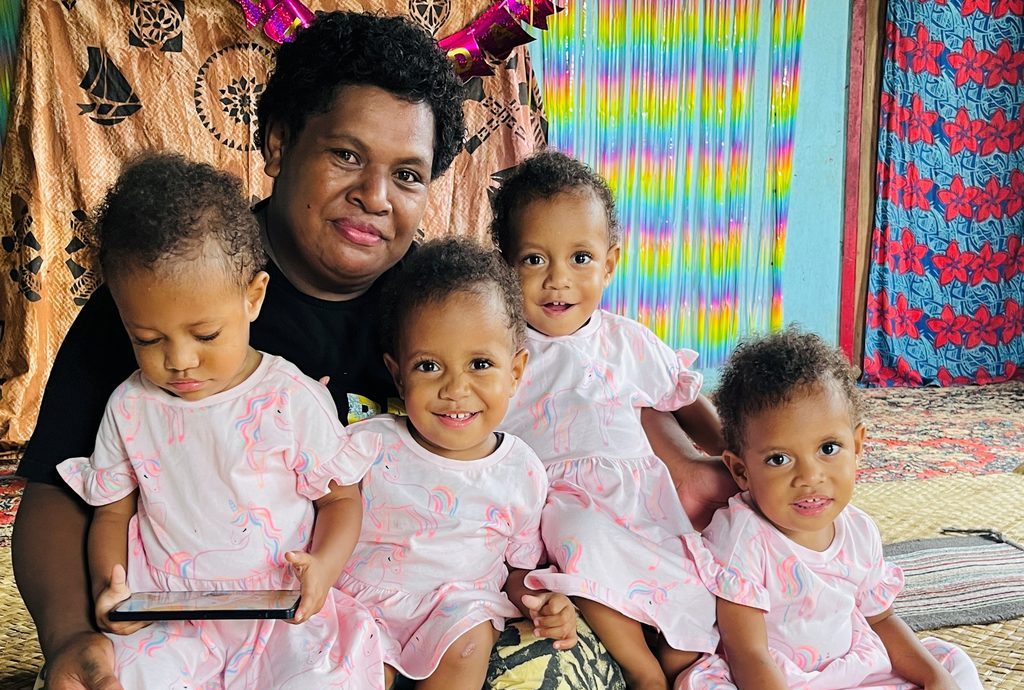
AT Vaturua Village in Nakelo, Tailevu a rare story unfolds of two-year-old quadruplets slowly discovering life together.
Titilia Delana Naisaramaki’s quadruplets, each with their own rhythm move through their days in a shared harmony that reflects both their individuality and the deep bond they share as identical sisters.
For Titilia her life has never been the same when she welcomed her daughters on April 22, 2024. It was a life changing moment for her and her family.
A diagnosis that changed everything
At five months pregnant, Titilia attended a routine clinic at the Nausori Health Centre, as it was a critical stage in the second trimester for pregnant women.
What was supposed to be just a standard check, revealed something unexpected.
“When I got scanned, the nurses realised I had four babies,” she said.
“They checked several times. When I asked them if there was a problem, they didn’t say anything, but I could tell something was up. When the doctor later saw her, she looked at Titilia oddly.
“She told me that I was carrying four babies…I was in disbelief.”
Breaking the news at home was the same.
“My husband was just as shocked as I was. He thought I was joking.”
“He looked at me for a long time trying to process the news.”
The rare discovery prompted an immediate transfer of Titilia’s care to CWM Hospital in Suva.
Her pregnancy quickly became high-risk. Around Easter in 2024, another clinic visit revealed complications.
“The medical team noticed that I had high blood pressure. The doctor told me I had to be admitted because of my condition.”
From that point, she was closely monitored and nurses were on high alert,” she said.
A carefully managed birth
A day before she reached eight months, the doctors decided she needed to undergo surgery.
In the early hours of April 22, she was wheeled in as the first patient of the day. A large medical team stood ready to assist with her delivery.
“I was told there would be many people present during the operation,” she said.
This was to ensure the safety of the mother and all four babies. When she woke, the news came all at once.
“They (the nurses) congratulated me and said I had four girls.”
That announcement ended months of uncertainty for Titilia and her family.
A fragile beginning
Titilia did not meet her daughters immediately after the delivery. Born prematurely, her babies were taken to the Neonatal Intensive Care Unit (NICU).
“After two to three days then I got the chance to meet them,” she said.
The girls’ father met them first while Titilia recovered from surgery and high blood pressure.
Each baby weighed between 2.1 kilograms and 1.6 kilograms (classified as very low birth weight). In the NICU, they were simply known as Q1, Q2, Q3, and Q4.
“We were told they were identical. None in our families have had twins. This was something very rare for both sides.”
Life inside the routine
In the hospital, Titilia got help in looking after the girls.
“The medical team allowed me to have someone assist me. I had relatives helping, someone during the day and another at night.”
Her days in hospital had been structured around the NICU.
“I went daily to provide breastmilk for the girls. “Three to four days after delivery, they were bottle-fed.
“When I was allowed to see them, I provided breastmilk. After a week at home, I continued bottle feeding. When they reached six months, lactogen became too expensive, so I introduced Rewa Powdered Milk.”
The cost of raising four infants at once required careful planning.
“We had a budget set aside for the girls. We would buy ten packets of powdered milk a week – two packs a day. For diapers, we bought two large packets to last until the next pay cycle.”
Support that made a difference
Help came from unexpected places.
“I met a lady, Jo Carter, when I was in hospital,” Titilia said.
“She was part of a women’s group that used to visit.”
That meeting became a turning point.
“I became close friends with her. Since delivering the girls, they have been helping us with expenses.”
Support extended beyond friendship.
“We also had sponsors who helped with bottled water, diapers, and food. Jo Carter, her family, and friends supported us tremendously. We’re so blessed we met her at the right time.”
Learning to tell them apart
In those early days, even a mother’s instinct needed help.
“Identifying them was hard in the beginning. The labels helped me differentiate between them. We bought colourful hair ties for their wrists.
“That’s how I identified them.”
Over time, their individuality began to show Sisi has a beauty spot on her nose. Sulu is taller than her sisters. Lite has a certain look, like a frown. And Vasemaca is the smallest – she was the one who weighed 1.6 kilograms.”
Their older brother, Emori 4, never has a problem with telling the girls apart.
“He knows them all just by seeing them,” she said.
Growing into toddlerhood
Two years on, the challenges have changed.
“In their first few months, the girls used to wake up at 4am,” Titilia said.
“Now they wake at 6am, so I get an extra hour of sleep.”
But rest comes with new demands.
“They are more active now. When they were babies, it was easier. Now I must pay close attention every minute of the day.”
Most days are spent indoors.
“The only time we leave home is for hospital checks or to step outside for fresh air, if not, we’re just inside.”
When she needs help, family steps in.
“I ask my sister-in-law for assistance when I need a hand,” she said.
A quiet reflection
Looking at her daughters, once fragile newborns identified only by labels, now lively toddlers moving with purpose, Titilia sees more than growth. She sees God’s love upon her family.
“For me, everything was a miracle. From delivering them safely into the world to getting support in caring for them, it’s all been God.”
Four toddlers. Four personalities. One journey that began with uncertainty and now settles into the steady rhythm of home.
The girls celebrated their birthday on April 22 (Wednesday).Quadruplets are exceptionally rare, with estimated odds of roughly 1 in 700,000 to 1 in a million, making them far less common than twins or triplets.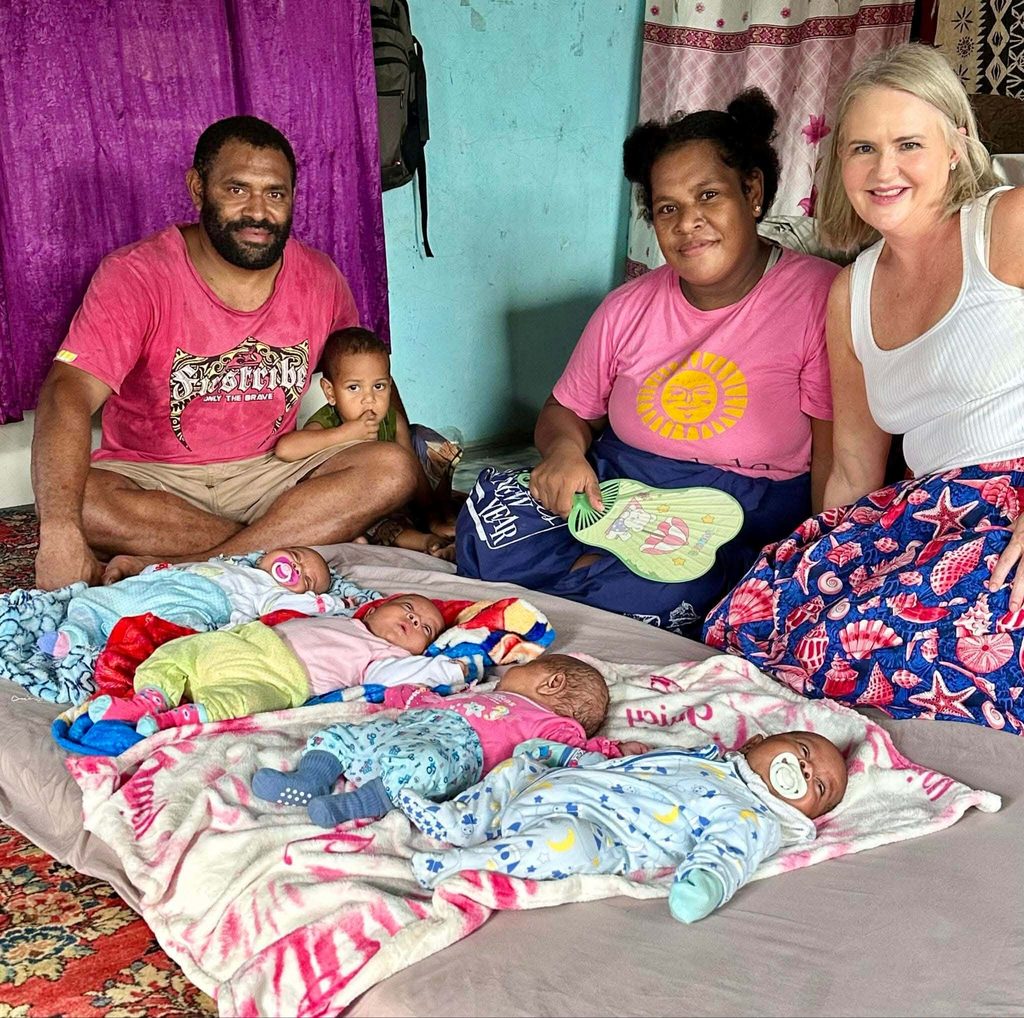
Titila, her husband, their friend, Jo Carter and the quadruplets. Picture: SUPPLIED
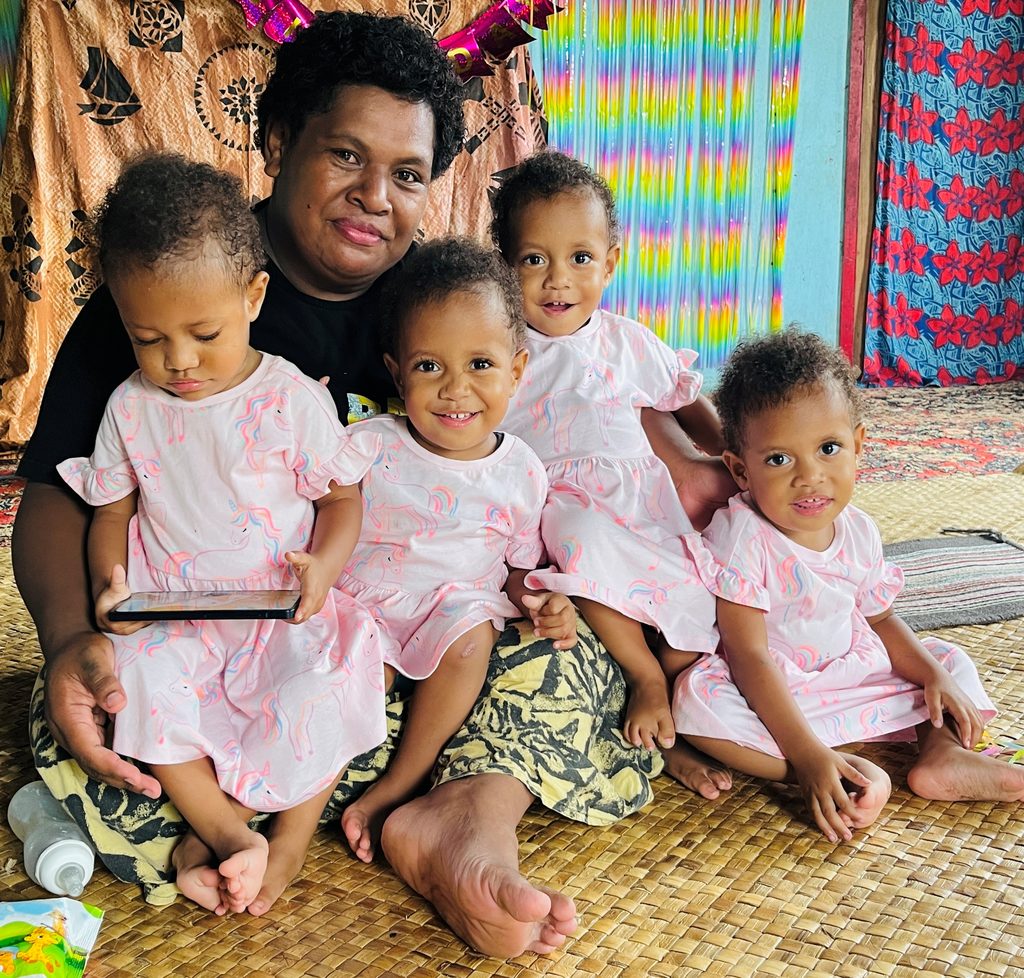
Titila with her girls a day after they turned two-years-old at their home in Vaturua VIllage in Nakelo. Picture: ANA MADIGIBULI
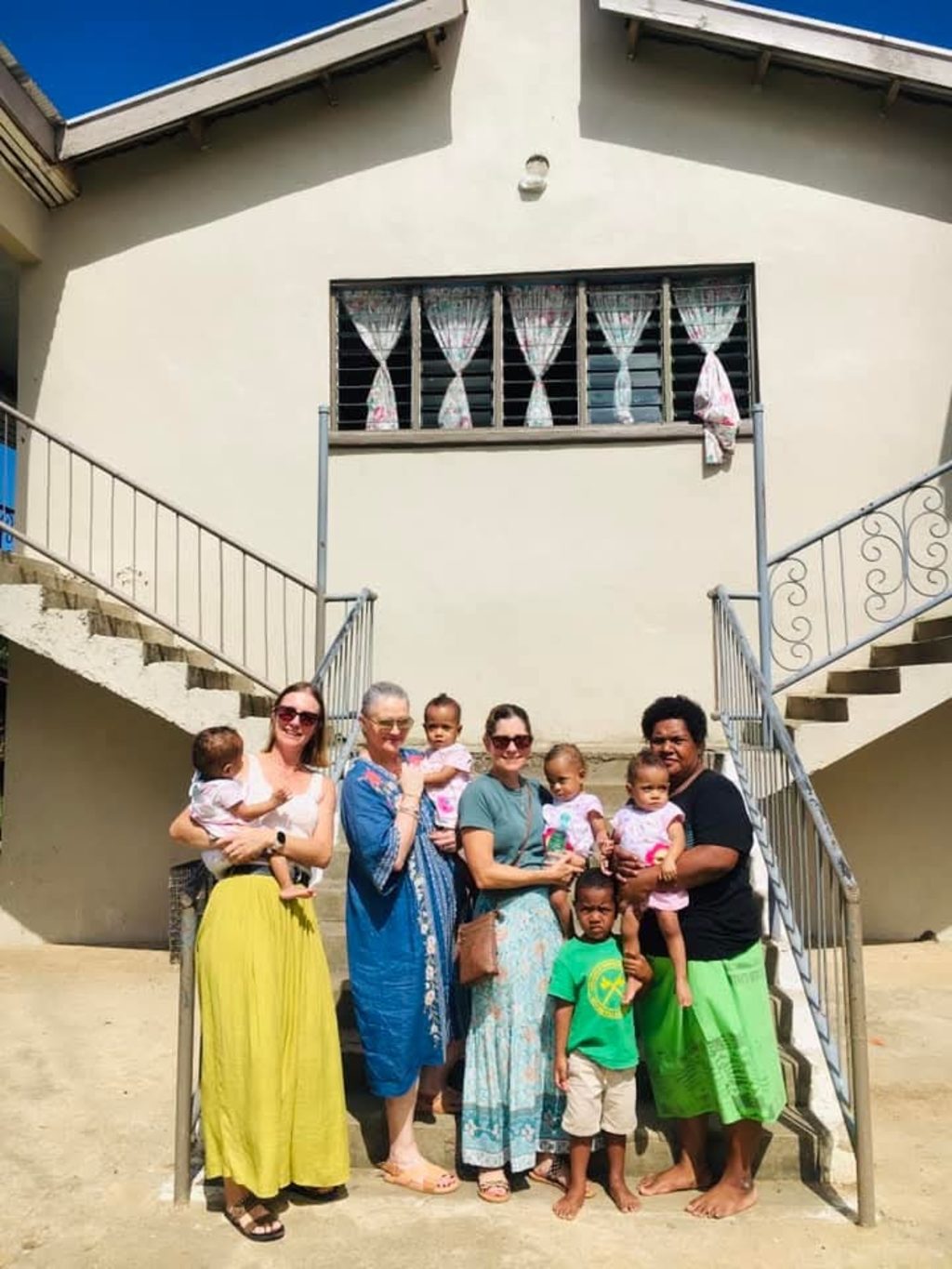
Titila with her children and friends that have been supporting her. Picture: SUPPLIED

