
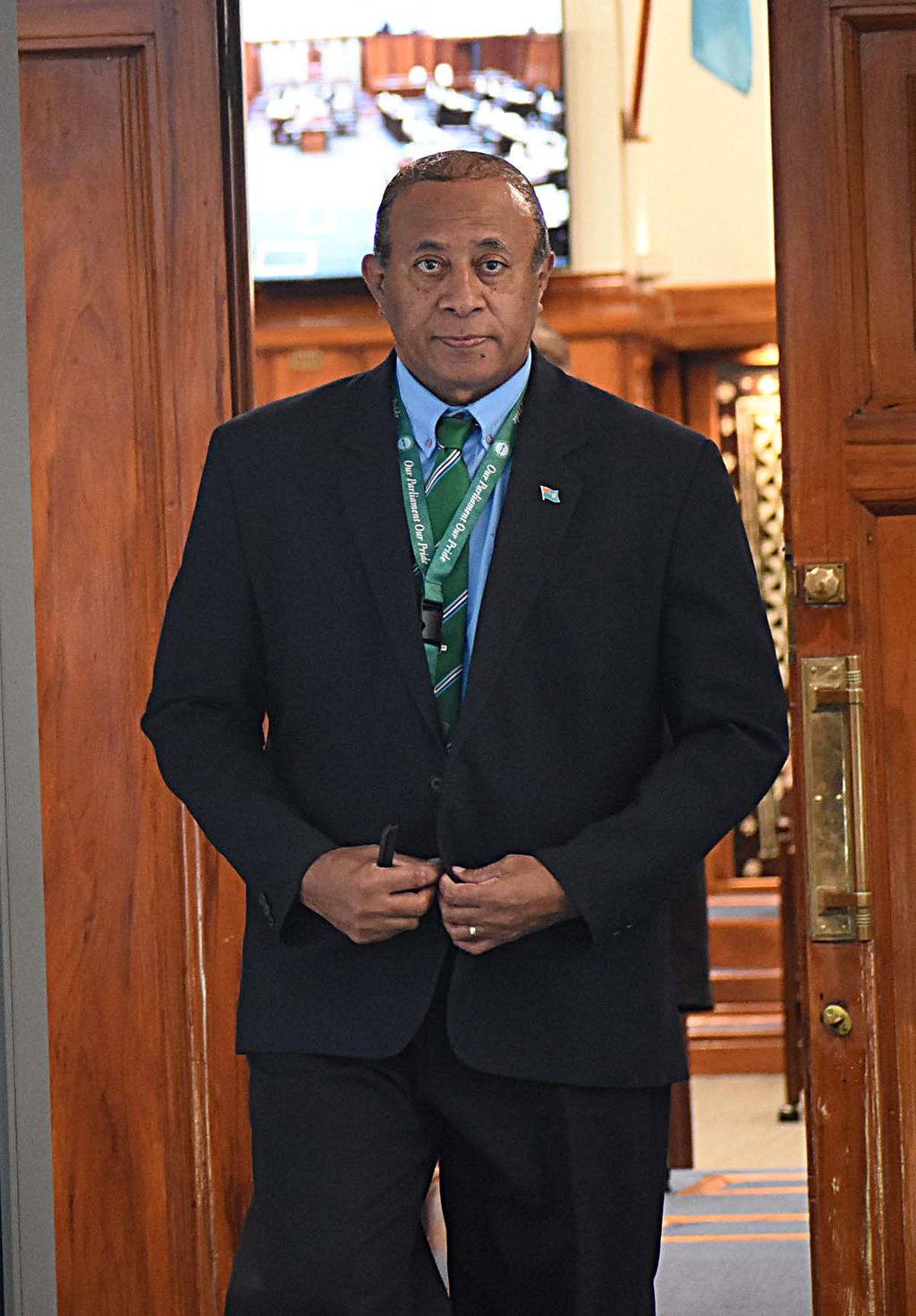
Fiji is accelerating one of the biggest energy transitions in its history as Government moves to reduce the country’s heavy dependence on imported petroleum and shield consumers from rising global fuel shocks.
This was the message delivered by Minister for Public Works, Meteorological Services and Transport Ro Filipe Tuisawau in Parliament while responding to a question from Opposition MP Rinesh Sharma on Government’s diversification strategy through the Department of Energy and Energy Fiji Ltd (EFL).
Ro Filipe said Fiji’s push towards renewable energy was not simply an environmental issue but one tied directly to economic survival, affordability and national security.
“This issue is not a simple energy matter,” he said.
“It is fundamentally about Fiji’s economic security, national resilience, cost of living stability, climate leadership, and protection of our people from external global shocks that are completely outside Fiji’s control.”
Breaking free from global oil shocks
Ro Filipe said Fiji continued to rely partly on imported diesel and heavy fuel oil for electricity generation, leaving the country exposed to international market volatility.
“Every sudden increase in international oil price eventually affects transport, food prices, business costs and electricity costs.
“These are not prices determined by Fiji. They are determined by international markets thousands of kilometres away.”
Government’s long-term strategy, he said, was therefore clear.
“We must progressively reduce our dependence on imported fossil fuels and transition towards our own renewable energy resources – our rivers, sunshine, biomass resources, and indigenous renewable potential.”
He said under EFL’s roadmap, Fiji had targeted to generate around 60 per cent renewable electricity by 2029 and close to 90 per cent by 2035, with a national goal of reaching 100 per cent renewable energy by 2036.
Massive solar and hydro investments
Central to this transition is a planned co-investment programme involving approximately 165 megawatts of solar energy generation backed by large-scale battery storage systems.
Ro Filipe said the projects are being developed with independent power producers and development partners including the Asian Development Bank and the World Bank.
“The battery storage systems are extremely important because they allow solar storage generated during the day to be stored and used during the evening peak demand period.”
He noted that solar and hydro power naturally complemented each other.
“Solar excels in dry season whereas hydro for wet season. In a way they naturally hedge and mitigate climate risk.”
He said major hydropower developments were also progressing, including the Qaliwana Hydro Project, expected to generate about 21 megawatts, and the Savatu Hydro Project, expected to provide another 28 megawatts.
He said feasibility studies for both projects were supported by the European Union and the European Investment Bank.
“These projects are not theoretical aspirations. They are practical infrastructure projects that will directly reduce Fiji’s fuel imports over time.”
Protecting Fiji’s economy
Ro Filipe said every additional megawatt of renewable energy meant less imported diesel, reduced foreign exchange pressure and improved national energy security.
He said reliable electricity was essential for tourism, manufacturing, ICT services, agriculture, health services and future investment growth.
“EFL therefore, has a dual responsibility – to maintain reliable electricity supply today, and second, to build a future renewable energy system that Fiji will depend on.”
However, he said the transition comes with major costs. Solar farms, hydro stations, battery systems, substations, transmission lines and cyclone-resilient grid upgrades required substantial long-term investment.
“The purpose of these investments is not simply expansion for its own sake. It is to protect Fiji and future generations.”
Ro Filipe said a financially sustainable electricity sector was essential for Fiji to continue attracting concessional financing and development partner support.
“Without that confidence, projects become delayed, financing costs rise, and ultimately the burden on consumers becomes even greater.”
Powering rural Fiji
Beyond urban centres, the Department of Energy is expanding renewable electrification projects in remote and maritime communities.
He said more than 20,000 solar home systems had already been installed across rural Fiji, powering lights and household appliances.
Ten solar mini-grids had also been completed in partnership with the United Nations Development Programme. Three additional mini-grids are now in procurement, while another 70 are planned over the coming years.
“These systems provide 24-hour power, enabling households to run lights, appliances and power tools, thereby reducing reliance on imported fuel.”
Ro Filipe said mini-hydro projects were also being expanded in areas with suitable water sources.
“The Kadavu and Muana hydro schemes have already been rehabilitated, while the Bua hydro scheme is being upgraded with support from the ADB.”
Electric vehicles the next frontier
Ro Filipe said Government was also targeting the transport sector through electric vehicle incentives and fuel conservation measures.
He said incentives included zero fiscal duty and VAT on electric vehicles, accelerated depreciation for businesses purchasing EVs, and a $10,000 rebate for businesses or individuals purchasing five or more EVs.
“Businesses investing in electric buses would also qualify for a 55 per cent tax reduction.
“The Government is actively exploring options for EVs to charge directly from renewable energy sources.”
He said they had also ensured “that as the grid becomes greener, transport is powered by clean, domestically generated electricity rather than imported fuel.”

