
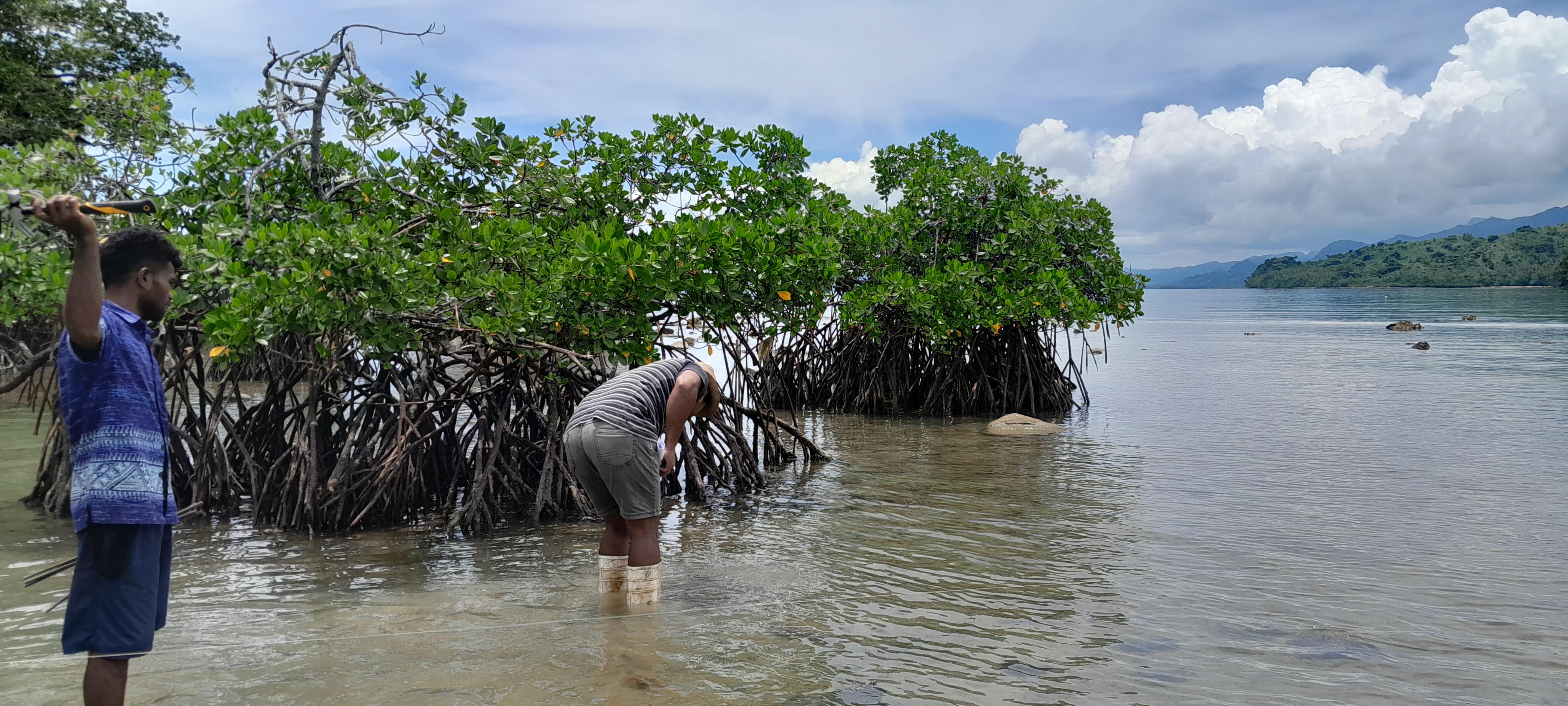
Nawi Island’s Mangrove Rehabilitation Program launched in November last year is aimed at helping to enrich qoliqoli areas and have rooted benefits within the communities and the environment.
The developers of Nawi Island had launched the program in conjunction with seven communities within the Wailevu district in Cakaudrove – a pledge to plant more than 25 hectares of mangroves.
“We recognise women play an effective part in mangrove development in Cakaudrove Province. Women at subsistence level fish and have intimate connections with mangrove biodiversity, and that is why our planting program directly focuses on women and youth training as mangrove monitors and custodians,” shared Ron Valenta, Nawi’s investors advisor.
A media release from Nawi Island said training would be provided over the duration of two years, with the aim that some of these communities declare mangrove reserve and managed areas.
“Nawi is adamant to educate our communities on how mangrove ecosystems go far beyond, and are the first line of defense against climate change. Our planting commitment will create a long-term carbon storage bank in the region, because we understand mangrove photosynthesis rates increase exponentially for the first 20 years of growth (doubling every year) and then level out.
“This means that approximately 15 years after planting, each six hectares of mangroves planted will photo synthesise and sequester at the same rate as the 1-hectare mature mangrove today, and in 20 years the area of new forest will photosynthesize and sequester almost six times as much carbon-dioxide,” said Mr Valenta.
He said with great support from the Tui Nasavusavu, Qolea Lovodua, the Turaga ni Mataqali Rokowaqa, Dominiko Wainui, Savusavu Town Council, and the local communities, Nawi Island was steadfast in aligning this important project with the region’s Millennium Sustainable Development Goals surrounding “Climate Action”.
“We invite other communities and private sector enterprises to join the cause.”
With the belief that mangroves are vital to coastal protection Nawi is dedicated in protecting this natural resource.
Nawi’s marine biologist, Sarah Makutu, proudly stated, “We will plant over 100,000+ mangrove seedlings within the Savusavu Bay area. It is our current focus to establish mangrove nurseries within each community and provide year-round seedlings, with a goal to achieve a 90 per cent survival rate at each mangrove rehabilitation planting site”.
Meanwhile seven partner communities of Nawi Island, under respective memorandums of understanding, facilitated by the Provisional Council of Cakaudrove, are Vatulele Village, Vuadomo Village, Dreketi Village, Wailevu Village, Nakasa Village, Natuvu Village, and Vunidamoli Village.
According to the media release two of these communities, Nakasa and Natuvu, previously planted mangroves in the past to protect the shoreline from the revenging currents that had taken sand and coconut trees from the shore, but now the shoreline had receded almost a meter and with the assistance from Nawi Island, were determined to put a proper planned mangrove rehabilitation project in place.
A villager from Natuvu Village also recalled seeing an old man planting mangroves once upon a time, “Such a wise man he was, knowing that planting mangroves would secure the future of our community. We need to get that mind-set back.”
The ecological importance of mangroves is one of the intrinsic and fundamental basis of Nawi Island’s belief that modern developers, like ourselves, can create positive and sustainable change in a developing country like Fiji, both for the environment and in people’s everyday lives.

