
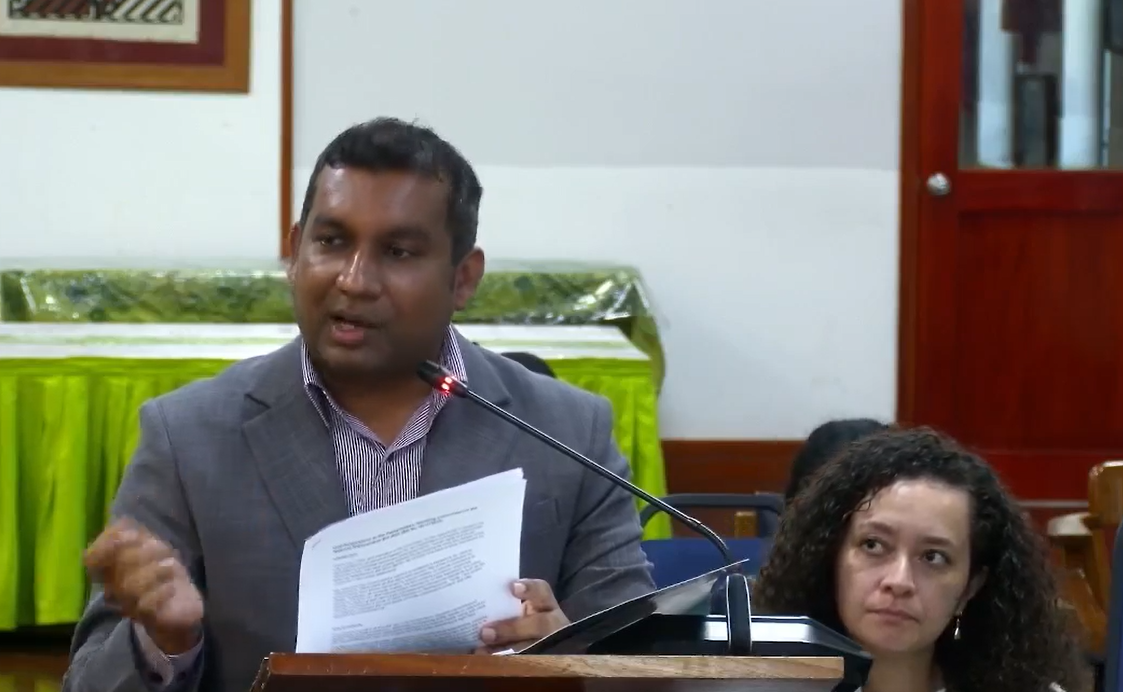
Dialogue Fiji Executive Director Nilesh Lal has told parliamentary proceedings that any referendum or constitutional amendment process must meet internationally recognised democratic standards, warning that failure to do so could undermine the legitimacy of future constitutional changes.
Making submissions on the Referendum Bill, Mr Lal said the Venice Commission’s Code of Practice is regarded globally as the “gold standard” for elections and referendums.
“The Venice Commission’s code of practice, whether it be for elections or referendums, is considered the gold standard and sets the benchmark for the rest of the world,” Mr Lal said.
He noted that while the code originates in Europe, it is also adhered to by other established liberal democracies and carries more than just persuasive influence internationally.
“It does not just have a persuasive effect, but it is also adhered to in other upstanding liberal democracies of the world,” he said.
Mr Lal said Fiji should aspire to these standards, particularly given long-standing criticism that the 2013 Constitution suffers from a democratic deficit, not because of its content, but due to how it was introduced.
“In a country where we have very lofty standards for what we constitute as democratic legitimacy, a lot of criticism has been directed at the 2013 Constitution because of its origins,” he said.
He explained that constitutional amendments, even when framed as changes, can effectively result in a new constitution altogether.
“If you’re going to be doing a new constitution or amending it, those amendments can lead to a totally new constitution,” Mr Lal said.
He cited Fiji’s own constitutional history, noting that the 1997 Constitution emerged from amendments to the 1990 Constitution.
“That’s exactly what happened in 1997 — it was essentially an amendment of the 1990 Constitution, and it led to a totally new constitution,” he said.
Mr Lal stressed that if the origins of the 2013 Constitution are being criticised, then any process to replace or amend it must be held to much higher democratic standards.
“If you’re saying the 2013 Constitution has a serious democratic deficit because of its origins, then you’ve got to make sure that the origins of any new constitution, or the process by which it is passed, meets far higher standards,” he said.
The submissions form part of ongoing consultations on the proposed Referendum Bill.

