Change has become a constant feature of the business environment.
Businesses are responding to workforce shortages, rising operating costs, new technologies, regulatory developments, climate-related risks and changing customer expectations. These pressures are occurring at the same time, requiring organisations to continually review how they operate.
This was a central message to emerge from TOPEX 2026. While the program covered a broad range of issues, productivity and the ability to adapt were closely connected throughout the discussions.
Fiji cannot improve productivity by continuing to operate in the same way while conditions around us change. Businesses, training institutions and government agencies must be prepared to review existing systems, introduce better ways of working and respond more quickly to emerging risks.
Productivity requires change
Fiji’s National Productivity Master Plan sets a target of 3.2 per cent average annual productivity growth. During TOPEX, Deputy Prime Minister and Minister for Industries, Commerce and Business Development Manoa Kamikamica stated that productivity growth remained at around 1.3 per cent.
Improving productivity does not mean simply requiring employees to work harder. It means examining whether existing systems continue to meet the needs of the organisation. Businesses must identify where time is being lost, why processes take longer than necessary and whether employees have the tools, skills and information required to perform effectively.
Change can be uncomfortable at first, but productivity cannot improve without it.
Productivity from an operational sense
The productivity discussion at TOPEX demonstrated that productivity problems are often found in ordinary business processes. Roshlin Lata, Head of Retail at Jack’s of Fiji, drew on the company’s experience operating 42 stores with approximately 620 employees.
“In retail, slow stock movement, incorrect pricing, unclear product placement and customers waiting to be served can all indicate a productivity problem. If several employees must correct one pricing error, or paperwork delays the movement of products from the warehouse to the store, the business uses more time and resources than necessary. Each issue may appear small, but repeated across an organisation, they affect costs, customer service and overall performance,” Ms Lata said.
The retail environment has also changed. Customers expect convenience, clear information and faster service. Businesses must understand how customer behaviour is changing and ensure that their people, processes and leadership respond accordingly. With approximately 70 per cent of Jack’s workforce from Generation Z, the company must also bring younger employees entering directly from school together with older and more experienced workers. This requires effective workplace training, appropriate supervision and a culture that enables different generations to perform well together.
How technology can solve a problem
The discussion on artificial intelligence provided a practical example of how businesses can approach change.
Rather than attempting to transform the entire organisation at once, delegates were encouraged to identify one costly or time-consuming workflow and measure how it currently operates. The next step is to determine whether technology can improve that process, introduce appropriate governance and provide role-specific training. The results should then be measured over 100 days.
The time recovered through improved processes should be redirected towards work that creates greater value, such as improving customer service, developing new business opportunities or strengthening quality.
Organisations participating in this initiative were invited to report their progress at TOPEX 2027. This creates an opportunity to move from discussing artificial intelligence to demonstrating how it has improved real business processes.
Skills must match workforce demand
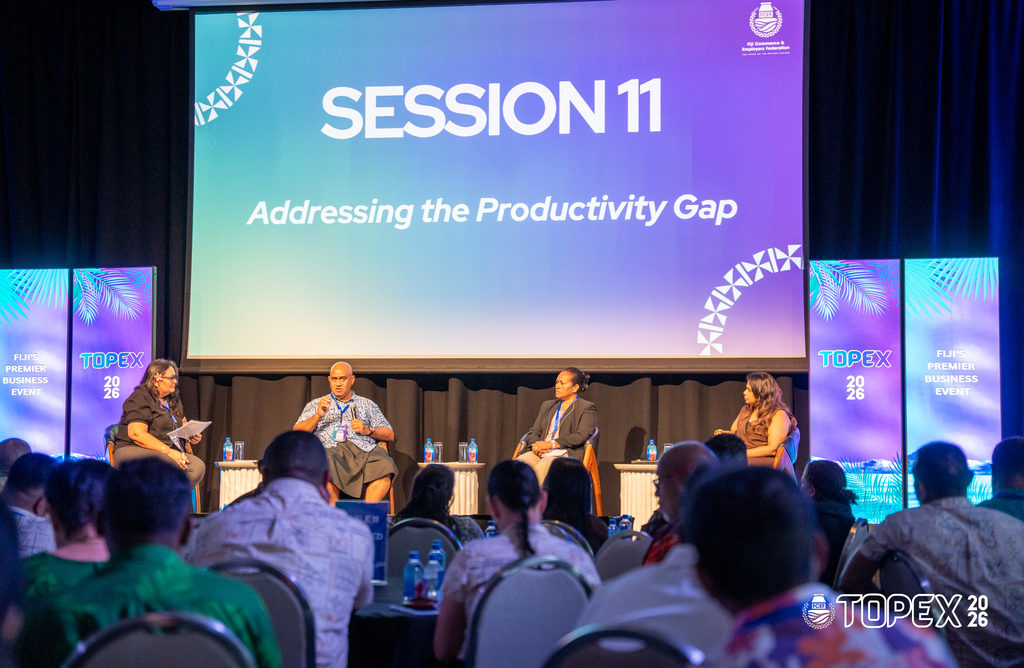
On the productivity panel – Rosalia Nabulivou, Human Resource officer at Zens Medical Centre, highlighted the mismatch between some new graduates entering the health sector and the needs of employers. Qualifications remain important, but employers also require appropriate workplace behaviour, a willingness to learn and the ability to perform within an organisation.
Human resource practitioners have an important role in developing systems that support performance, positive workplace behaviour and employee retention. Employers must also communicate their workforce requirements more clearly and provide training institutions with feedback about where graduates may not be meeting industry needs.
Fellow panellist Bob Mitchell, director of the National Training and Productivity Centre, acknowledged the need to review the scope and management of the employer training levy and improve how businesses, particularly MSMEs, access training and productivity services.
“A more accessible and coordinated service could help employers identify their training needs, obtain relevant support and connect workforce development more closely with business performance,” Mr Mitchell said.
Mr Mitchell’s central message was clear: productivity is everyone’s responsibility. Government, employers, employees and training institutions each influence whether Fiji can develop a more capable workforce and achieve stronger productivity growth.
The Fiji Business Excellence Framework also provides an opportunity for organisations to assess their performance, strengthen their systems and learn from enterprises that have successfully improved their business practices.
Adapting to emerging risks
The connection between change and productivity became particularly clear on the final day of TOPEX.
FCEF interrupted the planned program for the Water Authority of Fiji chief executive officer to brief delegates on the effects of El Niño and Fiji’s dangerously low water levels.
This situation demonstrates how quickly operating conditions can change.
Business owners were asked to identify water-dependent activities, repairing leaks, reducing non-essential use, maintaining appropriate storage and planning for possible supply interruptions.
Change is now a normal part of business. Improving productivity must become part of how we manage it.
Building the capacity to change
The productivity challenge requires businesses to build their capacity to review performance and respond when circumstances change. Employees must understand why changes are being introduced and how they can contribute. Managers must use evidence to identify problems and measure whether proposed solutions work.
Government agencies, regulators, training institutions and essential service providers also influence the conditions under which businesses operate. Improvements to approvals, infrastructure, workforce development and service delivery can release time and resources for more productive activity.
TOPEX 2026 reinforced that change, and productivity cannot be considered separately.
Change creates pressure, but it can also provide the reason to improve. The organisations that remain competitive will be those that recognise when existing systems are no longer sufficient and act before the cost of delay becomes greater.