THE conversations inside the vast halls of the Women Deliver 2026 conference in Melbourne are ambitious, global and, at times, hopeful.
But just beyond the buzzwords and policy frameworks, Pacific feminist leaders are issuing a quiet but urgent reminder: reality on the ground is far messier — and far more fragile — than what funding models often assume.
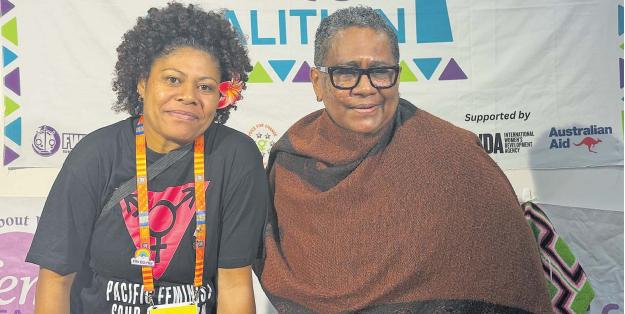
For Faye Volatabu, executive director of FemLink Pacific and a leading voice within the We Rise Coalition, that gap between policy and lived experience is where the real battle lies.
“We know that the resourcing is shrinking,” she says plainly. “But the problems are increasing.”
It’s a contradiction that sits at the heart of discussions this week — and one that Pacific organisations, often operating with limited resources across vast ocean distances, are forced to navigate every day.
A coalition built on many struggles
The We Rise Coalition is not your typical alliance.
It is a network of organisations across the Pacific, each tackling different but interconnected issues affecting women and marginalised communities.
From climate change and political empowerment to media transformation, gender rights and frontline crisis response, the coalition brings together groups such as FemLink Pacific, Fiji Women’s Rights Movement, Sista, Brown Girl Woke, Voice for Change in Papua New Guinea, and the International Women’s Development Agency (IWDA).
What sets the coalition apart, Volatabu explains, is its deliberately broad and layered focus.
“We’re quite unique because we are a collection of groups from around the Pacific that are mandated to talk on different thematic areas,” she says.
“Some coalitions focus on violence against women or climate change. Ours is about transformative change across all areas.”
That means looking at issues through multiple lenses at once — climate, media, policy, gender identity, economic empowerment — rather than isolating them.
It also means confronting what Volatabu describes as a “poly crisis.”
“There’s the fuel crisis, there is a drug crisis, there’s a climate crisis, and then there’s the geopolitical crisis,” she says. “We are dealing with many, many crises at the same time.”
When climate funding becomes a burden
One of the most striking concerns raised by Volatabu is how well-intentioned funding mechanisms can sometimes deepen hardship rather than ease it.
She points to climate financing schemes — including those in Fiji — that provide women with loans to build resilience or start income-generating activities.
On paper, these initiatives are empowering. In reality, they can leave women more vulnerable.
“How are women helped if they have a loan, and then they lose all their crops, they lose their livelihood?” she asks.
“They are left with the loan, as well as having lost their source of living.”
It’s a scenario that is becoming increasingly common across the Pacific as climate-related disasters intensify — floods, cyclones and unpredictable weather patterns wiping out months or years of work in a matter of hours.
Volatabu says the issue is not just about access to funding, but how that funding is structured.
“Is there a way in which women can not only be given support, but also be helped to mitigate the impacts of climate change,” she asks.
“What looks good on paper is not necessarily what women face on the ground.”
The missing link: before and after disaster
For organisations like FemLink Pacific and its partners, the challenge is not just responding to crises — it’s ensuring that funding frameworks recognise the full cycle of disaster.
“We need support not only before disasters, but also after,” Volatabu says.
She recalls how, during COVID-19, organisations had to negotiate with donors to redirect funding towards immediate relief efforts for women.
It’s a pattern that repeats itself with climate disasters — but without guaranteed flexibility.
“Sometimes the funding says you must complete training within a certain time,” she explains
“But then a cyclone comes, and the women you are supposed to train are trying to recover their lives.”
In such cases, rigid funding timelines can render entire programmes ineffective.
“That flexibility is something we would really appreciate,” she says.
The funding paradox
Even when funding is available, accessing and distributing it across the Pacific presents its own set of challenges.
For small island states, the barriers can be significant — from limited administrative capacity to strict financial regulations. Volatabu points to an often-overlooked issue: the difficulty of moving funds between countries within the region.
“Let’s say funding comes into Fiji,” she explains.
“We cannot easily share that with other countries like Vanuatu because of financial and regulatory constraints.”
This is where partnerships become critical.
The International Women’s Development Agency, based in Australia, plays a key role in housing and distributing funds on behalf of the coalition.
“It’s much easier for funds to be managed through a partner like IWDA,” Volatabu says. “They can hold the funds, and we can all access them.”
Without such arrangements, regional collaboration would be severely limited.
Strength in numbers — but not without challenges
Working as a coalition does offer advantages, particularly when it comes to attracting larger funding pools.
“When we work together, we are looking at a bigger pool of resources,” Volatabu says.
“For a small country like Tuvalu, it might be difficult to access funding on its own. But as a collective, the opportunity is greater.”
However, collaboration also brings complexity — balancing different priorities, navigating varying national policies, and ensuring that no voice is overshadowed.
Still, Volatabu believes the benefits far outweigh the challenges.
“One of the biggest joys of working as a coalition is that we have different voices from different islands,” she says.
“It’s not just one lens — it’s multiple lenses.”
Bringing Pacific voices to the global stage
For Volatabu, events like Women Deliver are more than just conferences — they are rare opportunities for Pacific voices to be heard directly by global decision-makers.
“Being here means that donors and funders can hear firsthand the experiences that we are facing,” she says.
“They are not hearing it second-hand.”
It’s a significant shift for a region that is often grouped under broader labels like “Asia-Pacific” — a categorisation that, she argues, can dilute Pacific priorities.
“Asia comes in first, and the Pacific is often left out,” she says.
“But here, the Pacific is being pushed to the forefront.”
Hosting the conference in Australia has also made it more accessible for Pacific participants — many of whom would otherwise struggle to attend global events due to cost and distance.
“Australia has the resources and the infrastructure,” Volatabu says. “For us as Pacific Islanders, this is a big plus.”
A region often underestimated
Despite their vulnerability to climate change and economic shocks, Pacific nations are often underestimated on the global stage.
Volatabu challenges that perception.
“We are often called small island states,” she says. “But we are big ocean states.”
It’s a reminder of the region’s vast cultural, environmental and geopolitical significance — and the need for its voices to be taken seriously.
“We often downgrade the importance of the challenges we face,” she adds.
“But they are real, and they are urgent.”
Listening to those on the ground
A recurring theme in Volatabu’s message is the need for funders and policymakers to listen more closely to community-based organisations.
“They need to consider the experts on the ground — the civil society organisations,” she says.
“These are the people who understand the lived realities.”
That means designing funding models that are adaptable, context-specific and responsive to changing circumstances.
It also means recognising that solutions cannot be one-size-fits-all.
“What works in one place may not work in another,” she says.
Looking ahead
As the Women Deliver conference continues, the We Rise Coalition is already planning its next steps — including meetings with donors and partners to rethink how funding can better support their work.
“One of the things we’ll be looking at is how we can better equip ourselves,” Volatabu says.
The goal is not just more funding, but smarter funding — funding that reflects the complexity of the challenges Pacific communities face.
A call that cannot be ignored
Back in the conference halls, the conversations continue — panels, speeches, networking sessions.
But for Volatabu and her colleagues, the message remains grounded in the realities of everyday life across the Pacific.
Resourcing is shrinking. Crises are multiplying. And the gap between policy and reality is widening.
Yet there is also resilience in the networks being built, the voices being amplified, and the insistence that Pacific experiences must shape global decisions. Because, as Volatabu makes clear, the stakes are too high to ignore.
“What looks good on paper,” she says, “is not what women face on the ground.”
Cheeriann Wilson is a communications consultant. She is attending the Women Deliver 2026 Conference in Melbourne as a scholarship awardee.