
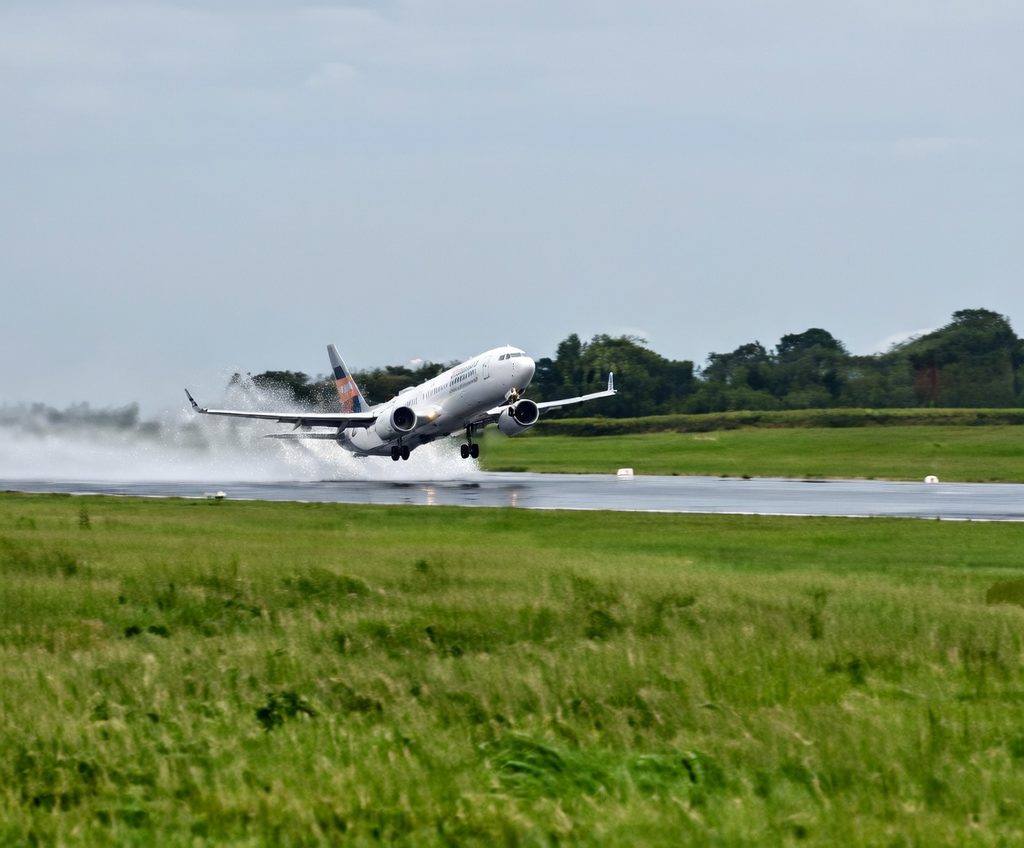
In the last week of February 2026, the world’s jet fuel price began its sharpest ascent in modern aviation history. The US-Israeli military campaign against Iran, launched on February 28, triggered the closure of the Strait of Hormuz, the choke point through which roughly 20 per cent of the world’s traded oil passes. By the week ending March 20, 2026, the International Air Transport Association’s Jet Fuel Price Monitor recorded a global average of $US197.83 per barrel. For the Asia and Oceania region, where Fiji Airways and every Pacific carrier draw its supply, the figure had climbed to $US217.34 per barrel for the week ending April 10, 2026. Against this inferno, a familiar chorus has returned: Sustainable Aviation Fuel will save us. SAF is the future. The green transition is underway. What those voices do not say, and what this article will, is that SAF today accounts for precisely 0.6 per cent of global jet fuel consumption. A rounding error is not a rescue plan.
The scale of the delusion
The International Air Transport Association (IATA) published its latest SAF production estimates in December 2025. The figures are unambiguous. In 2025, global SAF output reached 1.9 million tonnes, equivalent to 2.4 billion litres. The aviation industry burns approximately 300 billion litres of conventional jet fuel every year. SAF displaces 0.6 per cent. By 2026, on the most optimistic projections, that rises to 0.8 per cent. IATA’s 2025 estimate was itself a downward revision from earlier forecasts, driven by what the association described as a “lack of policy support.” The European Union’s ReFuelEU mandate required 2 per cent SAF blending at designated airports from 2025. The European Union Aviation Safety Agency’s first ReFuelEU Annual Technical Report, published in October 2025, found that the actual figure achieved across EU airports in 2024 was 0.6 per cent. There is a global mandate for a greener sky. There is not yet anywhere near enough green fuel to fill it.
Promises versus production
The gap between announcement and reality is where the SAF narrative collapses most completely. A peer-reviewed study published in Nature Communications in November 2025, produced by researchers at Hasselt University in Belgium and the Massachusetts Institute of Technology’s Laboratory for Aviation and the Environment, catalogued every SAF production project on earth and measured actual outcomes against announced capacity. The verdict was stark. By the end of 2024, only 24 per cent of the SAF production capacity announced for that year was operational. More than 40 per cent of planned capacity for 2030 is already at risk of delay or cancellation. Even modelling SAF development on the most rapid technology diffusion curve in modern energy history, patterned on the solar and wind build-out, global SAF capacity would still fall short of 2030 policy targets by 42 per cent. These are not the projections of pessimists. They are the measured findings of peer-reviewed science from two of the world’s leading aviation research institutions.
The price grotesque
Before the Hormuz shock arrived, conventional Jet A-1 fuel was priced at approximately USD 0.56 per litre. SAF, in the same period, was costing approximately USD 1.62 per litre according to UK Ministry of Defence modelling, a premium exceeding $US1.06 per litre that was projected to persist through 2040. In European mandated markets, the International Council on Clean Transportation calculated a cost premium of between 2.1 and 10.6 times the fossil jet fuel price, depending on production pathway.
IATA Director General Willie Walsh, in June 2025, publicly accused fuel suppliers of profiteering on the scarce SAF volumes available, citing European suppliers charging airlines up to five times the conventional jet fuel price. The SAF premium added $US2.9 billion to the global industry fuel bill in 2025 for less than one per cent of consumption. Now layer the Hormuz shock over that arithmetic. Conventional jet fuel has near doubled. SAF was already five times the old conventional price. In what economy does that calculation produce a workable airline?
Singapore’s pragmatic surrender
If a single data point exposes the SAF illusion in the current crisis, it is Singapore. The Civil Aviation Authority of Singapore had constructed what it described as a world-first SAF levy, a passenger-linked environmental surcharge scheduled to apply from April 1, 2026. Singapore was regarded internationally as Asia’s most credible and committed SAF adopter. On March 25, 2026, CAAS deferred the levy. The implementation was pushed to October 2026 for ticket sales, with first affected departures not until January 2027.
Director-General Han Kok Juan stated Singapore was taking a “pragmatic pause in view of the current situation.” Three days earlier, Singapore’s Foreign Minister Vivian Balakrishnan had told Reuters that the disruption around the Strait of Hormuz had become “an Asian crisis.” The country that designed the most advanced passenger-level SAF financing mechanism in the region could not hold the line for a single week against the economic reality of a war it did not start. If Singapore blinked, no one should pretend the problem is a failure of green ambition.
Fiji Airways bleeds at the pumps
For Fiji, this is not an abstraction. Fiji Airways chief executive Paul Scurrah confirmed to The Fiji Times, in an interview published in the week of April 12, 2026, that fuel accounts for 30 to 40 per cent of the airline’s total operating costs. The carrier has historically maintained hedging positions, but Scurrah was direct: those positions have not fully mitigated the impact of the Hormuz-driven surge. A fuel surcharge is under active consideration. For an island economy whose national carrier is the single critical artery connecting Fiji to its tourism markets in Australia, New Zealand, the United States and Japan, a protracted fuel price crisis carries consequences that extend far beyond any balance sheet. Hotel occupancies, ground transport, the entire value chain of inbound tourism, each is downstream of the jet fuel price. There is no SAF available to Fiji Airways. There is no Pacific SAF production facility. There is no blending pipeline, no regional refinery partnership, no supply corridor. What Fiji has is a carrier haemorrhaging on a price it did not cause.
The feedstock ceiling
The structural obstruction at the heart of the SAF story is not ambition or investment. It is feedstock. The SkyNRG and ICF Sustainable Aviation Fuel Market Outlook, published in June 2025, found that approximately 82 per cent of current global SAF capacity depends on a single production pathway: Hydro-processed Esters and Fatty Acids, universally known as HEFA. HEFA processes used cooking oil, animal fats and waste plant oils. The available volume of these feedstocks is finite.
It competes with food system supply chains. It cannot be rapidly scaled because a mandate demands it. The next generation of SAF technologies, electrolytic synthetic fuels called e-fuels, are priced by IATA at up to 12 times the cost of conventional jet fuel and cannot reach commercial scale before approximately 2030. The feedstock ceiling is not a political problem amenable to a better policy framework. It is a physical constraint. Chemistry does not respond to targets set in Brussels or Geneva.
The real medicine the industry needs
The honest prescription for aviation’s current emergency is neither romantic nor green. It is operational. Airlines need the Strait of Hormuz reopened to normal tanker traffic. They need damaged oil field and refinery infrastructure across the Gulf assessed and repaired.
They need strategic petroleum reserve releases from the United States, International Energy Agency member states, and the major importing economies of Asia to bridge the supply gap while markets stabilise. Rystad Energy estimated in April 2026 that oil and gas facilities across the Middle East conflict zone had suffered up to $US50 billion in damage.
Even if Hormuz passage normalised tomorrow, refineries require weeks to restart, and tankers require weeks to transit. ACI Europe, the airport operators’ council, warned the European Commission in April 2026 that a systemic jet fuel shortage across the EU could materialise by the end of this month if passage does not normalise. The medicine required is geopolitical, not biochemical. Diplomacy, resolution and supply chain restoration cannot be substituted with a blending mandate.
You cannot fly on good intentions
Sustainable Aviation Fuel is not a fraud. As a long-term decarbonisation instrument, properly funded and honestly scaled over decades, it deserves serious investment and serious policy support. But a long-term instrument applied to an acute emergency is not policy. It is performance. At 0.6 per cent of global jet fuel supply, costing up to five times the price of conventional fuel, with 40 per cent of its 2030 production targets already at risk, SAF is not standing between the aviation industry and the crisis unfolding today. The Strait of Hormuz is. The war is.
The damaged refineries are. Singapore had the political will and the institutional credibility to lead Asia on SAF adoption, and even Singapore stepped back on March 25, 2026. Fiji Airways has no SAF to purchase, no Pacific supply to call upon, and a tourism economy sitting in the full blast radius of a geopolitical shock it could not hedge against and cannot cure.
The world’s airlines are burning real kerosene in real aircraft serving real passengers. You cannot fly a Boeing 737 on good intentions.
DR SUSHIL K SHARMA BA MA MEng (RMIT) PhD (Melbourne) — World Meteorological Organisation (WMO) accredited Class 1 Professional Meteorologist with many years of aviation meteorology service with the Royal Saudi Air Force and British Aerospace under the Al Yamamah Program at the King Faisal Air Academy, Riyadh, and with the Bahrain Air Navigation Directorate. Dr Sharma held security clearance to operate on military installations alongside senior Kingdom of Saudi Arabia command staff. The views expressed are those of the author alone and do not represent the views of this newspaper.

