
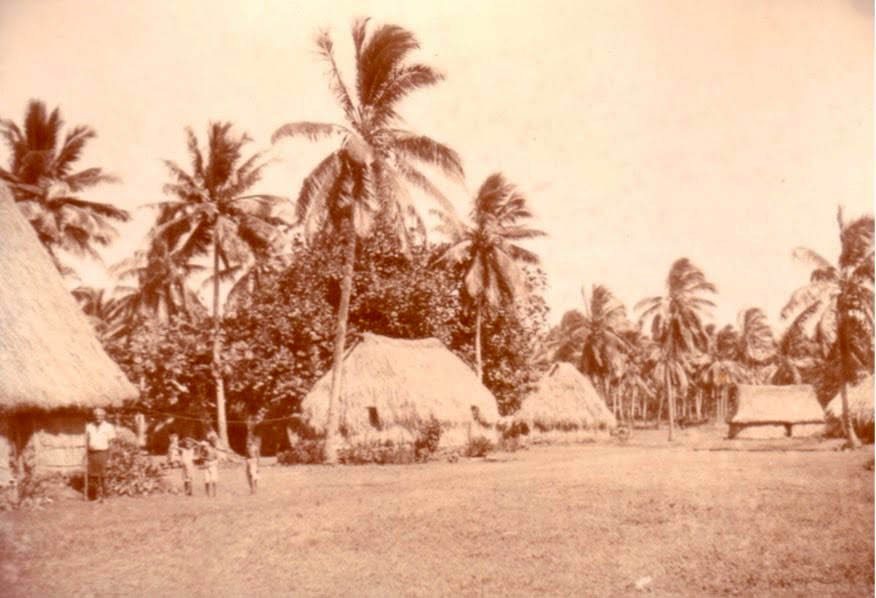
There are some places that continue to exist long after they have ceased to be what they once were.
The buildings disappear. Roads replace tracks. New families make homes where others once built lives. Yet memory has a way of preserving landscapes that no map can ever record.
For James Norman Stevenson, returning to Delanasau was never simply a journey back to a plantation. It was a return to childhood, to family, and to a chapter of Fiji’s history that had quietly slipped beyond living memory.
Time, however, had not stood still.
Stevenson writes that after the Anderson family’s departure, Delanasau passed through several hands. The plantation was first leased to Mah Yoh, who was ultimately forced to relinquish it because of ill health. Two farmers from the rice-growing district of Sarawaga later took over the property, but financial difficulties eventually brought their tenure to an end.
The estate was ultimately purchased by an Indian businessman who established his home on the banks of the main creek below the old milking sheds. Cattle, Stevenson notes, are once again bred and fattened there, ensuring the land continues to serve a productive purpose, albeit very differently from the Anderson years.
The world around Delanasau had changed as well.
The leisurely voyage aboard the Adi Rewa, once the lifeline between Suva and Lekutu, had long since disappeared. Stevenson recalls the vessel requiring three days to reach the Lekutu River before it was eventually decommissioned.
Today, travel follows a far more practical route through Nabouwalu aboard the inter-island vehicle ferry, known throughout Fiji simply as the “roll-on, roll-off”.
It is, Stevenson admits, considerably faster.
“But far, far less romantic.”
He remembers the old journey with remarkable affection.
The slow passage down the Rewa River. Villagers standing along the banks waving and calling out “bula”. Children swimming out to cling to the bow until Captain Edgar Williams attempted to chase them away with blasts of the ship’s whistle, much to the amusement of passengers and the complete indifference of the children themselves.
There were evenings anchored at the mouth of the Rewa River, mornings arriving in Levuka, afternoons wandering the streets of Fiji’s old capital before crossing the Koro Sea toward Nabouwalu and finally the Lekutu River.
“The modern age,” Stevenson reflects, “has indeed much to answer for.”
Nearly fifty years after leaving as a child, Stevenson returned.
In June 1995, he made the journey back to what he still simply called “home”.
Much had changed before he even reached Delanasau.
Nabouwalu, once little more than a modest staging point, had grown. Stevenson notes the addition of shops, a marketplace, an expanded police station and, where once there had been only a small medical dispensary, a hospital.
The contrast inevitably reminded him of Leslie Norman Anderson’s own illness decades earlier, when Hilda and her crew of fishermen had battled rough seas aboard the old cutter Jessie in a desperate effort to reach medical care.
From Labasa, Stevenson hired a vehicle and travelled toward Lekutu.
The narrow track remembered from childhood had become a proper road. When he remarked upon the clouds of dust thrown up by passing vehicles, a local replied with characteristic humour.
“That’s not dust,” he said.
“That’s Fiji mist.”
Lekutu itself had also evolved.
Stevenson writes that the village had grown into an important educational centre for Bua Province. There were more homes, more buildings and more people than he remembered, although he admits the settlement had lost some of the simple charm preserved in childhood memory.
As villagers gathered to greet him, they attempted English while Stevenson responded with his own Fijian, an exchange he says concluded in something of a draw. Two villagers offered to guide him around.
When he enquired about Sisa, the son of Lala, one of LNA’s trusted workers, Stevenson was pleased to learn his childhood friend remained well and was living nearby.
Crossing Vuni Gumu Creek once more, he followed the old track toward Delanasau.
It was here, Stevenson recalls, that the first real sadness arrived.
The creek where children once swam remained.
The memories remained.
Almost everything else had changed.
The old cow bails had disappeared. The copra sheds were gone. The familiar landmarks survived only as sites where buildings had once stood.
For the first time in half a century, an Anderson descendant stood once again upon Delanasau soil.
Around him, Stevenson writes, the bush had reclaimed almost everything.
Then something entirely unexpected happened.
As he stood quietly taking in the scene, two elderly Fijian men emerged from the forest carrying dalo suspended from shoulder poles.
Stevenson greeted them in Fijian before asking where the Anderson house had once stood.
One of the men gestured toward the bush before replying in his own language.
He remembered.
Not simply the house.
The family.
He spoke of “Missi Anderson,” “Missi Tooley,” “Missi Donno” and “Missi Pee Wee,” recalling names that had not belonged to Delanasau for nearly half a century.
Stevenson admits it remains one of the most difficult moments of his life to describe.
To hear those names spoken naturally, in the Fijian language, in the one place where they had once belonged.
“It was,” he writes, “still difficult to describe that fleeting moment.”
Yet alongside that recognition came another feeling.
Sadness. Not because the memories had vanished.
But because there was no one left beside him with whom to share them.
What remained of Delanasau itself was equally confronting.
The waterfall no longer thundered as it once had. More rock lay exposed.
The Lekutu River appeared narrower.
The suspension bridge, the wharf and the old holding shed had all disappeared into history.
The creek where village women had once gathered to wash clothes and exchange stories had fallen silent after water was piped directly into the village.
The Anderson home, together with its store and post office, had been dismantled over the years, its timber reused elsewhere or burned for firewood.
Lengths of forgotten wire disappearing beneath weeds.
The carefully tended gardens had surrendered to the advancing bush.
Stevenson observes that places remembered through the eyes of childhood often appear smaller when revisited as adults.
At Delanasau, that realisation carried with it a profound melancholy.
Even the coconut trees had changed. Once towering and productive, many now stood barren, their fruit left to rot beneath vines that slowly strangled the trunks.
From Vuni Gumu Creek to the government road, from the old pineapple fields to the waterfall, from the race to the flats beside the Lekutu River, Stevenson found only silence.
“A great aching silence.”
And perhaps that silence says something beyond the fate of a single plantation.
The physical reminders of Delanasau may continue to disappear, just as roads replace tracks and generations pass into history. But the foundations laid by people like Leslie Norman Anderson and Hilda Anderson endure in less obvious ways.
They belonged to a generation that accepted uncertainty, helped establish industries in remote parts of the country, built relationships across cultures and contributed, often quietly and without recognition, to the development of communities that would become part of modern Fiji.
History rarely remembers every planter, trader, teacher or farmer who shaped the country through ordinary acts of perseverance.
Yet Fiji was built not only by governments and governors, but also by families who endured hardship far from the centres of power, whose daily work left lasting marks on the communities around them.
As this series closes where much of the Anderson story began, perhaps that is the legacy worth remembering.
Not simply the plantation. Not simply the family. But the quiet lives that helped build a nation, and the memories that remind us why they should never be forgotten.

