
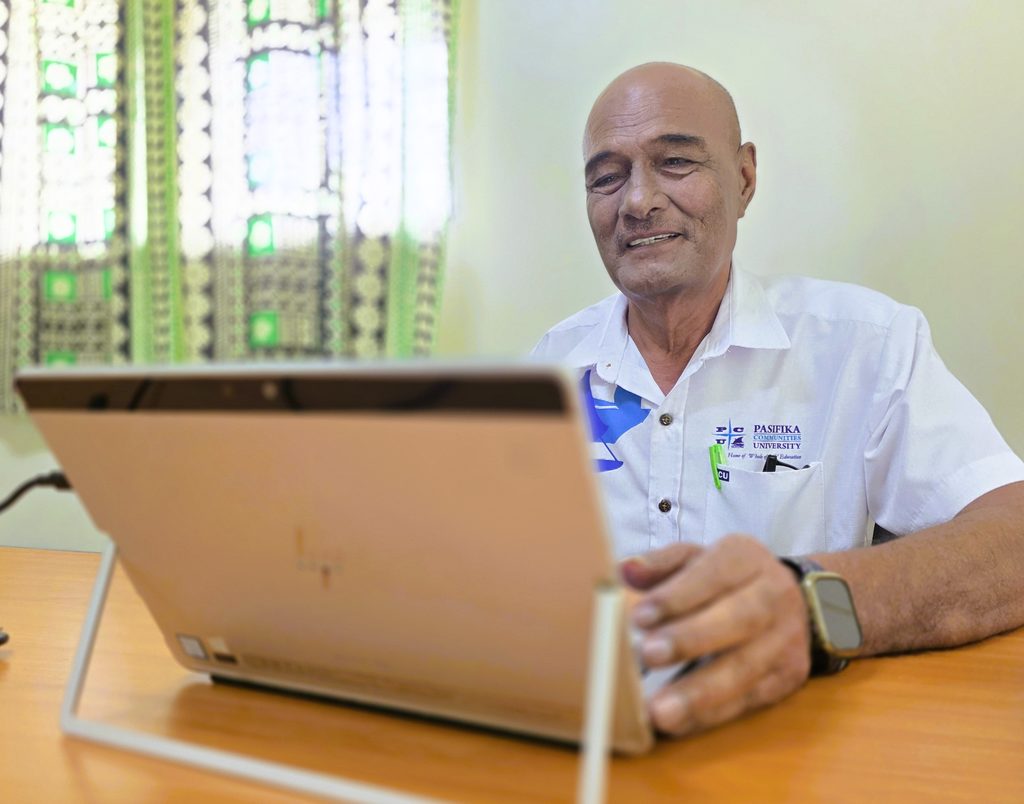
THE existential climate crisis we have and continue to face in the Pacific is not only environmental in nature but deeply spiritual according to Reverend Dr Tafue Lusama.
The Tuvaluan theologian and ordained minister with the Ekalesia Kelisiano Tuvalu or Tuvalu Christian Church has spent years grappling with difficult questions from communities on the frontline of rising seas.
Today, as Director of the Institute for Climate Indigenous Knowledge at the Pasifika Communities University, he is working to bridge the gap between faith, science and lived experience.
His journey into climate advocacy began with uncertainty.
“It was a search for answers,” he said.
“Communities were asking why we were losing food security, why our land was disappearing and often they wanted a theological explanation.”
He found that many interpreted climate impacts as divine will, fostering a sense of passivity which he argued is dangerous.
“As long as people believe God alone will intervene, we risk doing nothing,” he says.
“What is happening is not punishment, it is the consequence of actions beyond our control.”
This realisation shaped his academic path, leading him to pursue theological studies that examine climate change through both spiritual and ethical lenses.
It also strengthened his resolve to advocate for those he calls “the voiceless” communities and ecosystems bearing the brunt of global inaction.
Now, in his current role, Dr Lusama is championing a shift in how climate solutions are conceived in the Pacific.
He believes indigenous knowledge, long overlooked, must sit alongside scientific approaches.
“The climate narrative has been dominated by Western frameworks,” he said.
“But our communities are experts in their own environments.”
From reading weather patterns through bird movements to understanding seasonal changes in plants, Pacific communities hold knowledge systems built over generations.
Yet, he noted, these insights are rarely reflected in national or regional climate policies.
The result is often a disconnect.
“When solutions are imposed from outside, communities do not own them,” he explained.
“And when funding ends, so does the intervention.”
Dr Lusama believes the answer lies in integration, in blending indigenous knowledge with climate science to create solutions that people understand, embrace and sustain.
“It belongs to them and that is where real change begins” he said.

