
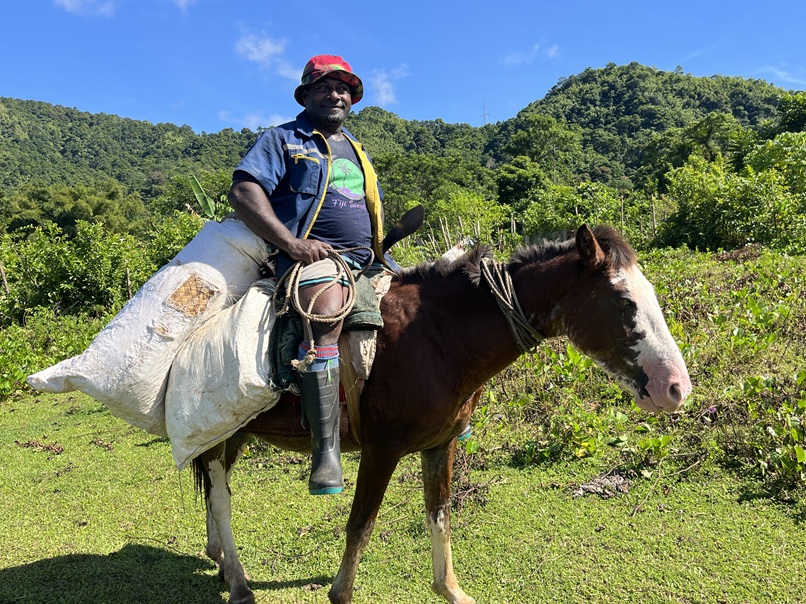
The cold water of the Wailoa river rose steadily against the legs of Osea Nabulivula’s horse as the animal pushed carefully through the current.
Strapped behind the saddle were cooking items, clothes, mats and sacks of supplies, enough for several days at the family farm hidden high above Laselevu Village in the district of Nagonenicolo, Naitasiri.
Nabulivula’s family also accompanies him, wading carefully across.
For villagers in the interior of Colo East, crossing rivers is part of everyday life.
The Wailoa river separates Laselevu Village from the main access road and Udu Village.
While some villagers climb onto wooden dory boats to get across, Nabulivula chose the familiar mode, horseback through the river.
“As you look uphill, that is where my farm is situated,” he said, pointing towards the thick green slopes rising beyond the village.
“We are making our way this morning to the farm.”
Nabulivula, who belongs to mataqali Nakasamai of Yavusa Nakaidrau, lives near Wainimala Secondary School and Ratu Alipate Primary School and often crosses the river to go to his farm, located miles away.
With schools on holiday break, his family had decided to travel together to spend a few days tending to their crops.
“We are taking our belongings on horseback because we intend to stay at the farm for a few days,” he said.
“We might return on Friday or Saturday.”
The narrow tracks leading into the farming areas becomes difficult as villagers ascend, making horses one of the most reliable ways to carry supplies.
For families in Laselevu, farming remains the backbone of survival.
Dalo and yaqona are now the main sources of income, although older villagers still remember the days when banana farming flourished across the district.
“Before, when my father was still alive, villages up here were known for banana production,” Nabulivula said.
“After cyclones and constant flooding, our banana plantations were damaged, and it became hard to continue.
“We used to earn well from bananas, but now we rely mostly on yaqona and dalo.”
He said while they continue to travel by horseback and track through the forest to get to their farms, they have submitted forms requesting for a farm access road.
“We have filled forms to request for a farm road to give us easier access to our farms,” he said.
He hopes that one day, villagers in remote places can be given proper road access so they can contribute more to agriculture.

