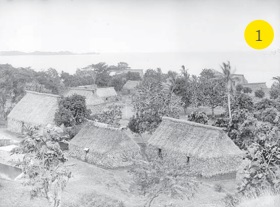
LAST week we discovered temple worship and the role of priests in old Fijian religion and society, according to two Gifford Lectures on Fiji, contained in Professor James Frazer’s book, The Belief in Immortality and the Worship of the Dead.
The book has Gifford’s 20 lectures delivered between 1911 and 1912 at St Andrew’s University. It focuses on the belief in immortality in primitive societies. This week we will look at how ancient priests were possessed and received their messages from the deities. We will also look at the practice of human sacrifice and its significance before the influence of Christianity.
Oracles have been given by the priest The principal duty of the Fijian priest was to relate the will of the god to his kinsmen and this he did through the direct inspiration of a worshipped deity. The revelation was usually made after a prayer was first offered.
The Fijians normally asked for a good crop of yams, for showers of rain, protection in battle, or a safe sea voyage, among other things. The worshipper would go to the burekalou with a gift, such as a whale’s tooth or artefact, and presented it to the priest at the temple.
“The man of God might have had a word of his coming and had time to throw himself into an appropriate attitude. He might, for example, be seen lying on the floor, near the sacred corner, plunged in profound meditation,” Professor Frazer’s book noted.
When a person seeking divine favour entered, the priest would get up and then seat himself with his back to the white cloth down which the deity was expected to slide into the medium’s body. Having received the whale’s tooth, he would forget all worldly matters and contemplate the tooth for some time with “rapt attention”.
The priest would tremble, with his limbs twitched and his facial features severely distort- ed. These were some visible signs showing that the spirit had entered into his body via the white hanging masi.
The intensity of his shaking body would in- crease until his whole frame trembled violently. “…His veins swelled, the circulation of the blood was quickened,” Professor Frazer’s book noted. At this stage, the priest was said to be fully possessed and inspired by the god. “… His own human personality was for a time in abeyance: all that he said and did in the par- oxysm passed for the words and acts of the in- dwelling deity.”
Then piercing cries filled the air, indicating the presence of the powerful spirit inside a vessel of flesh and blood. “In giving the oracular response, the priest’s eyes protruded from their sockets and rolled as in a frenzy: his voice rose into a squeak: his face was pallid, his lips livid, his breathing de- pressed his whole appearance that of a furious madman.”
The priest would announce the spirit’s exit by throwing himself on his mat or striking the ground with his club. The conch shell would be blown to tell everyone who could hear that the deity had with- drawn and a divine message had been received.
Lorime Fison, an Australian journalist and anthropologist, wrote that to be possessed by the spirit in old Fiji was a “horrible sight”. He said in one case after the spirit had left the priest’s body, his muscles and nerves continued to twitch and quiver in “in an extraordinary way”.
“He was naked except for his breech-clout and on his naked breast little snakes seemed to be wriggling for a moment or two beneath his skin disappearing and then suddenly reappearing in another part of his chest,” Mr Fison noted.
“When the mbete (priest) is seized by the possession, the god within him calls out his own name in a stridulous tone ‘It is I! Katouviere!(kalourere) or some other name. At the next possession, some other ancestor may declare himself. Oracular utterances of Fijian gods From the descriptions of the way the spirit possessed the priest and spoke through him, it was believed the spirit belonged to dead ancestors.
Some oracles of these prophets were re- corded. Here are two examples, one was given and spoken in the name of the god Degei, who was worshipped in the form of a serpent and believed to occupy a cave somewhere within the Nakauvadra range. “Great Fiji is my small club. Muaimbila is the head; Kamba is the handle. If I step on Muaim- bila (Muaibila), I shall sink it into the sea whilst Kamba will rise into the sky,” Professor Frazer’s book said about one experience.
“If I step on Kamba (Kaba) it will be lost in the sea whilst Muaimbila would rise into the skies. Yes, Viti Levu is my small war club. I can turn it in as I please. I can turn it upside down.”
In another example, speaking through a priest, the god Tanggirianima (taqiri- anima) once made the observations: “I and Kumbunavannua (Kubunavanua) only are gods. I preside over wars and do as I please with sickness. But it is diffi cult for me to come here as the foreign god fills the place.” “If I attempt to descend by that pillar, I find it preoccupied with the foreign god. If I try another pillar, I find it the same.
However, we two are fighting the foreign god; and if we are victorious we will save the woman. I will save the woman. She will eat food today. Had I been sent for yesterday, she would have eaten then.”. The woman whose case the deity was consulted died a few hours afterwards. Human sacrifices in Fiji Ferocious cannibals themselves, the early Fijians may have assumed that their gods loved flesh, hence human flesh was a common offering and the most valued of all, Professor Frazer’s book said.
So formal human sacrifices were frequent. Prisoners of war or slain enemies were often offered. The sacrificial victims too were sometimes taken from a distant tribe and when war and violence failed to supply the demand, some- times the human lambs had to be negotiated. Regardless of the way the human sacrifice was obtained, the victim was often fed and fattened to make him fl eshier. “Then tightly bound…they were placed on hot stones in one of the usual ovens and being covered over with leaves and earth were roasted alive while the spectators roared with laughter…”
“When their struggles ceased and the bodies were judged to be done to a nicety, they were rakedoven, oven their faces painted black and so carried to the temple where they were presented to the gods only, however, to be afterwards removed, cut up and devoured by the people.”
It must have been a frightening scene to watch. Human sacrifices for building a house or launching canoes Roasting human flesh in earth ovens to appease the gods was not the only reason and way in which Fijian men and women were sacrificed. Sometimes, when a powerful chief’s house was built, men were buried alive in the holes dug to receive the posts.
They were compelled to clasp the posts in their arms before the earth was buried over them. When a large war canoe was launched, it was hauled down to the sea over the bodies of living men who were laid out at intervals to serve as rollers. The canoe would glide smoothly over the men’s bodies and into the sea, leaving behind “a row of mangled corpses”.
Professor Frazer’s book explained that the theory of both these modes of sacrifice was explained by the Fijians to an Englishman who witnessed them. “… If the canoe was not hauled over men as rollers she would not be expected to fl oat long and in like manner the palace could not stand long if people were not to sit down and continually hold the posts up,” the book quoted the Englishman as saying. The Englishman asked, “How could they hold the posts up after they were dead?”
“They said if they sacrificed their lives endeavouring to hold the posts in their right position to their superior’s turanga kai na kalou (chiefs and god or turaga kei na kalou) that the virtue of the sacrifice would instigate the gods to uphold the house after they were dead and that they were honoured by being considered adequate to such a noble task,” the English- man quoted the native as saying in Professor Frazer’s book.
So the early Fijians imagined that the souls of the dead men had physical strength and would somehow strengthen the souls of the houses and canoes and so prolong the lives of these wooden structures.
Professor Frazer’s book suggested that ac- cording to Fijian theology “houses and canoes, as well as men and women” were believed to possess souls.
History being the subject it is, a group’s version of events may not be the same as that held by another group. When publishing one account, it is not our intention to cause division or to dis- respect other oral traditions. Those with a different version can contact us so we can publish your account of history too — Editor.