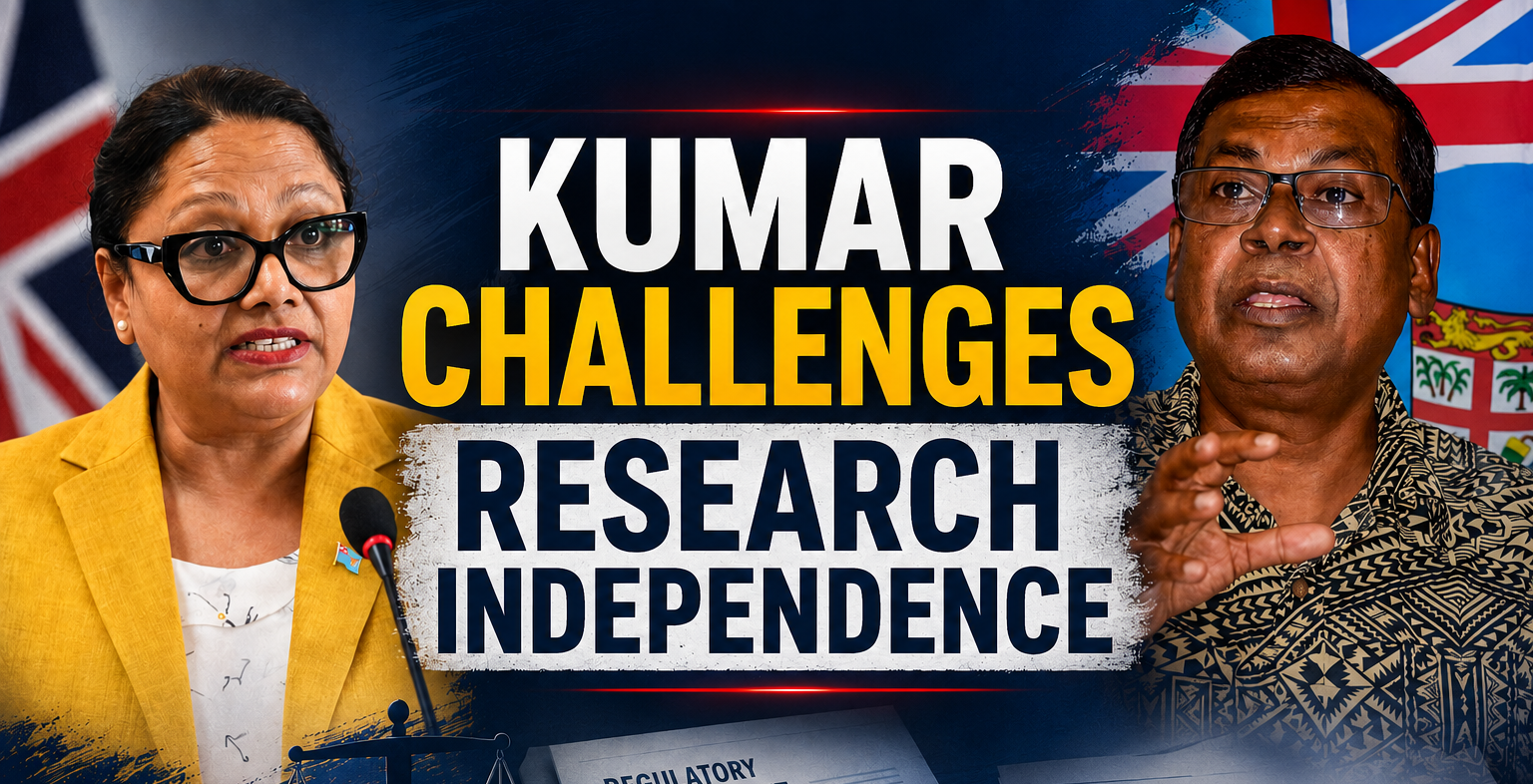
Opposition MP Premila Kumar says former Deputy Prime Minister and former Finance Minister Biman Prasad has missed the point entirely in attempting to dismiss concerns raised during the Parliamentary Standing Committee on Economic Affairs hearing into the Fijian Competition and Consumer Commission annual report.
Kumar said the issue raised before the Committee was never about academic qualifications or personal capability, but rather about governance, institutional independence and public accountability.
She said the central concern was whether a sitting Finance Minister should co-author research positively assessing a regulatory environment closely connected to the economic and fiscal policies he oversees.
“The issue is simple: should a sitting Minister for Finance co-author research that positively assesses a regulatory environment closely connected to the economic and fiscal policies he oversees?” Kumar said.
She argued that while the Ministry of Finance may not directly control the FCCC, there remained a significant indirect relationship because FCCC pricing decisions affect inflation, the cost of living and broader fiscal management areas that fall under the Finance Ministry’s responsibilities.
Kumar also pointed out that the FCCC operates through public funding appropriated by the Ministry of Finance.
“This creates a clear governance concern when the same Minister appears as a lead author, effectively validating the regulatory framework connected to his own policy environment,” she said.
Kumar stressed that the issue was about public confidence and the appearance of independence, rather than whether direct interference had occurred.
“Independence is not only about whether interference occurred. It is also about whether the public can have confidence that assessments are free from influence, bias, or institutional self-validation,” she said.
She further questioned whether publicly funded research using FCCC resources, staff time and taxpayer-funded systems should have instead been presented as institutional research rather than under the personal authorship of senior officials.
“When the FCCC CEO and the Minister for Finance appear as named authors, it creates the impression that the research is serving personal profiles rather than standing independently as institutional work,” Kumar said.
She also questioned why an external academic from Monash University had been engaged if both Professor Prasad and the FCCC chief executive already possessed the necessary expertise.
Kumar raised concerns over whether an external academic could freely publish findings critical of Government policy while co-authoring research with the sitting Finance Minister.
She said parliamentary scrutiny should not be dismissed as political point-scoring, noting that the concerns were raised through the proper oversight process of a parliamentary standing committee.
“The current FCCC CEO accepted the concern constructively during the proceedings,” Kumar said.
She added that indirect relationships between policymakers and regulators often present the very type of influence that strong governance systems are designed to guard against.