
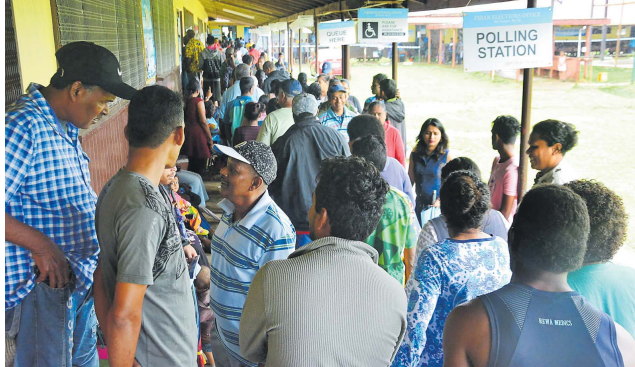
I am not a political activist, commentator nor have I done any studies in politics. I am just an observer and a listener. I usually sit with my friends and family members on Friday evenings or sometimes during the week around the tanoa to de-stress and talk about issues affecting us. In doing so, we find solutions and inevitably, our conversation finds its way to politics. We sit and discuss some of the political happenings in the country and laugh at some of the suggestions that are presented to the people to cope with the rising cost of living on minimum wage while our honourable members enjoy lavishly.
WITH election campaign period ongoing, we will have a good time watching videos of aspiring politicians, current and former ones included, promising people the moon and stars when they get into government.
The language of these candidates will be convincing, influential and most of the time their ideas without depth. I say this because no one talks about the real problems succumbing our country.
Fiji is a crippling nation now, barely surviving to make ends meet. Thank God for our vuvale partnership that secures budgetary assistance from Down Under.
The country is now plagued with issues that need urgent attention rather than political point scoring and electioneering on divisive racial lines.
In the last 40 years, Fiji’s political atmosphere has been somewhat stale with recurring racial hatred aimed towards ethnic groups, political parties and candidates.
The language is filled with racial filth to manipulate voters and dissuade them from real issues such as infrastructure development, youth opportunities, employment perspectives, education, standard of living, civic pride, agricultural support and so forth.
Instead, voters are being brainwashed on racial lines.
A point of commonality among the four coups that marred Fiji’s political standings on the world stage have been ethnic tensions between the two major ethnic groups in Fiji.
These ethnic tensions did not stem from the grassroot people who, still now, continue to live in peace and harmony.
These tensions were not fuelled by the public who continue to sit in villages and within their multiracial friends’ circles, but rather political leaders who decided otherwise.
The nationalist perspective shattered the once peaceful country to million shards of racial stereotypes which continue to hurt the very feet that dares to rise for the country.
One may ask, what did we get from this? Did the political landscape after the first and last coup change anything for the better? No.
It did not. It created further gaps in our friendship while the leaders continue to benefit. The home that once nurtured the memories of our friendships with each other lay broken.
No building materials or engineering plans or assistance can mend the damages many homes sustained. Some lost lives, some memories and Fiji lost its innocence being scarred forever.
This election needs to head to new directions.
The language needs to change.
No more sweet laden promises of moon and stars. We need aspiring politicians who can answer real questions without any fuss, politicians who are fluent in straight forward language and not skim on the surface without any facts or research. I generally equate election campaigns to job interviews.
Aspiring candidates will be holding their party campaigns on various communities and at no point in time must be turn into a speech and rally session about the failures of previous governments or one’s tenure as a former minister.
Voters need to hear new ideas, new thoughts and new innings in Fiji’s political landscape.
A robust campaign should reflect the views of the voting public and must engage both the politicians and the public into constructive question and answer session.
However, I fear that any question aimed at candidates may be viewed as anti-party slogans on social media.
Any candidate who throws personal and anti-party attacks just because they are unable to answer or are unable to take constructive criticism exhibits lack of democratic process.
To ask is to learn, to answer is to uplift. Fiji, as a nation, has come a long way to be dwelling on archaic issues.
We need to ask the candidates if they have solutions to the ongoing road congestions.
While motor vehicles have increased recently, our road infrastructure has not changed a bit.
A few months ago, I read that the Fiji Sugar Cooperation will close tramline operations in the west.
What will happen to the existing tramlines? Forward thinking elected leaders would take this opportunity to invest in passenger trains to ease the burden on roads.
It may not be an easy task and may require millions of dollars to set it up, but then the job of a government minister is to look for funds for projects that benefit the people.
Something that is lacking in recent times.
Another important aspect that needs to be considered is the language.
While political language often comes with jargon, it is the social media language that needs particular attention.
Candidates are body shamed, sworn at, threatened, or ridiculed on social media through various fake accounts and ill-mannered users.
As humans, our views may differ, but to agree to disagree amicably is the hallmark of a matured society.
The language we speak or use on social media should be respectful. However, this is too much of an ask in Fiji where online safety guidelines are somewhat weak in taking people to task.
Perhaps this is the reason many women candidates pull back from political aspirations because of body shaming and online abuse.
Political language makes a difference during campaigns.
Unwarranted attacks, personal remarks, filthy language and political innuendos will have a barring on the election results.
Candidates who possess the confidence to lead the country, candour in their expression and true to the calling should be voted to lead the people and not those who are unkind, arrogant and lack mannerisms.
Conclusively, a good voter turnout depends on the calibre of candidates contesting the elections.
Voters pull back from polling not because of lack of political engagement, but the calibre of candidates they are made to vote for.
They rather use the time doing something else than voting for people who possess no maturity or depth of being a leader.
With Fiji’s scarred political reputation, I am sure that the new crop of young leaders will take this ship to new directions focussing on issues we currently face and the plans for future for a nation which has been marvelled the world over for its pristine beauty and multiculturalism.
The facade doesn’t reveal what lies within. Its time to change the old ways of doing things in this country and be open for new ideas, new faces and new innings.
To leave is to let others grow!!
AVITESH DEEPAK KUMAR is a former high school teacher and a creative writer based in Ba. The views expressed are his and does not reflect the views of this newspaper. He can be reached via email aviteshdeepakk@yahoo.com.

