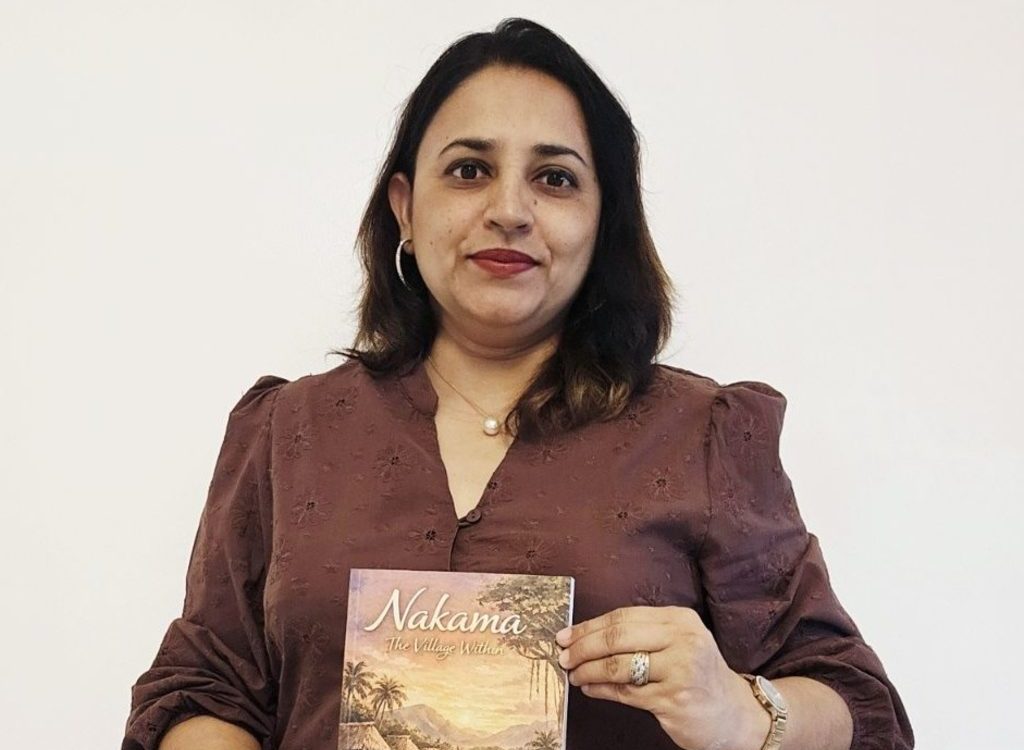
There are books that tell a story, while others preserve a world.
Manpreet Kaur’s Nakama: The village within belongs to the latter category. Published by Pacific Studies Press, this 180-page collection brings together ten interrelated short stories centred on Nakama, a village on Vanua Levu. Yet it is more than a collection of stories about a Fijian village. It is fiction, childhood recollection, cultural record and an exploration of how a place can become so deeply embedded in a person that leaving does not mean losing it. Nakama exists both as a geographical place and as an interior landscape carried in memory.
Ms Kaur transforms ordinary details of village life into meaningful literary material. Rivers, farms, temples, schoolyards, sugarcane and paddy fields, village gossip, religious festivals, childhood games, family relationships and elders’ voices become building blocks of a larger story about Fiji, its people and the changing meaning of home.
THE opening story, “Nakama: The hamlet on the banks of the Hot Spring”, establishes the collection’s emotional foundation. A conversation between mother and daughter becomes a doorway to the past. A familiar phrase triggers memories, transporting the narrator from the present to a village that exists as much in memory as in geography. This movement between past and present is one of the book’s most effective techniques. Sugarcane and rice farming are not merely economic activities, but part of the community’s social fabric. The Nakama River provides water for agriculture, recreation and domestic life. Children swim in it, women wash clothes beside it, and farmers depend on it; religious traditions also connect it with birth and death. In “River Nakama”, the river becomes the “River of life”, serving iTaukei and Indo-Fijian communities while carrying different cultural meanings for each.
The river is an apt symbol for the book. Like the river, Nakama brings together different histories and communities. Although Ms Kaur’s world is distinctly Indo-Fijian, it remains connected to the wider Fijian cultural landscape. The Nakama Koro, the turaganikoro, iTaukei vocabulary and interactions between Indo-Fijian and iTaukei children give the stories a multicultural character. The village is shaped by communal living, traditional authority and intersecting cultural and religious traditions. Language is another compelling feature. English, Fiji Hindi and iTaukei appear naturally, allowing characters to speak in ways that reflect their surroundings rather than translating village life entirely into standard English. Language is therefore more than communication; it marks identity. Words such as “amma”, “bappa”, “bhaini” and “momo levu” carry social meanings beyond dictionary definitions. The glossary provides readers with a bridge into this linguistic world.
The collection is also notable for its portrayal of women. They are not merely background figures supporting male characters: They farm, raise children, preserve traditions, manage households, endure hardship, challenge injustice and participate actively in community life. The observation that women were “not only farmers’ wives but were also farmers” captures an important dimension of rural life. Nauki Amma embodies both the limitations and possibilities of her social environment.
Shaped by arranged marriage, widowhood and traditional expectations, she becomes a source of knowledge and support.
Her neem tree extends her character, offering a place where villagers gather, exchange stories and find a listener for private pain.
The stories also confront darker realities. “Bloody Julie” explores the consequences for a young woman who challenges social expectations through her relationship with a Muslim man. The village response raises questions about honour, reputation, gender and conformity. Julie is neither simply a rebel nor a victim; her disappearance leaves the narrator wondering whether she has been lost or liberated. “Romancing Radha” addresses women’s vulnerability and the consequences of abuse. Such episodes prevent Nakama from becoming an uncomplicated portrait of village life. Ms Kaur remembers community warmth alongside its silences and inequalities. Nostalgia is present, but it does not control the narrative. This complexity also appears in “Lalji”, a humorous, socially revealing story. Clever and manipulative, Lalji seeks to maintain his advantage. His interactions with Sarup expose inequalities within a close-knit community. Through humour, gossip and agricultural life, the story explores power, jealousy, economic difference and status. Ordinary relationships contain both affection and rivalry.
“Ramlila” turns to education, religion, performance and community. The school becomes a place where children encounter tradition through participation, not only textbooks. Preparations for Ramlila bring students, teachers, families and religious institutions together. Yet the narrator observes that Ramlila is becoming a dying art. The story captures a central tension: What happens when cultural practices that once anchored communal life begin to disappear?
Education becomes even more significant in “Bappa’s dream”. Savitri’s journey from Nakama to the University of the South Pacific represents more than personal achievement; her graduation becomes a village triumph. Her success expands what young people, particularly girls, can imagine for themselves. Education symbolises possibility, social mobility and transformation while preserving an emotional connection to the village. History comes to the fore in “Picnic at Korovatu Beach”. A childhood school excursion connects with the journey of the narrator’s great-great-grandfather, who travelled to Fiji aboard the SS Sutlej in 1916. A family diary written in Gurmukhi links generations, connecting personal memory with migration and indenture. The sea becomes both a physical space and a historical passage through which generations experienced departure, danger, arrival and belonging.
The final stories deepen the theme of loss. “Goodbye” opens with a funeral and presents a generation living between Fiji and overseas homes. Characters arrive from Auckland for the funeral, showing how migration has changed the meaning of home. The village remains the place for important rituals, even when people’s everyday lives are elsewhere. Ultimately, Nakama: The village within is about memory, but not simply a nostalgic return to childhood. It preserves a changing social world while acknowledging its contradictions. The book asks what constitutes home: The house where one was born; the village where one played; the river where one swam; the temple whose bells marked the day; or the language spoken by parents and grandparents? Kaur’s answer seems to be all of these.
For readers who grew up in Fiji’s rural communities, the collection may evoke places, people and practices increasingly difficult to encounter in their original form. Younger readers can enter a world shaped by farming, communal responsibility, oral storytelling, multilingualism, religious practice and village relationships. For readers outside Fiji, it offers an intimate introduction to Indo-Fijian life that tourist images and official histories cannot adequately capture.
The lasting contribution of Nakama: The Village Within is its insistence that ordinary lives are worth remembering. A village need not be famous to matter, nor must its people appear in history books to shape a place’s history. A river, neem tree, thatched bure, schoolteacher, storyteller, farmer, mother or child can become part of a community’s cultural inheritance when someone remembers them. Perhaps this is the deepest meaning of the title. The village within is not simply Nakama carried inside one writer; it is the part of home that remains within us after familiar roads, houses, farms, schools and landscapes have changed. Places disappear, communities evolve and generations move on, but stories keep a village alive. Ms Kaur’s book is not simply about looking back. It is an act of remembering and preserving Fiji’s cultural memory for later generations.
n RAVNIL NARAYAN is a senior lecturer in Applied Linguistics in the School of Communication, Language and Literature at the Fiji National University’s, Lautoka Campus. The views expressed in this article is his own, and not of the affiliated institution. For comments: email at ravnilnarayan@gmail.com.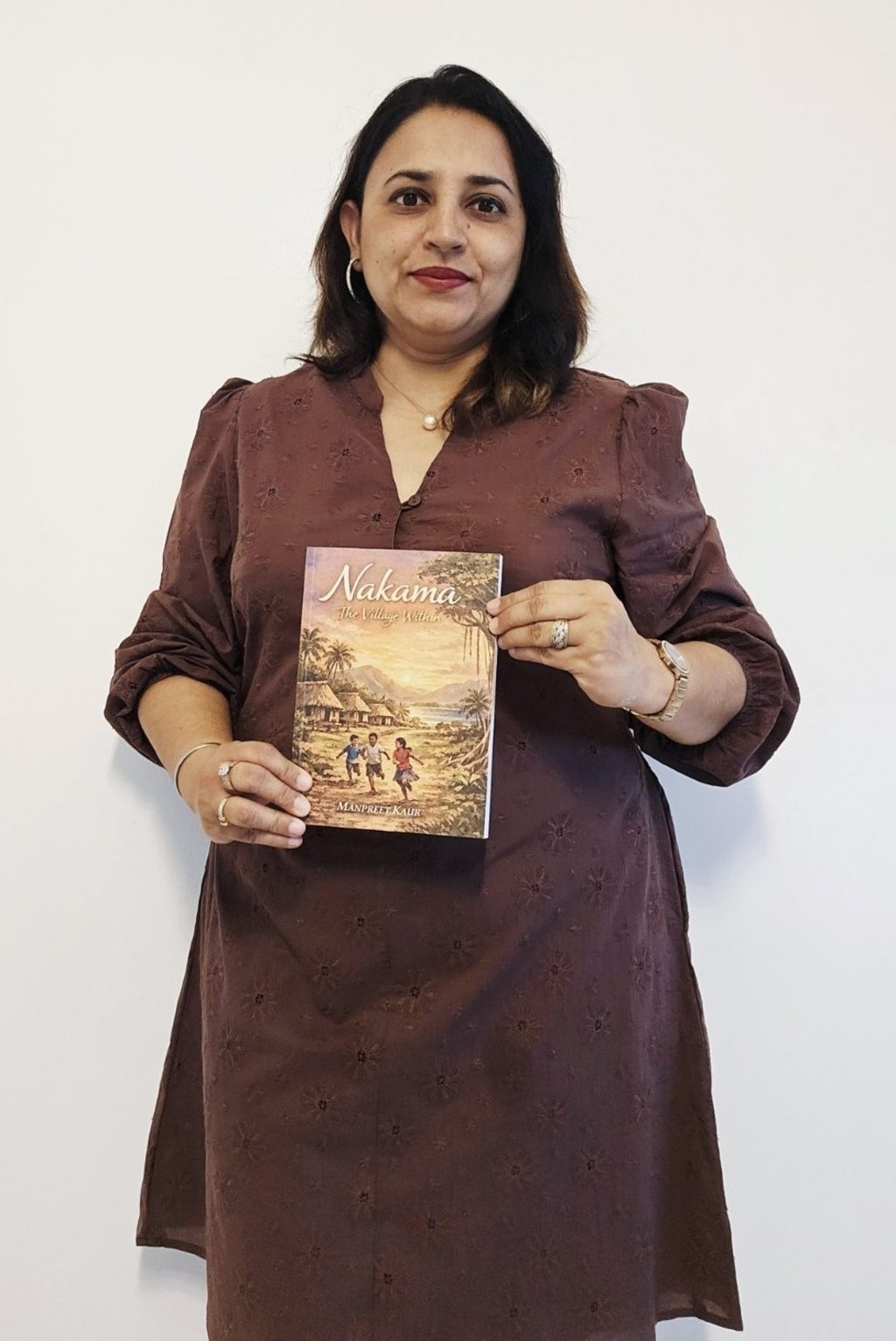
Left: Manpreet Kaur with her 180-page book that brings together ten interrelated short stories centred on Nakama, a village on Vanua Levu.