
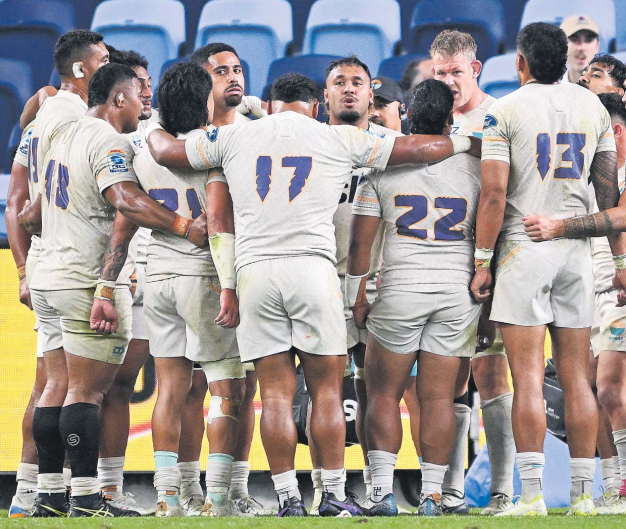
For rugby union fans of Samoa, Tonga and other Pacific Islands, the news that Moana Pasifika would be disbanded at the end of the 2026 season would have come as a big disappointment.
It is important for the rugby union fans to examine the root causes of the failure of Moana Pasifika in the Super Rugby Pacific competition: The preference of ticket-buying Australian rugby fans for NRL rather than rugby union.
Some of the lessons might also constitute writing on the wall for the Fijian Drua, but can there be opportunities arising out of this adversity going into the future?
Especially if we keep an open mind about which “brand of rugby” or “code of rugby” might be most “beneficial” for sports persons in the Pacific in the long run.
Rugby excelling countries like Fiji can have more than one egg in the basket, hedging their bets with both rugby union and NRL.
The three rugby codes
Let us leave aside soccer in which the only players allowed to handle the ball are the goal-keepers.
The other three (AFL, NRL and Rugby Union) all allow players to handle the ball, but all have complete different rules of operation and scoring, geographical location and most importantly, different degrees of fan followership willing to fork out high prices for tickets at stadiums.
The incredibly popular AFL or Australian Rules Football has its origins in Victoria and today have teams from all over Australia, playing usually in packed stadiums.
NRL (National Rugby League) originated in NSW and now have teams from all over Australia and NZ usually playing in packed stadiums
Rugby Union originated in Britain but spread to Australia, NZ and South Africa. Super Rugby Pacific has teams from Australia, NZ and the Pacific. Today, their stadiums are more than half empty.
Different degrees of popularity
There is little doubt about the immense popularity of AFL which will regularly draw crowds in excess of 80,000 at the MCG in Melbourne. The games are usually broadcast free to air.
NRL is similarly extremely popular, regularly filling stadiums where they play while most games are free to air.
In contrast, it is clear that rugby union games have great difficulty in filling stadiums: Most games are very poorly attended, while they are not broadcast free to air.
Any ordinary television viewer will immediately understand one possible factor in the demise of Moana Pacifika: The relative lack of paying customers for rugby union.
With rugby union raising much lower gate takings and advertising revenue than the other two rugby brands, it is not surprising that the team lowest in the league table (Moana Pasifika) will have difficulty surviving financially.
If the relative decline of rugby union vis a vis AFL and NRL continues into the future (as is likely), the demise of Moana Pacific may be “writing on the wall” for the Fijian Drua, though that may be some seasons away.
Pacific origins of players
There are very few Pacific Islanders playing AFL.
Most Pacific Islanders have opted for rugby union, largely because of the historical colonial popularity of this brand in Fiji, Samoa, Tonga and Cook Islands.
It was not surprising therefore that there was a Fijian Drua team based in Fiji, as well as Moana Pasifika based in NZ but drawing on Pacific Islanders, mostly Samoa and Tonga.
It is extremely encouraging, however, that there are more and more Pacific Islanders playing and starring in the NRL competition even though there is no NRL competition in the Pacific Islands.
I suspect that the salaries of the Pacific Islanders in the NRL teams are far superior to the salaries of the Pacific Islanders in the Super Rugby competition.
Which code for Pacific rugby?
Pacific Island Countries wishing to foster sport in their own countries and populations, of course cannot disregard the love of their people for particular codes of rugby. Clearly, we in the Pacific have absolutely adored rugby union.
I personally prefer to watch rugby union with exciting free-flowing possibilities at every move with competitive line-outs and scrums, rather than NRL which I consider relatively monotonous. But it is the ticket-paying fans’ views that matter, through their pockets. Not the views of armchair critics.
But those with an eye to the future must take account not just the historical origins of the various codes and the future directions they are taking currently, but they must also understand the financial and now also geostrategic aspects.
For Pacific countries, the AFL does not hold any future prospects, not the least because the grounds required are much larger than that required for rugby union and NRL. So the choice is therefore between rugby union and NRL.
I have alluded to the clear commercial popularity of NRL in Australia, over rugby union. But in the last year, there has been an astonishing Australian Government initiative for NRL in PNG which Pacific Islanders should pay heed to.
PNG NRL and sports diplomacy
Just last year, the Australian Government (PM Albanese) announced a $A600 million package to initiate a PNG NRL team based in Port Moresby and debuting in 2028 in the NRL competition in Australia/NZ.
This deal attracted the attention of political commentators in Australia as highlighted in The Conversation which surmised that part of the deal was that “PNG will not sign a security deal that could allow Chinese police or military forces to be based in the Pacific nation”.
The Conversation also noted that “other possible negatives: perceptions (are) that this is just neocolonial Australia bullying, patronising, poaching talent, demonising China, militarising the Pacific (via AUKUS), and even sportswashing — that is, co-opting rugby league to deflect attention from other issues”. Be that as it may.
Far more important is the lesson it poses for the future of rugby in the Pacific.
What lesson for the Pacific?
For Pacific Islanders, the Australian Government support of PNG NRL has a powerful lesson here: Rugby is not just all about fostering healthy sports for Pacific Islanders.
Pacific sports administrators must also take into account that the superpowers in our region (Australia and NZ) are now viewing sports as a powerful force binding our peoples together, against perceived external threats. Just as expensive defence agreements can.
So which code of rugby should our countries foster: Rugby union or NRL?
Clearly, even Australian and NZ rugby unions have recognised, especially after COVID, that there are commercial drawbacks to maintaining sporting links with Britain, France, South Africa, and Argentina. Their Super Rugby therefore contracted to the Pacific.
Fiji had its Drua. Samoa and Tonga focused their efforts on Moana Pasifika operating out of NZ for financial benefit.
Unfortunately, the Moana Pasifika could not survive financially in the limited competition. I suspect that there is very little chance that they can make it back.
If the declining trends for rugby union continue, it is possible that even the Fijian Drua teams (both men and women) may end up struggling in the future.
Here is a tough decision for rugby union administrators in the Pacific to make for the benefit of sports players and fans in the Pacific.
Switch emphasis to NRL?
The governments of Samoa and Tonga (and Fiji) might wish to consider a drastic policy shift: Switch support to a Pasifika NRL team playing in the Australia/NZ NRL competition, alongside the PNG team.
Fiji can of course continue its current focus on the Drua, but there is nothing to stop some of its considerable depth of rugby players to also have a go at NRL.
I am sure that just as the Australian Government provided a substantial financial package to assist the PNG NRL Team, it would also not be averse to providing one for the Pasifika NRL team whose base can still be NZ to start with, but have occasional games in Samoa, Tonga and Fiji.
Almost certainly, there will be far more Pacific Island players in the NRL competition, playing for all the teams and not just their own, than currently.
Nearly all will be sending part of their earnings home to their families, strengthening the remittance earnings of Tonga, Samoa and Fiji way above their already record levels.
This is all the more reason for their governments to think long and hard about switching their national support from rugby union teams to NRL teams and competitions, in their respective countries. Or for Fiji to support both codes of rugby and not just rugby union.
For economists watching the packed NRL stadiums in Australia and empty rugby union stadiums, the choice is obvious.
PROF WADAN NARSEY is one of the region’s senior economists and a regular commentator on political and economic issues in Fiji. The views expressed in this article are his and not necessarily the views of The Fiji Times.

