
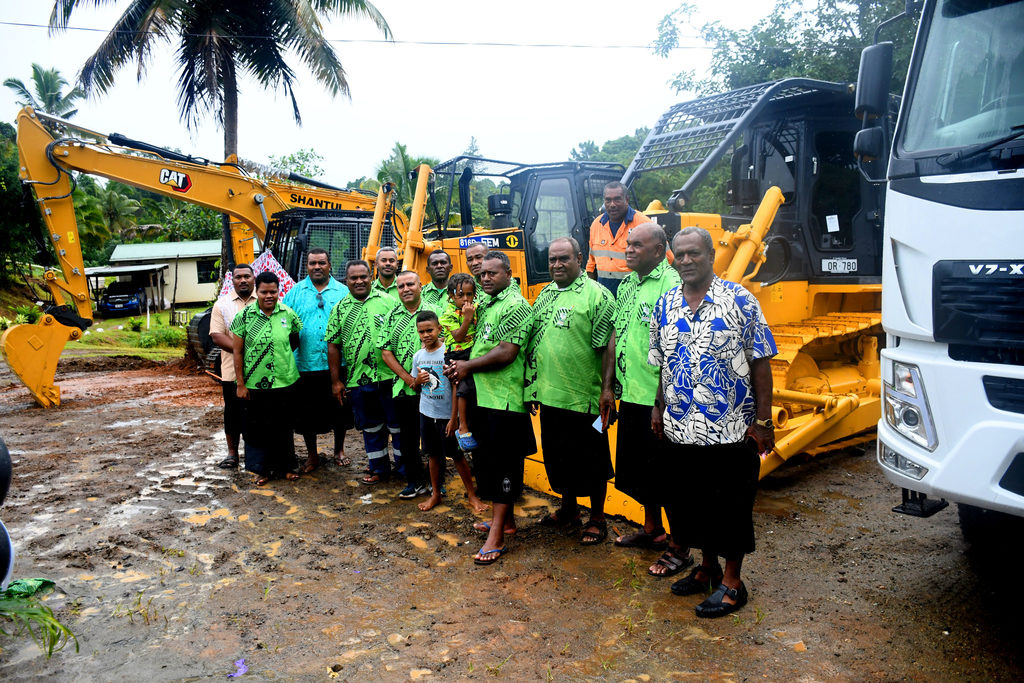
Fiji holds 44,000 hectares of one of the world’s most regulated and coveted plantation timber species — grown in the fog-wrapped orographic wet zones that make its logs among the finest in the Pacific. For decades, political interference, ownership disputes, environmental controversy and the raw log export trap have consumed the margin this industry should have built. The machinery is turning again at Nukurua. Whether the institutional will can finally match the ecological opportunity is the question Fiji’s plantation timber sector must now answer.
A land-rich nation’s green paradox
Fiji carries a contradiction at its economic core. Approximately 91 per cent of all land is owned by iTaukei landowners — one of the highest concentrations of indigenous land ownership of any Pacific nation — yet the plantation timber industry sitting atop that land remains one of the most consistently underperforming assets in the national economy. Pine and mahogany together contribute roughly 1.5 to 2 per cent of GDP against a sugar sector that has collapsed below 1 per cent. These are not the numbers of an industry realising its potential. They are the numbers of an industry that has survived its own governance failures long enough to attempt, once again, a credible reset. Whether this reset holds is the central question in Fiji’s most consequential natural resource debate.
The ecology that makes Fiji’s mahogany exceptional
To understand what is at stake, it is necessary to understand what Fiji’s wet zone actually produces. The Western Division receive approximately 1800 millimetres of annual rainfall — adequate for agriculture but not exceptional. The eastern and interior zones are fundamentally different. Orographic uplift from Fiji’s central mountain ranges forces moisture-laden trade winds skyward, producing slow-burn saturated conditions — persistent mist, fog, filtered light and consistent soil moisture — that generate rainfall of 2500 millimetres or more annually across Tailevu, Ra, Colo East and adjacent provinces. Swietenia macrophylla — Big-leaf mahogany — is a species built for exactly these conditions. It drinks deeply, grows with extraordinary vigour, produces massive straight-grained logs with dense, lustrous timber and carries the kind of green canopy architecture that defines a mature tropical plantation at its finest. Fiji’s wet zone does not merely grow mahogany. It grows some of the finest plantation mahogany on earth. That ecological fact must drive every commercial and governance decision that follows.
The FHCL reset and the commercial shift
Fiji Hardwood Corporation Ltd is attempting to translate that ecological advantage into commercial reality. At the commissioning of the company’s new $FJ2.7 million machinery fleet in Nukurua, Tailevu, board chair Iowane Naiveli was direct about the intent. “These arrangements have the potential to create additional economic opportunities and income streams for landowners, beyond the usual stumpage fees, lease payments and land management fees already received,” he said, signalling a shift toward genuine commercial partnership rather than passive royalty flows. FHCL CEO Semi Dranibaka put the discipline required in plain terms: “We do the proper training, we do the proper monitoring, we do the proper planning, so that people know that money is business.” These are the right words. The industry’s credibility now rests on whether the actions match them — and whether landowner-operated machinery can meet commercial performance standards that were absent for too long.
The virgin bush problem nobody talks about
There is an uncomfortable truth embedded in every plantation expansion announcement that Fiji’s forestry debate consistently avoids. Both mahogany and pine operations have involved the clearing of native hardwood bush, secondary forest and indigenous scrub vegetation — environments of real ecological value — to make way for commercial monoculture. Heavy machinery used in clearing and access road construction compacts soil, damages watershed hydrology and exposes slopes to erosion in the high-rainfall wet zone where mahogany grows best. This is not theoretical. It is visible across plantation perimeters throughout the eastern and interior regions. It matters commercially as well as ecologically: Forest Stewardship Council certification — the gateway to premium US and European markets — requires rigorous proof that no high conservation value native forest was converted after the certification cutoff date. Fiji cannot pursue FSC certification while simultaneously clearing native bush for new plantation areas. The environmental ledger must be addressed honestly before the premium market door can open.
The politics that nearly broke the industry
The deeper wound in Fiji’s mahogany sector is not ecological. It is political. Following the restructuring of state commercial enterprises after 2006, FHCL became a contested institutional space in which landowner trusts, government shareholding interests and politically appointed board structures all competed for influence over an asset that desperately needed commercial management rather than political administration. Ownership disputes slowed governance. Harvesting plans were disrupted by disputes between stakeholder groups. Replanting lagged behind harvesting as debt servicing consumed investment capital. Board appointments reflected political settlement rather than forestry or commercial expertise. Everyone wanted a share of the dividend from an industry that had not yet earned one. The result was a decade of underperformance in which one of the Pacific’s most ecologically advantaged plantation industries produced returns far below what its asset base justified. FHCL’s new language — performance targets, commercial accountability, training as a condition of machinery access — is the institutional antithesis of that era. It must stay that way regardless of who forms the government.
The raw log trap and the margin Fiji gives away
Even when the mahogany industry has functioned, it has functioned badly at the value chain level. Global plantation mahogany commands between $US1200 and $US2500 per cubic metre at the log export stage, depending on grade. The same cubic metre, processed into kiln-dried sawn timber, furniture components, flooring panels or architectural joinery, generates $US4000 to $US8000 in downstream markets. Fiji exports logs and low-value sawn timber, shipping the processing margin to importing country manufacturers. Every container of raw mahogany that leaves a Fijian port is a transfer of value from the plantation to someone else’s factory. Without sustained investment in kiln drying, precision milling, grading and finishing capacity, mahogany will continue to subsidise the margins of its trading partners rather than building national wealth.
Pine’s lesson and what mahogany must learn
The Fiji Pine Group is proof that this industry can be turned around. Over the past decade, pine underwent genuine commercial transformation — governance reform, landowner shareholders, rising dividends, processing investment, disciplined replanting. Pine now delivers meaningful rural incomes and demonstrates what institutionally mature plantation management produces. The divergence between pine and mahogany is not ecological. Pine has no natural advantage over mahogany. It is entirely institutional. Mahogany’s wet zone ecology is superior to pine’s. Its global market position — in a CITES-constrained supply environment — is stronger. What mahogany needs is the same governance discipline that turned pine around, applied with greater urgency because the global market window for certified plantation mahogany is opening now.
The agroforestry and carbon dividend
Two revenue streams remain almost entirely unclaimed by Fiji’s mahogany sector. First, the agroforestry opportunity: during the first 10 to 15 years of mahogany plantation growth, before the canopy closes and light diminishes, the wet zone between rows supports high-value intercropping — ginger, dalo, kava — that generates immediate landowner income from land that is otherwise commercially idle for over a decade. This transforms plantation economics from a 25-year wait for timber revenue into a mixed-income system earning from year one. Second, carbon credits: Fiji’s 44,000 hectares of growing mahogany represent a measurable, verifiable carbon sink eligible under Article 6 of the Paris Agreement. International voluntary carbon markets are paying rising prices for forest carbon from credibly managed plantations. A dual timber-and-carbon revenue model would transform FHCL’s financial position and fund the replanting investment the industry has chronically deferred.
From potential to performance
Forest Stewardship Council certification remains the single most transformative step available to the mahogany sector. FSC-certified plantation mahogany commands price premiums of 15 to 30 per cent in United States and European Union markets where major procurement policies exclude uncertified timber entirely. The barriers to certification — traceability systems, harvesting documentation, governance accountability, confirmation that no native forest was converted — are exactly the same barriers that must be addressed to restore commercial credibility regardless of certification. FHCL’s new contractual framework with the Fiji Mahogany Trust is the necessary precondition. Accessing ADB and IFC concessional green finance, which is explicitly available for certified sustainable forestry in Pacific island nations, requires certification as a threshold condition. Fiji has the land. The ecology is exceptional. The global market is waiting. The machinery is running at Nukurua. What is now required is governance that cannot be captured by politics, environmental accountability that supports rather than blocks certification, and downstream processing investment that keeps Fiji’s margin in Fiji. The green gold has always been there. The reckoning is whether this generation of leaders can finally deliver it.
Dr Sushil K Sharma BA MA MEng (RMIT) PhD (Melbourne) — World Meteorological Organisation (WMO) Accredited Class 1 Professional Meteorologist is a former Associate Professor of Meteorology, Fiji National University, and Operational Meteorologist and Manager, Climate Research and Services Division, Fiji Meteorological Services. The views expressed are his and not necessarily shared by this newspaper.

