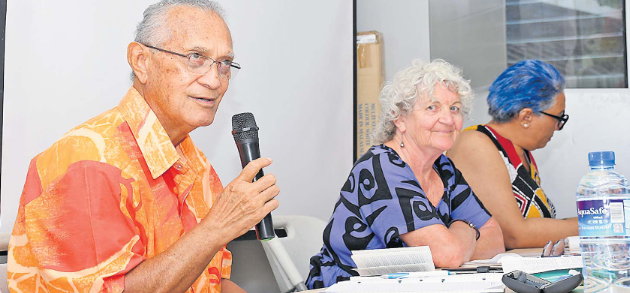
IN July 2025, the 2025 Fiji Electoral Law Reform Commission (FELRC) chaired by Daniel Fatiaki (and comprising Professor Wadan Narsey, Seini Nabou and Dr Deidre Brookes) presented its final report (An Electoral System from the People for the People) to the Acting Attorney-General Siromi Turaga.
In November 2025, I pleaded for the Report and its recommendations to be made public and tabled in Parliament for discussion by all political parties: “Fiji on cusp of democratic electoral revolution: people’s choice or politicians?” (FT 15/11/2025).
With no response from the Government and after the appointment of the 2026 Constitution Review Commission, I wrote another article in April 2026 “Can the 2026 CRC save taxpayers’ funds” (FT 9/4/2026). There has still been no response from the Coalition Government.
A week ago, Dr Sushil Sharma made the same requests (Fiji Sun, April 18, 2026) and gave many sensible comments on both the 2026 CRC (which I do not comment on) and the 2025 FELRC Report, emphasizing the importance of public awareness and debate, if Government’s processes with both constitutional and electoral reform were to be truly democratic and cost effective.
One of his criticisms of our FELRC Final Report drove home to me the great benefit of public discussion of what the FELRC had recommended through the Proportional Open List Constituency System – I could easily accept one easy modification in our recommendations resulting from Dr Sharma’s criticisms.
The POLCS
To remind the public the key elements that the 2025 FELRC Report recommended were (as indicated in the acronym POLCS) addressing all the weaknesses identified by the Fiji public we consulted:
q 25 Open constituencies throughout Fiji (all boundaries have already been outlined in an Annex prepared by Daniel Fatiaki and Seini Nabou);
q 25 Reserved Seats for Women in the same 25 Open Constituencies: only women standing and men and women both voting (hence giving women candidates greater security in campaigning – a weak point currently).
q total proportionality where the proportion of MPs in Parliament claimed by political parties represent closely the proportions of total votes they received throughout Fiji, implemented by selection from an Open List of highest losers from the 25 Open Constituencies, after standardising their votes to take account of different sizes of constituencies.
Dr Sharma’s criticism: “standardising” too complex?
Dr Sharma made a valid point about the public not understanding why the POLCS recommends that votes of Losers in the 25 Open Constituencies be “standardised” before going on to the “List” which ensures proportionality for political parties.
Our reasoning had been that a loser in a large constituency (e.g. in the Central Division) would most likely have more votes than a loser in a small constituency (eg. a Maritime constituency like Yasawas, Kadavu or Rotuma).
So to compare them fairly, we recommended that we would use percentage of the votes received in that constituency (multiplied by some standard number of voters – like 5000 or 10000).
But after Dr Sharma’s criticism that the public would not understand this standardisation process, I asked myself, why bother standardising anyway?
We have already given enormous weight of numbers of MPs to the five small Maritime constituencies: two MPs per constituency already (1 Open winner and 1 RSW) and hence 10 MPs altogether.
It can be argued that the small constituencies do not need more representation in Parliament through the List.
Of course, Losers in large constituencies can be expected to have larger numbers of votes behind them than losers in small constituencies. But surely that would be good in Parliament to strengthen Opposition, which currently is extremely weak.
I suggest that the authorities and the 2026 CRC can forget about the standardisation of Losers votes that we have recommended in our 2025 POLCS Report Perhaps my other FELRC colleagues can write in and express their views.
Dr Sharma’s Comment: regional unfairness
Dr Sharma of course repeats many of the valid points I had made in my earlier two articles about the costs to Fiji of Government not releasing our 2025 FELRC Report while having yet another 2026 CRC embarking on the same journey at great taxpayer cost and duplication of public effort (which I do not repeat here).
May I suggest that his comment about ensuring that the economic centres or contributors to Fiji’s economy should be given greater weight, is already being addressed in our POLCS: the economic “weight” is represented by the “numbers of voters”.
To do otherwise by industry etc. (eg. sugar, tourism, mining, water, retail etc) would be an impossibility arousing great never-ending debate.
71 MPs too many?
Dr Sharma does ask the valid question: isn’t 71 MPs too large for a country the size of Fiji (we currently have 55)?
In our 2025 POLCS Report we had suggested that we could keep the total numbers at 55 if that was what the public wanted but that would require the number of List MPs to be reduced from 21 to 11. Doable but making proportionality a bit more difficult.
But I remind that the 1997 Constitution which had been approved by both Houses of Parliament in 1997 had 71 MPs in its electoral system without any great questions about affordability.
Of course, those MPs were all paid much less than the current MPs (my salary as an Opposition MP in 1997 was a mere $25,000 I think, a third of my USP salary then as an Associate Professor).
But having 71 MPs in Parliament not only gave people throughout Fiji the sense of local accountability of “their” MPs, but also produced a better diversity of opinion in Parliament.
Surely, the way to contain the costs of parliament is to reduce the numbers of Ministers and Assistant Minister who currently are at an incredibly high proportion of the current Parliament.
Parliament should also keep their salaries and perks to an appropriate level, set by an Independent Salaries Commission and not set by the MPs themselves as done unprofessionally by the Coalition Government and the Tabuya Committee, despite the clear conflict of interest.
That transparent and independent process needs to be re-established for the next Parliament.
Other benefits
There are of course other benefits in our POLCS.
It should be possible for Independents to get elected: there have been none since 2014.
It should also be possible for small parties which have less than the 5 per cent National Threshold (excluded in the 2013 Constitution) to still be able to win in local constituencies where they may localise support.
It is great that scholars like Dr Sharma are contributing so perceptively in this field so important for Fiji’s democracy and development, even though he is a meteorologist. Of course, all his articles show the application of logic and commonsense that good meteorologists have.
Of course, we can disagree on issues but we can surely also agree to disagree while respecting others’ views.
PROF WADAN NARSEY is one of the region’s senior economists and a regular commentator on political and economic issues in Fiji. The views expressed in this article are his and not necessarily the views of The Fiji Times.