
Fiji imports more than US$700 million in petroleum products every year – its single largest import bill. A proposed plant at Vuda Point says it can generate 40 per cent of the country’s electricity needs from rubbish. Here is what the numbers actually show.
Every morning, somewhere between Suva and Lautoka, a diesel generator rumbles to life. Then another. And another. Across Fiji’s outer islands and remote communities, the ritual repeats itself – fuel shipped in from Singapore, trucked out, burned, gone. On the main grid, thermal power plants fuelled by imported diesel and heavy fuel oil cover the gaps when rain-fed hydro cannot keep up. It is an arrangement that costs Fiji hundreds of millions of dollars a year, leaves the economy exposed to a commodity it cannot influence, and makes climate commitments structurally difficult to honour.
Refined petroleum is Fiji’s single largest import by value. International trade data shows Fiji imported approximately US$718 million worth of refined petroleum products in 2023 – almost entirely from Singapore – representing roughly a quarter of all merchandise imports. That means for every $4 Fiji spent on imported goods, about $1 went on fuel alone. For a small island economy that exports fish, sugar, and bottled water, that is a structural vulnerability of the first order.
Fiji’s National Energy Policy 2023-2030 states the problem directly: the country’s energy production and consumption remains highly dependent on imported fossil fuels, exposing it to price volatility, supply insecurity, and rising greenhouse gas emissions. Currently, approximately 40 per cent of Fiji’s electricity is generated from diesel and heavy fuel oil. The government’s stated ambition is near-100 per cent renewable electricity by 2030, backed by a $2 billion transition plan. The distance between that ambition and current reality is significant and it is measured, for now, in diesel.
It is into this gap that a proposed energy-from-waste facility at Vuda Point, put forward by TNG Holdings Fiji, is positioning itself as a base-load answer.
What happens if nothing changes
The case for urgency begins with a straightforward projection: if Fiji’s energy mix does not change materially, diesel dependency deepens rather than eases. The numbers are already hard enough. Fiji’s National Development Plan targets 100 per cent renewable electricity by 2030. The Nationally Determined Contribution under the Paris Agreement commits to reducing diesel and heavy fuel oil imports to no more than 200 million litres by the same year and cutting overall emissions by 30 per cent. Neither target is on track. The 2022 global energy shock exposed how little insulation Fiji has against oil price movements. Diesel peaked at FJD$3.61 per litre, nearly 75 per cent above its long-run average. Households paid more for power. Transport costs rose across the supply chain. Tourism operators absorbed fuel surcharges. Government subsidies expanded to soften the blow, deepening a fiscal deficit already running at more than 4 per cent of GDP. Singapore had Fiji’s economy in a headlock, and Suva had no meaningful lever to pull. Climate change sharpens the risk further. Hydro provides roughly 60 per cent of Fiji’s electricity in good years, but rainfall patterns are becoming less predictable. Extended dry periods mean reduced hydro output, which means the grid falls back to diesel.
The more extreme the climate scenario, the more diesel Fiji burns – precisely the inverse of what its climate commitments require. Fiji speaks with authority at global climate forums as one of the Pacific’s most affected nations. Its domestic energy mix has not yet caught up with that voice.
Solar and wind can reduce daytime diesel consumption significantly, and the government’s $2 billion plan allocates half its investment to 165 megawatts of new solar capacity. But solar does not generate at night. Wind is intermittent. Battery storage at grid scale remains expensive and technically complex. Without a reliable base-load source that runs continuously regardless of weather, the renewable transition has a structural ceiling and diesel fills the space below it.
The proposal: 80 megawatts from rubbish
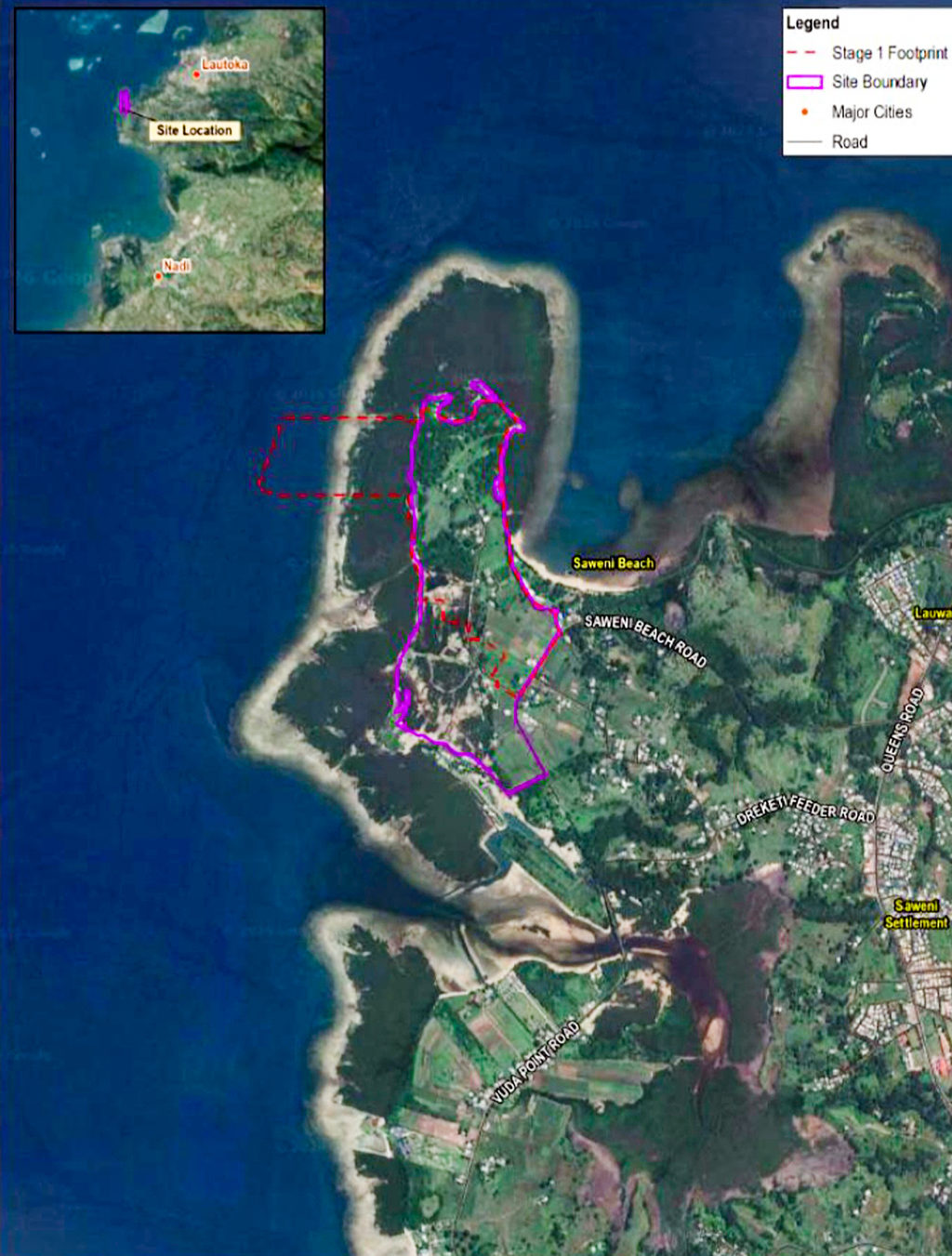
The TNG Holdings Fiji proposal, assessed in an Environmental Impact Assessment (EIA) prepared by GHD and submitted to the Fiji Department of Environment in March this year, is for an 80-megawatt energy-from-waste facility on an 84-hectare site at Vuda Point, approximately 10 kilometres south of Lautoka. The facility would use two 40MW power units to turn up to 900,000 tonnes of non-recyclable rubbish into energy each year. Critically for Fiji’s energy equation, it would run 24 hours a day, seven days a week delivering what solar panels and wind turbines cannot: continuous, weather-independent base-load power. According to the EIA, using Energy Fiji Limited’s latest demand estimates, the facility would generate enough electricity to meet approximately 40 per cent of Fiji’s current national power demand. That’s enough to power hundreds of thousands of homes, businesses and public services across the country. The facility’s design capacity reflects projected long-term waste growth within Fiji. The EIA notes that the facility is capable of operating on domestic and legacy waste streams without reliance on waste imports.
Forty per cent is not a marginal contribution. It would reduce Fiji’s reliance on diesel and make waste-to-energy a key part of the power system instead of just a backup.
If that output were fed into the grid from 2029, as the proponents target, it would represent the single largest step-change in Fiji’s energy security in a generation and it would come from a fuel source that currently costs Fiji nothing: its own waste.
The project is designed to meet strict European emissions standards. It would also connect to Fiji’s national electricity grid through a new substation on-site and a transmission line to the Vuda substation.
The emissions dividend
Beyond keeping the lights on, the project could also cut pollution. The EIA estimates it would reduce greenhouse gas emissions by about 83 per cent compared to the current system of dumping rubbish in landfills and generating electricity from diesel.
The mechanism matters. When rubbish is buried in landfill, it breaks down and produces methane – a gas that traps heat in the atmosphere much more strongly than carbon dioxide. If that same waste is burned at very high temperatures instead, it produces carbon dioxide, which is less harmful, and also generates electricity.
So you get two benefits at once: less methane from landfill, less diesel needed for power.
That combination is what leads to the estimated 83 per cent drop in emissions.
Methane from landfill waste is one of the most powerful short-term gases driving climate change, far stronger than carbon dioxide over the next 20 years.
The project is expected to reduce overall emissions by more than 1 million tonnes of carbon dioxide equivalent each year compared to doing nothing.
The overall emissions reduction claimed for the project is driven largely by avoided landfill emissions.
This distinction is important in how the project is assessed against Fiji’s Nationally Determined Contributions (NDCs), and it will be a key consideration for regulators when evaluating its climate impact. In simple terms, emissions from running the facility would be counted in Fiji’s own national totals under standard carbon accounting rules. But when you look at the full picture – compared with continuing to dump waste in landfills and generate electricity using diesel – the project is expected to significantly cut overall greenhouse gas emissions. This matters for Fiji because its National Energy Policy recognises that relying on diesel makes it harder to meet Paris Agreement obligations. A project that could cut total system emissions by more than 80 per cent is therefore not a peripheral consideration. It is central to the policy case.
Where this fits in the policy framework
Fiji’s National Energy Policy 2023-2030 is built around five pillars: energy security and resilience, energy access and equity, energy sustainability, energy efficiency, and energy governance. The TNG Fiji proposal is directly relevant to the first three.
On security: the facility would produce domestically generated electricity from a fuel source which is waste that is not subject to Singapore spot prices or geopolitical disruption. It would be continuously available, filling the base-load gap that makes Fiji’s grid vulnerable whenever hydro output falls.
On equity: A steady source of electricity that replaces diesel power can help lower the cost of generating electricity, which could ease pressure on power prices for households and businesses. From a climate point of view, if the 83 per cent emissions reduction is achieved, it would make a significant contribution to Fiji’s national climate targets under its Paris Agreement commitments (NDCs).
When announcing Fiji’s $2 billion renewable energy plan in October 2025, former Deputy Prime Minister Professor Biman Prasad was direct: without private sector investment, the country’s renewable targets would not be met within the government’s own timeline.
The TNG Fiji facility, backed by private capital and structured to connect to the national grid, is the kind of investment the policy explicitly requires. The National Energy Policy calls for import taxes on heavy fuel by 2024 and a complete ban by 2030. Energy-from-waste, at scale, makes that ban structurally achievable in a way that intermittent renewables alone currently do not.
A decision with consequences either way
The project is not without legitimate questions. The Vuda Point site carries real environmental, cultural, and community sensitivities that Fiji’s regulatory process is designed to test.
The EIA warns that by 2090, stronger cyclones and rising sea levels could pose serious risks to the site if global emissions stay high.
These are important concerns, not minor ones, because they could affect whether the facility can safely operate long-term and whether the chosen location is suitable. The Department of Environment’s Technical Review Committee will weigh all of it. But the energy problem does not pause for the regulatory timeline.
Every year that Fiji’s grid remains 40 per cent dependent on imported diesel is another year of exposure to commodity markets it cannot control, another year of emissions that undermine its climate commitments, and another year of fiscal pressure from a fuel bill that crowds out spending on health, education, and infrastructure. Energy-from-waste is one possible solution to the base-load power challenge. It is not the only option, but it is one of the few proven technologies that can provide steady electricity at a large scale and be built within a realistic timeframe. Countries such as Germany, Sweden and Denmark use energy-from-waste as part of their energy mix, alongside recycling and renewable energy, because they recognise that renewables alone cannot always provide constant power to a modern electricity system.
Fiji’s situation is more acute than theirs. It is an island economy paying a quarter of its import bill for a fuel it burns to keep the lights on. The question of whether an energy-from-waste plant at Vuda Point is the right solution is a legitimate one. The question of whether Fiji can afford to keep doing what it is doing is not.
Disclaimer: The author is a communications consultant engaged by TNG Fiji to support public
communications relating to the proposed energyfrom-waste project. The views expressed are not necessarily the views of this newspaper.

Cheerieann Wilson

