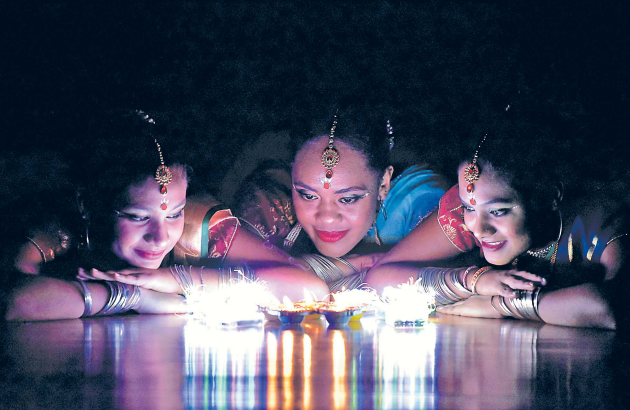
THE smell of burning ghee and the earthy scent of hawan-samagri are etched into my deepest memory. Growing up in Lautoka, I attended an Arya Samaj school. Built on Vedic teachings, its doors were nonetheless thrown wide open. Every Tuesday and Friday, life paused for an early morning havan. Sitting cross-legged, the morning sun illuminated the holy fire.
Looking around, you saw the beating heart of Fiji. My iTaukei, Muslim, and Hindu classmates all participated. We chanted Sanskrit mantras in unison and offered ghee into the flames. Nobody felt compromised. To the iTaukei boy beside me, or the Muslim girl across from me, the fire wasn’t an erasure of identity; it was a shared moment of grace and community.
In the afternoons, while waiting for my brother at Tilak High School, my friends and I would visit a kind neighbourhood lady. We sat on her floor listening to Bible stories — David and Goliath, loaves and fishes — and sang Christian songs. I fed a Hindu holy fire in the morning and listened to Christian parables in the afternoon alongside Hindu and Muslim friends. My young mind never felt torn. I was raised by a village that understood God has many names, and grace isn’t confined to a single building.
This was the wildly multicultural Lautoka of my childhood. During Diwali, plates of barfi were passed over fences to hands of every skin tone. On Eid, we celebrated with Muslim neighbours, and in December, Christmas trees blinked in Hindu, Muslim, and Christian homes alike. We didn’t just tolerate each other; we lived in the warm intersections of each other’s lives. Shielding this utopia were adults who understood the assignment of raising the next generation. My teachers were devout Hindus, strict Muslims, faithful Christians, and unapologetic atheists. Yet, none brought their religion into our education. They treated the classroom as a secular sanctuary where every child was equal.
Today, that lived reality is under siege. It breaks my heart, and it should break yours. We are witnessing the dangerous resurrection of an old ghost: the push to declare Fiji a “Christian State.” This ethno-nationalist rhetoric fuelled the traumas of 1987 and 2000. Seeing it weaponised by politicians and zealots for leverage is not just insulting; it is profoundly dangerous. In our delicate post-dictatorship transition, politicians grasping for relevance are banging the drum of religious nationalism. They prey on indigenous insecurities, falsely equating state secularism with an attack on Christian values, arguing the majority must elevate their religion in the eyes of the law.
It is a lie. It is a manufactured crisis designed to divide a united people. Let us be brutally honest: abandoning secularism to formally adopt a specific religion does not make a country holier. It legally and psychologically reduces every citizen outside that faith into a second-class citizen in the land of their birth. If Fiji becomes a Christian state, what happens to the legacy of that Arya Samaj school? The moment a government places a crown on one religion, it places a boot on the neck of all others. The state suddenly dictates who truly “belongs” and who is merely “allowed to stay.”
I refuse to accept a Fiji where the children from that havan are told their faith makes them lesser Fijians, or where diverse teachers are alienated by the constitution they serve. We must recalibrate our understanding. Religion exists to provide a moral compass and build communities bound by divine love. The government’s role is entirely different: to manage the economy, fix roads, and protect citizens’ rights — including your right to faith, without forcing it upon your neighbour. These entities must remain separate for the survival of both. When politicians twist the words of God to secure votes, they drag faith through the mud of parliament. Conversely, when religious doctrine dictates national policy, democracy dies, replaced by a theocracy where the rule of law yields to dogma.
Do not be fooled by the theatrics. Politicians push this because religion is the easiest primal button for power. When leaders fail to fix the cost of living or solve crime, they throw God to the crowds as a distraction. They frame secularism as a threat, hoping you won’t notice their incompetence. Think of the arrogance required to “protect” Christianity. It has survived millennia; it thrives in the hearts of believers, not through parliamentary bills. Faith is a matter of the soul, not the State.
Secularism is not the absence of religion; it is its ultimate protector. It guarantees the Methodist can sing hymns, the Muslim can answer the call to prayer, and the Hindu can light diyas — all without asking the Government for permission. Fellow Fijians, we must fiercely protect the quiet secularism we have lived and breathed for generations. We are the children who shared lunches, played muddy rugby, and danced at each other’s weddings. We already figured out how to live together; politicians are the ones struggling to catch up. We cannot let them erase the memory of the iTaukei boy throwing ghee into the fire, or the Hindu child drawing Jesus. That is the real Fiji.
When we sing our national anthem, listen to the words:
“Blessing grant, oh God of nations, on the isles of Fiji…”
We do not sing to a sectarian God. We swear allegiance to our country and a shared future that belongs to us all, equally and forever. Let politicians have their games. But let us hold the line with calm clarity. Fiji is a secular state, and it must remain one. Not because we lack faith, but because our faith in each other is far too sacred to let politicians tear it apart.
-ASHNEEL JAYNESH PRASAD is a Fiji-born New Zealand citizen currently working as a teacher in Tokyo, Japan.