
OVER decades, the language of food security has largely been associated with the question of whether we have “enough to eat”.
But here in the Pacific, that is not the only concern.
A country can have food on supermarket shelves, functioning supply chains and access to imported staples, yet still face a serious food security crisis if much of that food is contributing to obesity, diabetes and other non-communicable diseases.
That is the uncomfortable contradiction at the center of Fiji’s food system which was highlighted during Irish politician and former European Commissioner Phil Hogan’s recent visits to the country as he campaigns to become the next director-general of the food and agriculture organisation.
Hogan’s central argument is that the Pacific does not simply need greater food security.
It needs nutrition security.
When having enough food is not enough
The 2025 Fiji STEPS Survey found that 68.2 per cent of adults are overweight or obese, while diabetes affects 16.5 per cent of the adult population.
Almost nine in 10 adults consume fewer than five recommended servings of fruit and vegetables a day.
These are not merely health statistics but are also evidence of how Fiji’s food system is changing.
Traditional foods such as dalo, cassava, yam, breadfruit, vegetables and locally caught fish have increasingly competed with imported and highly processed foods.
The problem is not that Fiji has suddenly forgotten how to grow food.
It is that the economic incentives surrounding food can make the less nutritious option easier, cheaper and more convenient.
This is where Hogan’s argument deserves attention apart from his FAO campaign.
“Fiji does not lack calories. It lacks nutrition,” he said.
That may be a simple line, but it captures a complicated policy problem.
The economics behind what ends up on the plate
Fiji’s own agricultural figures tell part of the story.
In 2023, the country imported about $1.106 billion worth of crop and livestock products while exporting only $343.4 million.
The trade imbalance is usually discussed in terms of agriculture, foreign exchange and economic resilience.
But more importantly, it should also be discussed in terms of health.
If a country becomes increasingly dependent on imported food while simultaneously seeing traditional diets displaced by processed alternatives, food policy can no longer be separated neatly from public health policy.
So, what kind of food system are we trying to build?
The government’s Non-Sugar Agriculture Sector Policy 2025-2035 already recognises the need to increase domestic production and reduce dependence on imports.
More recently, the government’s Horizon 2030 National Food Systems Pathway has framed food production as part of a broader economic development strategy.
But increasing production alone will not solve the problem.
Fiji could produce more food and still have an unhealthy population.
The more difficult task is to ensure that what is produced, imported, sold and consumed contributes to better nutrition.
Consumers do not make choices in a vacuum
That requires policymakers to confront that reality that consumers do not make food choices in isolation.
Prices, availability, advertising, school environments, household income, transport, storage, and the ability of farmers to consistently supply markets, are all factors that matter immensely.
The 2025 STEPS Survey itself recommends stronger policies to promote healthy eating and reduce imported, processed and unhealthy foods, including measures involving food marketing, labelling, trade and fiscal policy.
This is why the debate should not be reduced to telling people to “eat healthier”.
It is difficult to tell a family to choose fresh vegetables when the healthier option costs more, is not consistently available and requires more time to prepare.
Nor is it enough to tell farmers to produce more when they face unreliable markets, inadequate infrastructure, seasonal constraints and competition from imported food.
Food security therefore sits somewhere between agriculture, health, trade, climate policy and household economics.
The climate question cannot be separated from food
That is particularly true in the Pacific.
The region’s food systems are uniquely exposed to climate change.
Rising seas threaten agricultural land, changing weather patterns disrupt production, cyclones destroy crops and infrastructure, while warming oceans affect fisheries.
For many Pacific communities, the ocean is not simply an environmental asset.
It is a supermarket, workplace and source of cultural identity.
That makes climate resilience inseparable from food security.
During Hogan’s second visit to Fiji, around the Pre-COP31 meetings he added another dimension to his argument.
His proposal to put farmers, fishers and communities at the centre of FAO programmes reflects a wider question about how international institutions engage with small island states.
Too often, the Pacific is approached as a recipient of expertise.
But Pacific communities already possess generations of knowledge about farming, fishing, weather patterns, food preservation and resource management.
The challenge is not to choose between traditional knowledge and modern science.
It is to find ways of bringing the two together.
Trade should strengthen, not weaken, local food systems
There is also a lesson here for international trade.
The Pacific cannot realistically become completely self-sufficient in food.
Geography, economies of scale and vulnerability to natural disasters make reliable imports essential.
But dependence and resilience are not the same thing.
Imports should help fill gaps in domestic production rather than undermine the capacity to produce nutritious food locally.
That distinction will become increasingly important as climate change makes global supply chains more vulnerable.
What should the Pacific expect from global food leadership?
The Pacific therefore has a legitimate reason to ask what global food institutions mean when they talk about food security.
Is success measured simply by whether calories are available?
Or should success increasingly be measured by whether people can afford and access nutritious food, whether farmers can earn sustainable incomes, whether fisheries remain productive, whether traditional food systems survive and whether communities can withstand climate shocks?
The second definition is much harder.
But it is also much closer to the reality facing Fiji.
Hogan is seeking to lead an organisation whose members will elect its next Director-General in 2027, alongside other candidates.
His campaign will ultimately be judged by all FAO members, not by the Pacific alone.
But his visits have nevertheless put an important issue on the table.
The opportunity for Fiji is not simply to listen to another international candidate make promises.
It is to articulate what the Pacific expects from global food leadership.
The region needs investment that reaches farmers and fishers, climate finance that reaches communities, trade rules that do not make nutritious food inaccessible, and agricultural policies that recognise health as part of food security.
Most importantly, it needs to stop treating food, agriculture, health and climate as separate policy conversations.
The dalo farmer, the fisher, the market vendor, the child eating lunch at school and the patient in a hospital ward are all part of the same food system.
That may ultimately be the most important lesson from Hogan’s Pacific campaign.
Food security in the 21st century cannot simply mean ensuring that people have something to eat.
It must mean ensuring that what they eat allows them to live healthy lives, that the people producing it can sustain their livelihoods, and that the systems providing it can survive the climate pressures ahead.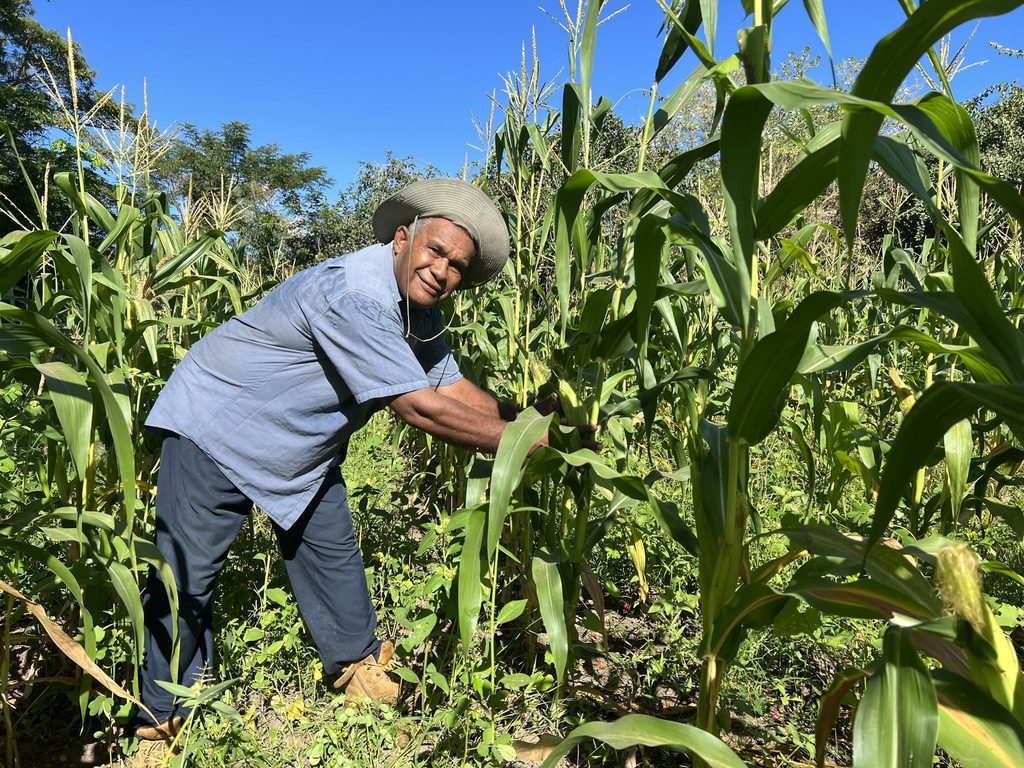
Hogan argues that Pacific nations should be concerned not only with whether people are eating enough, but whether they are eating the right kinds of food. Picture: SEED COMPANY OF FIJI

