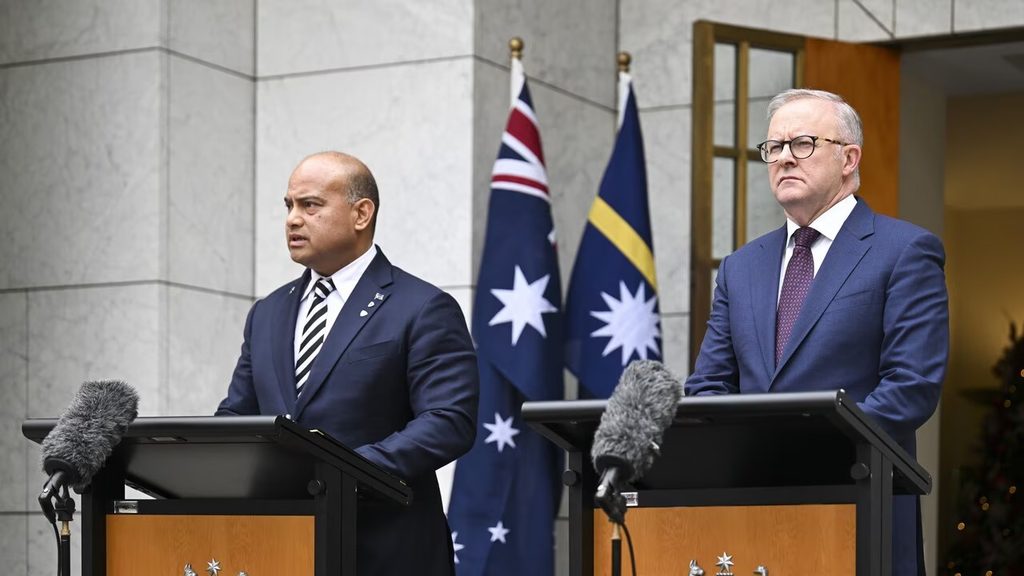
THE concerns and arguments relating to Australia’s offshore processing policy have often been framed around border protection, deterrence and regional security.
Less attention, however, has been paid to another issue that sits at the heart of democratic accountability, which is, how easily can journalists, civil society organisations and the public scrutinise what happens in one of Australia’s closest Pacific partners?
This question has resurfaced following the latest assessment by CIVICUS (World Alliance for Citizen Participation), which revealed that Nauru continues to maintain restrictions that limit media freedom and freedom of expression, even as Australia deepens its financial and strategic partnership with the island nation.
The issue here is not whether Australia should support Nauru.
Few dispute that Canberra has legitimate strategic interests in the Pacific or that Nauru, as one of the world’s smallest and most isolated nations, requires significant external assistance to maintain essential public services.
Rather, the fundamental concern is whether a country investing hundreds of millions of taxpayer dollars into another jurisdiction should also expect a level of transparency that allows those investments to be independently scrutinised.
The information gap
CIVICUS’ concerns extend beyond the treatment of asylum seekers.
The organisation argues that Nauru continues to reject key reforms aimed at strengthening civic space, including reducing the prohibitively high visa fees imposed on foreign journalists, decriminalising defamation and creating conditions for a more independent media landscape.
It also noted that all journalists are employed by the state-run Nauru Media Bureau, limiting the diversity of independent reporting. Nauru’s civic space continues to be rated as “Obstructed”.
Taken individually, each concern may appear to be a domestic governance issue.
Collectively, however, they raise a broader question.
Can independent scrutiny meaningfully exist when access for foreign journalists remains difficult, criminal defamation laws continue to exist, and independent media institutions remain limited?
For democratic societies, journalism performs a function beyond simply reporting events. It enables accountability by providing citizens with independently verified information about how governments exercise power and spend public money.
When those mechanisms become constrained, scrutiny inevitably becomes more difficult.
Australia’s financial stake
Australia’s relationship with Nauru is unlike that of most donor-recipient partnerships.
For more than a decade, Canberra has funded offshore processing on the island while simultaneously providing broader development assistance and direct budget support under an expanding economic, social and security partnership.
The relationship has grown beyond migration policy into one encompassing policing, infrastructure, banking, health, governance and regional security.
Australian governments have consistently argued that such assistance supports stability, development and resilience in the Pacific while helping maintain regional security amid increasing geopolitical competition.
These objectives are reflected throughout DFAT’s Pacific engagement policies and Australia’s official development assistance framework.
Canberra also maintains that Nauru, as a sovereign state, determines its own domestic laws and institutions, and that Australia cannot dictate internal legislative reform.
These are legitimate policy positions.
Yet sovereignty does not necessarily remove legitimate questions about accountability when substantial public funds are involved.
Transparency and taxpayer accountability
Successive parliamentary inquiries, legal experts and oversight bodies have repeatedly examined Australia’s offshore processing arrangements.
Among the recurring themes are transparency, value for money, parliamentary oversight and public accountability.
The current Senate inquiry into offshore processing arrangements, for example, is examining issues ranging from expenditure and contractual arrangements to transparency surrounding agreements with Nauru.
The Law Council of Australia has similarly argued that greater transparency and independent monitoring are necessary, including publication of key agreements to enable effective parliamentary scrutiny.
Recent reporting has also highlighted the scale of Australia’s financial commitment.
Despite expenditure amounting to hundreds of millions of dollars annually, advocates continue to argue that independent verification of conditions on the island remains difficult because of limited media access.
The relationship between transparency and accountability is not unique to Nauru.
Across democratic systems, governments are generally expected to demonstrate not only that public money is spent lawfully, but that sufficient independent oversight exists to allow citizens to evaluate whether public objectives are being achieved.
Why media freedom matters
This is where media freedom becomes more than a human rights issue.
It becomes a governance issue.
Restrictions on journalists do not simply affect news organisations.
They affect the broader ecosystem through which governments are held accountable.
Independent reporting allows taxpayers, parliamentarians and civil society to test official narratives against observable evidence.
Without that capacity, much of the public understanding of offshore processing relies on government statements, court proceedings or reports produced by advocacy organisations rather than sustained on-the-ground journalism.
That does not necessarily mean official accounts are inaccurate.
It does mean opportunities for independent verification become significantly narrower.
For Australia, this presents an uncomfortable paradox.
Canberra has long promoted democratic governance, transparency, accountability and media freedom as central pillars of its foreign policy across the Indo-Pacific.
At the same time, one of its closest operational partnerships continues with a country that international organisations argue maintains significant restrictions on media access and freedom of expression.
The apparent inconsistency has become a recurring point raised by organisations including CIVICUS, the Australian Human Rights Commission, Amnesty International and Human Rights Watch, all of which argue that Australia’s influence carries responsibilities extending beyond financial assistance.
A broader regional question
None of this suggests Australia should abandon its partnership with Nauru.
Nor does it imply that Australian funding is responsible for Nauru’s domestic media laws.
Rather, it poses a more nuanced policy question.
Should Australia’s significant financial, diplomatic and strategic influence also be used to encourage reforms that strengthen transparency, media freedom and independent oversight?
Governments routinely attach expectations to development partnerships in areas such as financial management, anti-corruption measures and institutional strengthening.
Whether media freedom deserves similar prominence is becoming increasingly difficult to ignore.
In the Pacific, where geopolitical competition is intensifying and democratic resilience has become a recurring policy objective, the credibility of governance partnerships may increasingly depend not only on the amount of assistance provided, but on whether those partnerships also reinforce the openness and accountability that democratic governments publicly champion.
The debate now is ultimately no longer centred solely on the issue of offshore detention; in fact, it is more about whether independent scrutiny can be carried out across the borders where public policy is being implemented.
This analysis draws on the latest CIVICUS Monitor assessment of civic space in Nauru and the country’s 2025 Universal Periodic Review outcomes before the United Nations Human Rights Council. It also references Australian Government and parliamentary sources, including the Department of Foreign Affairs and Trade’s Pacific and Official Development Assistance policy documents, the Department of Home Affairs, the Australian National Audit Office, and the Senate Legal and Constitutional Affairs Committee’s inquiry into offshore processing arrangements. Additional context is drawn from reports and submissions by the Australian Human Rights Commission, UNHCR, the Law Council of Australia, Amnesty International, Human Rights Watch, Reporters Without Borders and the Committee to Protect Journalists, as well as analysis by the Lowy Institute and the Australian Strategic Policy Institute on Australia’s Pacific engagement, regional security and governance.