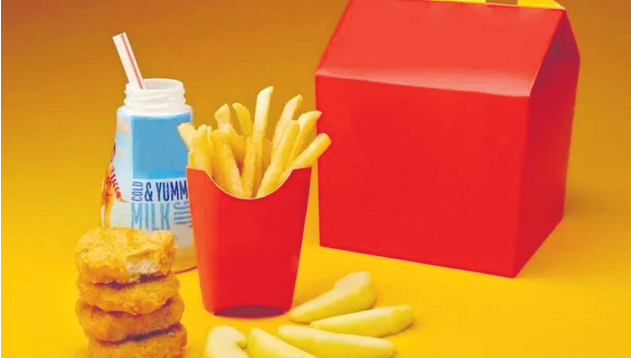
Recently, I ordered McDonald’s for my nephew, Aarav. It was not a small order either – nuggets, wings, filet-o-fish, burgers, and fries. It was the sort of lazy afternoon feast we pretend is for the child, even though the adults circle the brown paper bags with equal interest. Aarav was busy digging through his Happy Meal box, far more excited about the plastic toy than the food, when I reached in casually to take a single nugget. But the moment I bit into it, something shifted. The crunch, the warmth, that unmistakable McDonald’s taste – not quite chicken, not quite memory, but somehow both – pulled me back without warning. Suddenly, I was no longer an adult watching my nephew eat, nor the kaka who could now order without counting coins. I was gone, thrust back into a version of myself I thought I had long outgrown.
I WAS back in Fiji at Arya Samaj Primary School, around 2004 or 2005. I was small again — all bones, elbows, knobby knees, and oversized Bata shoes that made every child look like they were walking into a future too big for them. My midday lunch was simple: Bhindi roti wrapped tightly in foil, sweating slightly and smelling of home, oil, turmeric, and my mother’s hands. That morning, before I left for the school trip, mum had pressed a 50-cent coin into my palm. To some, that is loose change forgotten at the bottom of a handbag. But to me, it was treasure. My mother gave it with the seriousness of someone giving everything she could, and I took it with the faith of a child who believed his mother’s abundance was real, checking my pocket throughout the day just to ensure it was still there.
Back then, McDonald’s was not ordinary. It was not a quick dinner after a long day or casual background noise; it was an event. There was only one McDonald’s in our world — in Namaka, Nadi — and even the name sounded foreign and glamorous, as if America had opened a tiny golden window in Fiji that children like us were lucky enough to stand outside and look into. When our teacher asked the bus driver to stop there on the way back from our school trip, the stop alone felt like luxury. But as the bus pulled in, we became different children: hungrier, quieter, and acutely aware of our uniforms, our lunch boxes, our coins, and our homes. We immediately knew who could walk inside and order, and who could only stand there breathing in the smell of fries, ketchup, and hot oil. It was not just food; it was another kind of wealth.
Inside the glowing restaurant stood a boy from a polished home. Every school has one — the child who never seemed worried, whose shoes were always clean, and whose family supposedly owned convenience stores or half of Lautoka. We did not know the economic facts, but children understand hierarchy. We knew who got picked up in nice cars and who never had to pretend they were not hungry. Quiet but confident, he reached into his pocket and pulled out a crisp ten-dollar bill. At that age, a $10 note looked like adult money, wedding-envelope money, or grocery money. As the class paused and the teacher blinked, he walked up to the counter and ordered nuggets with absolutely no hesitation, no counting coins, and no quiet shame. He ordered what he wanted because the world had already taught him he could.
Pride always came before hunger for me, and that day I had plenty of both. My 50 cents could buy nothing inside that golden building, so I did what many children from ordinary homes learn to do early: I pretended I did not want anything. That is one of poverty’s first lessons. It is not just the lack of things; it is the art of pretending. Pretending you are full, pretending you do not like what you cannot afford, and pretending your stomach is not louder than your pride. You pretend because sometimes pretending is the only dignity a child can afford. Back on the bus, I ended up sitting across from him. He opened that McDonald’s box slowly, and in my mind, he peeled it open like a chest of gold as steam rose and filled the bus. He and his entourage began eating – nugget after nugget, laugh after laugh. I did not look directly, but the scent told me everything. I sat there with my bhindi roti in my bag and my 50-cent coin in my pocket, feeling a complicated childhood mixture of hunger, shame, longing, and hope roaring inside me. I wanted just one. Not the whole box, just one small piece of that world. I kept telling myself that if I were him, I would offer one, because that is what kind people do. Perhaps that was unfair; he was just a boy eating his lunch, not a symbol of structural inequality. But children do not understand economics; they understand the quiet violence of being close enough to smell something, but not close enough to taste it.
Then, there was one nugget left. The last piece sat there like a test neither of us knew we were taking. He paused, looked around, and his eyes flickered in my direction. I held my breath. That is the part that still embarrasses me — not the hunger, which is human, but how openly I hoped. My fingers clenched, and a desperate part of me became ready to be noticed and included. He looked at the nugget, looked at me, and then, like a scene cut too quickly, popped it into his mouth. Clean. Gone. I swallowed my pride and my hunger at once, and though the bus moved on, a part of me stayed there with that empty box.
Years have passed, and I do not know where he is now or if he even remembers that bus ride. For him, it was probably just nuggets, but for me, it became a time capsule. Adults think children forget things because they stop talking about them, but they don’t; they store them in the body, the throat, and the quiet corners of memory where a single taste 20 years later can unlock everything. It was never really about the food. It was about the first time I understood how small a child can feel in a world that teaches difference early — where some children learn abundance as a birthright, and others learn gratitude so early it becomes a survival skill.
This is the part that hurts most as an adult: My mother did nothing wrong. That 50 cents was not a failure; it was love, sacrifice, and her way of making sure I did not go empty-handed. But society has a cruel way of making a child compare love with money. A mother’s hand can press a coin into your palm with all the tenderness in the world, and still, by noon, the world can make you feel poor. That is the true wound — the education of lack and the quiet ranking of children before they even know what social class means.
We like to romanticise childhood, laughing about eating roti and bhuja, walking barefoot, and sharing one ice block among cousins. There was beauty and resilience in that, but not everything poor children endure should be turned into nostalgia. Some of it was painful, teaching us to observe rooms before entering them and prices before desire. Some of us became adults who still check the right side of the menu first and feel guilty ordering extra – adults who buy too much food for the children in our lives because a small boy inside us is still sitting on a bus, hoping someone will offer him a piece.
Watching Aarav eat recently, unaware of the memory he had unlocked, I realised he does not know that a McDonald’s bag can carry more than food. For some of us, being able to order “the works” is not about showing off; it is about healing, about overfeeding a younger version of ourselves who once learned to say “I’m OK” when he was not. Children are always collecting evidence of love, neglect, fairness, and whether the world is generous or mean. That is why the small things matter. One nugget, one kind word, or one adult noticing a quiet child can stay with them forever. So can the absence of it. I am not angry at that boy anymore; he was a child too, shaped by his own comfort. This is simply about remembering what it felt like to be on the other side of the box, and asking what kind of adults we become when we forget those children. Do we eat the last nugget without looking around, or do we notice the quiet child whose hunger has learned manners?
That day, I bit into a nugget and travelled 20 years. Food feeds the body once, but it feeds memory forever. The world does not become softer through grand speeches or polished ideas about compassion; it becomes softer when someone looks at the last piece, sees another person’s longing, and says, “here, you have it.” Just one act, just enough to tell a child: I see you.
n ASHNEEL JAYNESH PRASAD is a Fiji-born New Zealand citizen working as a teacher in Shinagawa-ku, Tokyo, Japan.