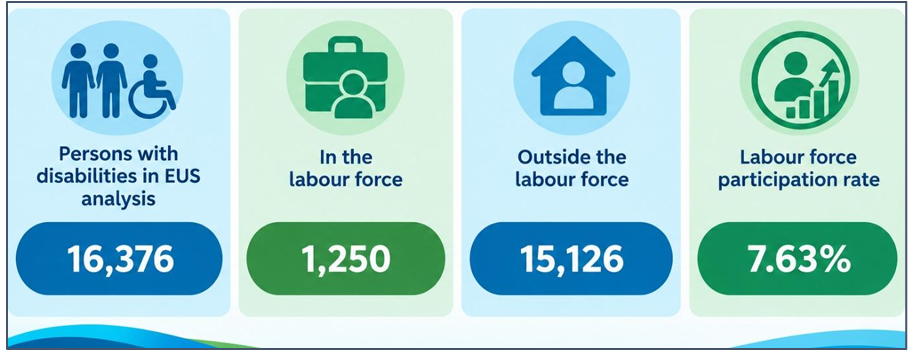
Only 7.63 per cent of persons with disabilities covered in Fiji’s 2023–2024 Employment and Unemployment Survey were participating in the labour force, according to figures released by the Fiji Bureau of Statistics.
The findings, published in the bureau’s Fiji’s Social Trends: Miscellaneous 2021–2025 report, highlight the low level of labour force participation among persons with disabilities.
The survey recorded 16,376 persons with disabilities, of whom only 1,250 were in the labour force, while 15,126 were outside it.
This means more than nine out of every 10 persons with disabilities identified in the survey’s analysis were not participating in the labour force.
The bureau cautioned that these figures relate specifically to the population and definitions used in the Employment and Unemployment Survey and should not be interpreted as a national disability count covering all age groups.
The report also highlighted functioning challenges among children.
According to the 2021 Multiple Indicator Cluster Survey, 8.8 per cent of children aged between two and 17 years experienced functional difficulties in at least one area of everyday activity.
Among children aged five to 17 years, the proportion was slightly higher at 9.4 per cent.
The bureau explained that the two age groups overlapped and their percentages should not be added together.
It said information on functioning challenges was important for inclusive planning in education, employment, healthcare and social services.
However, the bureau warned against directly comparing the findings of the two surveys because they covered different population groups, reference periods and purposes.
The report also examined Fiji’s linguistic diversity, revealing that approximately 95 per cent of Fiji nationals were bilingual.
English serves as the shared formal language between ethnic communities, while iTaukei and Hindi are also taught in schools.
The report noted that most indigenous Fijians speak iTaukei as their first language, with the Bauan dialect being the most widely spoken.
Fiji Hindi is the most commonly used language among Indo-Fijians, while Gujarati, Urdu, Tamil, Telugu and Gurmukhi are also spoken within the community.
Using the 2017 census population of 884,887, the bureau reported that indigenous Fijians accounted for 62.8 per cent of the population, Indo-Fijians 32.7 per cent and other ethnic groups 4.5 per cent.
The bureau said Fiji remained strongly multilingual, with its two main ethnic communities maintaining their vernacular languages while English provided a common means of communication.
It emphasised that the functioning figures from 2021 and 2023–2024 were separate survey reference points and should not be treated as annual estimates or evidence of a trend over time.