
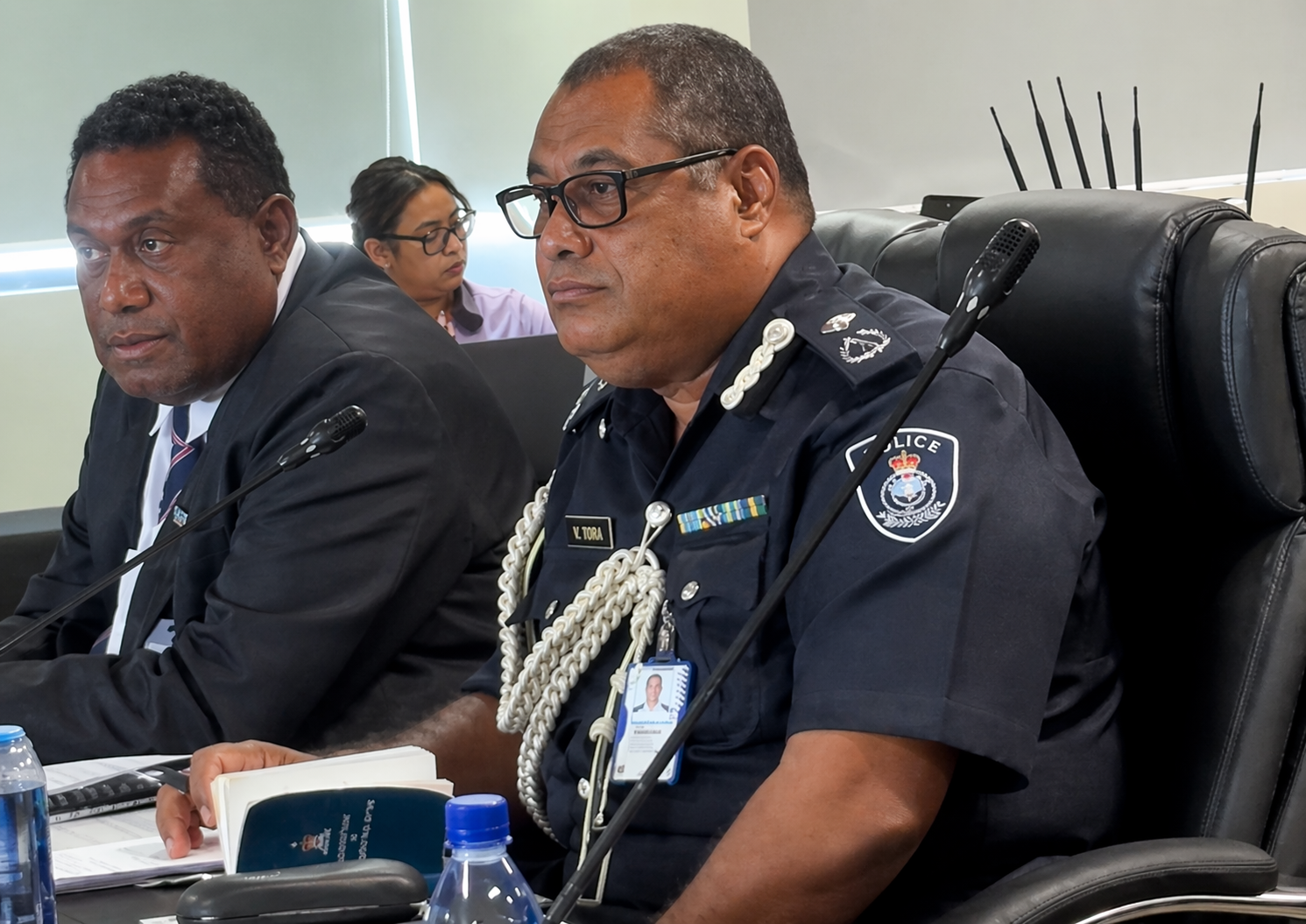
POLICE officers should undergo mandatory drug testing to ensure a sober, disciplined force and restore public trust in law enforcement.
Acting Assistant Commissioner Police (AACP) Planning, Research and Doctrine Viliame Soko said current constitutional protections were limiting their ability to detect and address drug use within their ranks.
Speaking before the Constitution Review Committee (CRC), Mr Soko said existing internal policy required officers to give consent before undergoing drug testing.
This requirement stems from Section 11(3) of the 2013 Constitution, which guarantees every person “the right to freedom from scientific or medical treatment or procedures without an order of the court or without his or her informed consent…”
He described this as a “significant challenge,” noting that officers could refuse testing making enforcement administratively difficult and legally fragile.
“The legal impasse is administratively impossible and legally fragile,” Mr Soko said.
“We propose amending the constitutional provision to allow mandatory medical testing for members of the Fiji Police Force and other disciplined services.”
Under the proposal, such testing would be conducted within strict regulatory safeguards to ensure privacy, procedural fairness, and accountability, while being justified on the grounds of public order, national security, and maintaining the integrity of the force.
Mr Soko stressed that the amendment would not remove individual rights but rather balance them against the broader public interest.
“The right of an individual officer must be weighed against the right of a detainee to be protected by a sober, disciplined, and reliable police force.”
However, CRC member John Fatiaki suggested an alternative approach that mandatory testing could instead be implemented as a condition of employment, rather than requiring constitutional change.
Dr Fatiaki pointed to practices in high-risk professions such as aviation where employees were subjected to compulsory testing as part of workplace safety requirements.
He said employers could require informed consent at the point of hiring, making drug testing a condition for holding the position, particularly in occupations where impairment posed significant risks.
“I think existing provisions under employment law may already allow for such measures where safety is a concern,” he said.
Police propose tweak in legislation for ‘use of force’
PUBLIC mistrust over perceived excessive force has prompted the Fiji Police Force to propose a
constitutional amendment to clearly define when and how officers can use force.
Acting Assistant Commissioner of Police Planning, Research and Doctrine Viliame Soko told the
Constitution Review Commission (CRC) that while the 2013 Constitution guaranteed fundamental rights
such as the right to life and freedom from inhuman treatment, it did not explicitly outline the thresholds
for use of force by officers.
Instead, these are largely governed by provisions in the Police Act and internal administrative standing
orders, which he said could be inconsistently interpreted in court.
Mr Soko said the proposed amendment would “quantify the principles of necessity and proportionality” within the Constitution, ensuring that force was only used when required and to the extent justified by the situation.
“The State holds a monopoly on the legitimate use of force to maintain public order and protect the lives of its citizens,” he said.
“Clearer constitutional standards would protect both officers and the public.”
Under the proposal, police or any authorised person would be permitted to use force that is “reasonably
necessary and proportionate” for purposes such as making an arrest, preventing escape, protecting
individuals from violence, or suppressing serious crime or unrest.
Lethal force, the submission states, would only be justified in situations involving an immediate threat
of death or serious injury.
Mr Soko stressed that elevating these rules into the constitution would create a uniform legal
benchmark, reduce hesitation in high-risk situations, and improve accountability through clearer standards for judicial and internal review.
CRC member Conway Begg said concerns about the perceived misuse of force continued to shape public
opinion, noting that mistrust remained a key issue.

