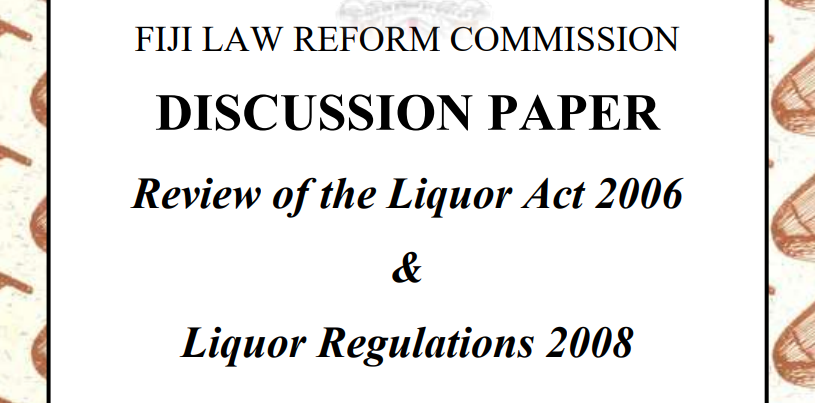
The Fiji Law Reform Commission has released a discussion paper proposing sweeping administrative reforms to Fiji’s liquor licensing framework, with the aim of creating a simpler, more consistent and efficient licensing system.
The review, undertaken in collaboration with the Ministry of Commerce and Business Development, follows longstanding concerns from government agencies and private sector stakeholders, particularly those in the tourism and hospitality industries, about the complexity and inconsistency of the current licensing regime.
According to the discussion paper, liquor licence applications and annual renewals remain overly complicated, with procedures, documentation requirements and fees differing across Fiji’s three divisional licensing authorities. The lack of standardised processes has created confusion, delays and increased compliance costs for businesses.
The paper notes that applicants may currently be required to submit up to 17 supporting documents, with applications still processed in hard copy and often requiring multiple physical submissions due to the absence of a comprehensive online licensing system.
Among the proposed reforms are the standardisation of documentary requirements nationwide, the removal of duplicated documents, the introduction of online applications, digital payments and application tracking, as well as greater use of electronic approval processes for routine applications.
The discussion paper also calls for a review of liquor licence fee structures to improve transparency and consistency. It notes that while licence fees prescribed under the Liquor Regulations 2008 have not been charged since a 2010 government decision, the absence of formal clarification has created uncertainty within the private sector regarding potential recovery of arrears.
The overarching objective of the review is to establish a simplified, standardised and efficient liquor licensing system that reduces administrative burdens, enhances transparency and supports private sector investment, particularly within Fiji’s tourism industry.
The Commission is inviting feedback from stakeholders on key reform proposals before preparing draft legislation and a draft Cabinet paper, with its final report expected by 30 October 2026.