
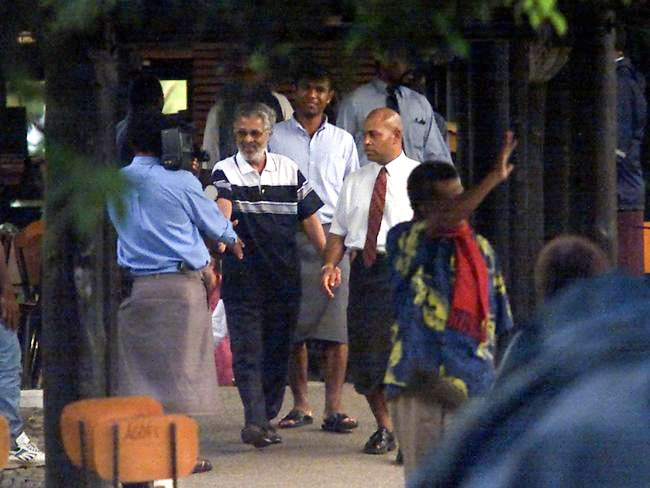
26 years down memory lane!
The coup of May 19, 2000, was one of the darkest times in Fiji’s history. Twenty-six years down memory lane, images come to the fore as an armed group invaded Parliament and held hostage the then prime minister, Mahendra Pal Chaudhry, his Cabinet, and other members of Parliament. The group was supported by rebel soldiers and led by George Speight. A wave of rioting and looting shook Suva to the core. Scared bystanders watched in horror as people made their way with the stolen stuff. Several attempts were made to negotiate the release of the hostages and on May 28 Chaudhry was removed from office by then-president the late Ratu Sir Kamisese Mara due to his inability to govern while being a hostage. Commodore Frank Bainimarama declared martial law, and the Republic of Fiji Military Forces abrogated the 1997 Constitution. The hostage crisis ended on July 13, when the hostages were released in return for concessions. The rest is bitter history. As a Year 13 student at Labasa College, I felt the full brunt of the coup that was one of the darkest times in the lifetime of many people. Race relations worsened and Indians were tortured. Another wave of migration crippled Fiji’s economy. As I reflect on the dark days, I pray for Fiji’s safety. I pray that unity and healthy race relations take charge! RAJNESH ISHWAR LINGAM Nadawa, Nasinu
Women in politics
As our leaders debate national priorities for the upcoming budget, we must confront a glaring democratic failure: why is it that we still have very little women in the Fijian Parliament? Holding less than 10 per cent of parliamentary seats, women are effectively locked out of our nation’s highest decision-making body. This is a national crisis, not a minor issue. This severe under representation is not because of a lack of capable women, but rather a political system rigged by patriarchal gatekeeping, unequal campaign funding, and hostile public spaces. We cannot claim to be a true democracy when half of Fiji’s population has no voice in shaping laws on healthcare, inflation, or economic recovery. Political parties must stop giving empty promises and immediately enforce mandatory gender candidate quotas. Our Parliament must reflect our society. True national progress is impossible until women have an equal seat at the table. Patricia Mateiwai USP Laucala Campus, Suva
Drugs escalation
The more the drugs puzzle gets solved, the more it arises. The escalation rate is high. It’s hard to tell if it is coming or going. However, no doubt our hard-working law enforcers are tackling the issue and deserve the accolades but where are we going wrong? Imagine what this nation would have been right now if the so-called casino was being built which was a suggestion by a great mind who I believe is deciding to stand in the upcoming elections. Lucky that dream didn’t see the light of the day. There are many things Fiji is not ready for yet and a casino is one. Kirti Patel Lautoka
Losing our farmers
We are losing our farmers fast. Two key reasons are access to land and the younger generation are gravitating towards white collar jobs. We need to entice the next generation of farmers in the country. Few things we can do to secure our future food supply. One, compulsory agricultural studies till Year 12. Two, full scholarship for tertiary agricultural studies. Should include modern farming techniques and the business skills to export produce. Three, government to sublease 10 acres of farmland to agricultural graduates at zero cost for at least 5 years with expiry after 50 years. This is paramount. This is better than handouts. This is more important than a new constitution. Kiran Khatri Samabula, Suva
Trash talk
We are told that the $40 litter fine that has never worked, will be increased to $200. The hike is aimed at scaring the litterbugs. It is probably going to be a good revenue earner, potentially grossing higher than the vehicle and driver fines. I mean, we undoubtedly have more litterbugs than motorists. Just look around, and one will see the trash on the roadsides after a fresh round of grass mowing. Look at those frequently flooded drains: diapers, food packaging and other household refuse all getting swept onto the road pavement. Even those open tray garbage trucks spill high volumes of rubbish on the road. We have become so accustomed to seeing rubbish strewn around that now we have started to believe it is part of our society. Yes, littering has become a culture. It’s no longer a bad habit. On an afternoon last weekend, I was shocked to see the amount of rubbish lying right in front of a prominent supermarket at a very prominent plaza. I took a picture of the scene. My wife thought I was overreacting. Didn’t I say we are so accustomed to seeing rubbish thrown casually? Anyway, I waited for some ten minutes to see if someone in a supervisory role would get someone to collect the trash. Didn’t happen. The trash had apparently been there and increasing since the morning, right! The stray dogs had eaten the edible ones though. The $200 fine, whether it works on the people or not, the fine issued to commercial operators should be in the thousands. Maybe then they will give a garbage can about it! Donald Singh Nausori
Pipeline and timeline
When any government comes into power, they always have certain projects forecasted to be done or completed within their term. While they draw up their new project plans, incomplete projects from the previous government are also on the table for them to complete. Some of these incomplete projects have been within the project pipeline for too long with no end in sight and it is always a burden to investigate what went wrong for the said project not reaching its end state. Now as we are about to go into another general election, I believe some forecasted projects for this current Government are still within the project pipeline. The fuel crisis, cost of living plus other financial challenges have put this Government in a tight spot. All promises made via the manifesto before winning the elections are yet to be fully fulfilled, therefore, the project pipeline and timeline are still open. Whether it be a short, medium or long term projects, the voting public should be made aware of such challenges. As the saying goes, only time will tell us and your guess is as good as mine. Juki Fong Chew Nadawa, Nasinu
Any resemblance?
Do you think there is any resemblance between idle fertile land and the population which is totally capable of being in employment but choose otherwise? Mohammed Imraz Janif Natabua, Lautoka
What is Plan B?
So after more than half a century of holding the electricity supply monopoly in Viti, Energy Fiji Limited still do not have a contingency plan if there is a fuel crisis even though they are fully dependent on diesel-powered generators to meet our electricity demand. Unbelievable eh? Sobo! Wise Muavono Balawa, Lautoka
Municipal elections
Rabuka: Cabinet has final say on municipal elections (FT 20/5/26). I believe what the ordinary people of Fiji want to know is when will the people have a say? When will democracy at the local community level be restored? What was the Rabuka government’s promise about holding local council elections? How come the Rabuka gang in government so swiftly reinstated the elitist GCC so soon after coming to power? What has been the priority of Rabuka’s “people-centred government?” Rajend Naidu Sydney, Australia
Australian obligation
Daniel Urai is absolutely correct when he says Australia has an obligation to assist Fiji. Australia is a member of the Commonwealth of Nations. Although we ask the question, “when was the wealth common”, Australian companies and banks have made billions of dollars out of Fiji from the days of colonialism. Rakesh Chand Sharma Nadi
Race against time!
Tough times loom ahead. Prime Minister Sitiveni Rabuka shared that the Coalition Government was racing to avert possible nationwide power rationing as it worked with Energy Fiji Limited (EFL) ahead of tomorrow’s critical deadline. PM hinted at power rationing, citing it as a last resort but acknowledging that it may be necessary, adding Fiji’s hydro and growing solar capacity could help manage demand if carefully structured. I urge Fijians to prepare well for whatever that could unfold! Rajnesh Ishwar Lingam Nadawa, Nasinu
Polls and minimum wage
Local elections must proceed
Prime Minister Sitiveni Rabuka has revealed that local government elections scheduled for September this year may not proceed due to budget constraints, the fuel crisis and other challenges. On the other hand, Finance Minister Esrom Immanuel recently and confidently stated that “government finances are well” and that $5million has already been allocated for both the local government and national elections. One now wonders whether Rambo is even “aware” of his own Finance Minister’s statement. Nonetheless, come what may, these local government elections must go ahead. Fiji cannot continue having unelected special administrators running our towns and cities indefinitely while democracy is conveniently placed on hold every few years. And if the Coalition Government is truly in financial strife, perhaps they can simply grab a begging bowl and “kerekere” some funds from abroad, something they seem to have mastered rather well over the years. Nishant Singh Lautoka
Wages and poverty
Mr Jamnadas is correct that he is not an economist. His bread example demonstrates precisely that. He proposes that if wages rise from $1 to $10 per hour — a tenfold increase — the price of bread rises from $2 to $14–$15. This arithmetic collapses under elementary scrutiny. Labour is one input cost among many. In most food production and distribution businesses, direct labour represents between 20 and 35 per cent of total cost. A tenfold increase applied to a 25 per cent labour share raises total costs by approximately 225 per cent on the labour component alone — not by 600 to 650 per cent as his example implies. The remaining 65 to 80 per cent of production costs — raw materials, freight, utilities, rent, capital — does not move with wages. His bread would cost closer to $3.50 to $4.50, not $14. The difference between his figure and reality is the space where low-wage employer interest operates. The productivity-first argument has a longer record than Mr Jamnadas acknowledges. Fiji’s minimum wage was suppressed for 16 consecutive years — from 2006 to 2022 — during which period the productivity gains that this argument promised failed to materialise. Workers who cannot afford adequate nutrition, healthcare, or their children’s education do not become more productive. Poverty wages produce exactly the low-productivity workforce the productivity-first school then uses to justify continued poverty wages. It is a closed loop designed to remain closed. The international empirical record is unambiguous. Australia, New Zealand, and the United Kingdom have all implemented staged minimum wage increases well above productivity growth rates in the same period. None experienced the export collapse, business closure cascade, or consumer price explosion that the productivity-first school consistently predicts and consistently fails to deliver. Fiji’s tourism, water, and primary agricultural exports are not price-sensitive to domestic minimum wage in the manner Mr Jamnadas implies. I documented this in detail — with 16 years of wage data, comparative regional benchmarks, and the structural impact on Fiji’s working poor — in Reddy’s Wages of Exploitation: Sixteen Years of Suppressed Pay and the $10 Minimum Wage, published in this newspaper on Saturday 17 May 2026. Mr Jamnadas may find it instructive reading, particularly the sections addressing the employer productivity argument, which has remained unchanged in substance since colonial labour economics of the nineteenth century — the same economics that brought our ancestors to these islands under indenture. Workers who are paid poverty wages do not reduce poverty. They perpetuate it — for themselves, for their families, and for the domestic consumer economy that employers like Mr Jamnadas depend upon to survive. Dr Sushil K Sharma Lautoka

