
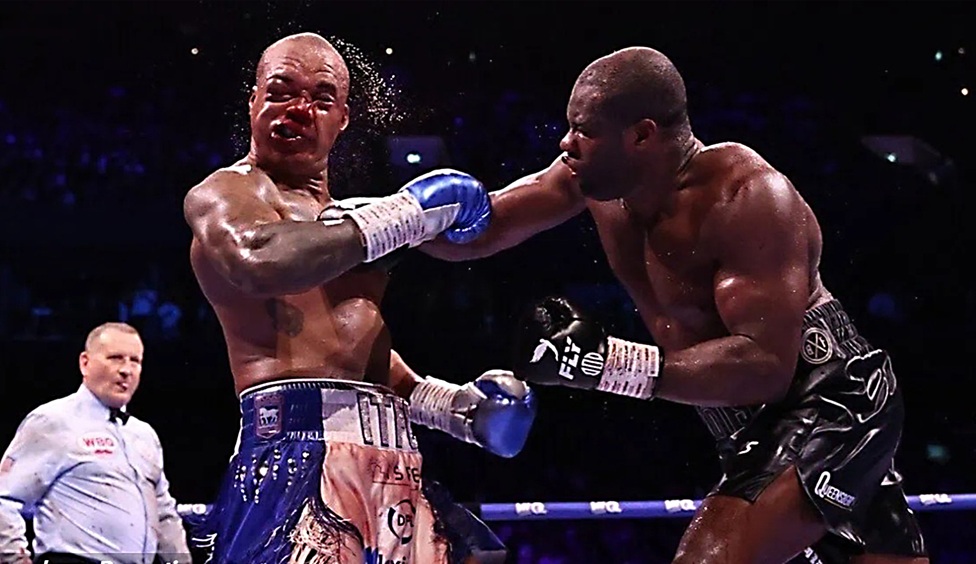
Deadly Dubois v furious Fabio
The heavyweight boxing match, perhaps the match of the decade, between Daniel Dubois and Fabio Wardley was not only entertaining but also has taught us some life lessons along the way as well. Dubios was floored within ten seconds of the opening round, but remained focused. The darkness was temporary and for him there was light at the end of the tunnel. That’s what we all must believe in, fight the obstacles to achieve goals. He did not rise off the deck once but twice. He completed his latest resurgence with deadly efficiency when he stopped Wardley in the 11th round of a dramatic, mesmerising and blood-soaked contest. Wardley was literally tasting blood, his own blood. The referees light blue long sleeve shirt turned red, as if he was working in an abattoir rather than being the man in the middle of the ring. How many of us have this character of resurgence? How many of us have this resolve, particularly, in the face of current and future difficulties? Despite losing, Wardley has also taught us a life long lesson. He said, “My body failed me, but not my heart. And that I can live with.” Get the message? ARUN PRASAD Dilkusha, Nausori
Girmit holiday
May 14 will be another very important 147th commemoration day for Fiji, regarding its Girmit heritage, in my opinion. These were the foundational platform, I believe, of Fiji’s economical journey towards its independence. They were, in my view, the sacrificial colonial labour force that actually mapped out the ground root stages of Fiji’s civil development. And from my perspective, Fiji as a whole, owes them so much, for the inhumane and unprecedented exploitation done during the colonial era. There are those who came in after, but the girmitiya were the “Indian indentured labourers” and their legacy should always be honoured for as long as Fiji exists, in my opinion. It was a very sensible and honourable idea by the Coalition Government, in my view, to replace Constitution Day with Girmit Day. Let us intactly uphold such a meaningful history. Samu Silatolu Nakasi, Nausori
The plight of Indo-Fijians
On May 14, 2026, the nation will celebrate Girmit Day (Diwas), this year online to mark the arrival of indentured Indian labourers to Fiji. Some think that this was a dreadful day and whether we need to celebrate it. In 1879, India was a British crown colony and the end of slavery in 1833 led to a labour crisis in British colonies. Thus the scheme of indentured labourers was cooked up to use Indians as cheap labourers on a five-year contract basis. Agreements of contracts were signed which the illiterate labourers called as girmit. Thus the concept of girmitiya emerged. Forty-two ships made 87 voyages and brought in 60,965 labourers to Fiji. The first to arrive was Leonidas which carried 463 labourers (men, women and children). It reached Fiji on May 14, 1879. The journey originated at the port of Calcutta in India and the journey lasted for two to three months depending on weather conditions. The ship journey was dreadful as the labourers had not ever seen a vast stretch of ocean. Seasickness was rife and squalid conditions on ships were almost unbearable. Labourers were treated as animals and packed like sardines. Poor sanitation and meager food led to dysentery and cholera. Some labourers succumbed and died on board and their bodies were thrown overboard. It was nothing short of hell and thus emerged the concept of Kala Pani and Jahaji Bhais: brothers in suffering. The labourers were deceived into believing that Fiji was a wonderful place and they could make a lot of money. It was exactly the opposite! In 1870 the Colonial Sugar Refining Company had established a sugar industry in Fiji. Sir Arthur Gordon was the Governor at the time and he found it convenient to bring in Indian labourers because the native Fijians had failed to provide sustained labour needed by the sugar industry. Indians ate less, complained less and worked long hours (sunrise to sunset) under the burning sun. After the quarantine period was over, the Indian labourers were sold to European sugarcane planters. Labourers were treated like animals and after the auction they were sent to various parts of Fiji. Separation from their families, loneliness and harsh discipline and living in crammed labour lines depressed many of them. Many committed suicide. There was a shortage of women and this led to conflicts surrounding them. Murders were common. Sugarcane industry workers and farmers agitated for fair treatment from the planters. It led to the abolition of the indentured labour from India in 1916 and it was phased out in 1920. Many indentured labourers opted to stay back in Fiji and were allotted small farms to ensure steady supply of sugar cane. Slowly the population grew and one point in time it was 54 per cent. However, after the events of 1987, Indo-Fijians migrated en masse: taking with them the skills and the capital. Now their population stands below 30 per cent and is continuing to decline. Indo-Fijians have huge challenges before them. Many are landless people. They reside on leased lands and there is no guarantee that it will be renewed. I believe in Fiji, land has been weaponised against Indo-Fijians. Their economic struggles, social and political marginalisation is very obvious. They are still being treated as vulagi. The use of the common name “Fijian” has created a furore. I believe most Indo-Fijians who have migrated to New Zealand, Australia, Canada and the USA have done exceedingly well for their families. Thus Fiji has become a vague memory and a holiday destination. Dewan Chand Namadi Heights, Suva
Leadership style
Why does a foreign company have to tell us that they can bring an incinerator to turn our waste to energy, when we have brain factories in the Government to come up with some brilliant projects. Are they (Coalition Government) still trodding on the moce boko (sleepy mode) leadership style or are they truly desperate for the dollar. AREKI DAWAI Suva
Fuel-free races
While many are struggling to meet their needs in this global fuel crisis, some are enjoying car races or other fuel consuming devices for sports competitions. You can still enjoy racing by using horses, bicycles or even wheelbarrows. Go for fuel-free races! Tahir Ali Hamilton, New Zealand
Minimum wage proposal
The minimum wage rate proposal has aroused a lot of interest but unfortunately the means by which employees (at least try) can reach that rate hardly arouses interest. Mohammed Imraz Janif Natabua, Lautoka
Healthy population
Dear three-wheeler Coalition Government and honourable members of Parliament, you can tell a healthy and happy population by the way it is governed. Does the Government of the day have any percentage of the population that are healthy and happy today in Viti. Ministers are content with their pocket I guess! AREKI DAWAI Suva
National language
With reference to the proposal that Fijian be recognised as a national language (FT 1/5/26), readers may be interested to know that this proposal was first made by myself in a letter to the editor of The Fiji Times in 1976, in July I believe. I did have a copy but cannot find it right now, maybe the current editor can help. Anyway, it is good to know that the ministry has caught up after fifty years! Paul Geraghty USP, Suva
Blind following
Why are pari drivers notoriously linked to peddling drugs? Is it only because they are illegal operators even though they are trying to earn an honest income? Herd mentality is definitely a significant societal issue in Viti. Sobo! Wise Muavono Balawa, Lautoka
Trump’s foreign policies
President Trump’s aggressive foreign policies, including the abduction of Venezuelan President Maduro and war on Iran, threat towards Greenland, and straining NATO ties have crashed the US global perception for a second straight year according to a new democracy survey. The study finds US is now viewed less favourably than Russia overall (Graphic News May 12, 2026). And, this was the US President who was going to “Make America great again”! Many intellectually challenged Americans believed him! Rajend Naidu Sydney, Australia
Market and rugby league
Dark and dreary Nadi market
I passed through the section of Nadi market closest to the carpark and bus station during lunch hour yesterday. Even with the midday sun, this whole section, selling mainly yaqona, next to the fish market, it appeared really dark, dreary and most unwelcoming — in my sincere opinion. Something must be done without unnecessary delay to lift its profile. I plead with our civic leaders to address my observations, shared with utmost care, responsibility, respect, pride and dignity. No offence. Just lending a helping thought in the unlikely event of any inadvertent oversight. This section of our ageing market can become bigger, brighter and more welcoming. Nadi market can be better looking and welcoming. Enough of the “same old; same old”. Nadi, like West Viti Levu, boasts enormous free sunlight. Nice coats of light coloured paint and a few lengths of sun-roofing, will enhance the market’s profile and image, a thousand-fold. As a caring senior citizen, betrayed of stolen FNPF pensions since 2012, I share my views, free of charge, for all who use Nadi market. (Both Suva and Lautoka municipalities have made admirable improvements to their markets and bus stations. Sadly, Nadi is left lingering far behind). I invite our township leaders to inspect this section of our market ASAP and prove me wrong. Procrastination, is always the thief of time. Ronnie Chang Martintar, Nadi
Schools rugby league
I salute the executives of the Fiji Secondary Schools Rugby League for taking rugby league to greater heights with a sublime conclusion of the Vodafone FSSRL competition at the iconic 4R Stadium at Govind Park in Ba. In front of passionate fans and a deafening crowd, the Nasinu Panthers, Ba Methodist Saints and Queen Victoria Knights walked away with the U-15, 17 and 19 titles in emphatic and grand fashion. The Panthers defeated first timers Gospel Saints 12-8 in a fierce and closely contested battle. The Panthers stood out with their game management, discipline and composure and Gospel’s fightback was too late. Western giants Ba Methodist proved too strong for Sigatoka Methodist, edging the side from the Coral Coast by two points (18-16). The late rally by Sigatoka Methodist proved futile as Ba Methodist, who enjoyed a huge support from the local crowd, did their homework properly. I was impressed with the performances from Ba Methodist’s Taniela Kunarara, Isoa Nukunidreke, Joji Banuve and Maciu Waqaira. In the main grade (U-19), QVS proved superior to neighbours Ratu Kadavulevu School (RKS), winning 28-26 in a thrilling contest that had fans on the edge of their seats. After ending a 33-year-old drought in the Coca-Cola Games boys’ division, the hunger to win was imminent as the Knights used their cards right. The atmosphere was electric as old scholars from both schools cheered their hearts out. QVS, playing in front of our PM, played a strong game. RKS was no exception, but the boys from Matavatucou held their fort exceptionally well and the likes of Isikeli Bari, Joseph Vadei, Simione Ramasei, Josua Naitini and Anare Vakarautaki led the onslaught. The future of rugby league is bright. Rajnesh Ishwar Lingam Nadawa, Nasinu

