A Personal Tribute
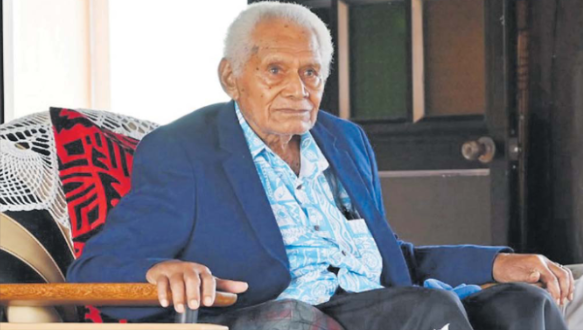
I WRITE with deep reverence to honour our late paramount chief, Momo Levu na Tui Vuda, Ratu Eparama Kitione Tavaiqia.
As the vanua o Vuda bids him farewell, we mourn a leader who embodied traditional humility.
In 1984, the then Momo na Tui Vuda, Ratu Josaia Tavaiqia, invited my father to Vomo. As a wide-eyed eight-year-old Waiyavi kid, I tagged along and met Ratu Eparama, who lived on the island at the time.
Long before luxury resorts, the island was untouched, housing a single cabin and cattle herds. There, I saw how deeply the Vuda chiefly family connected to the land and grassroots Fiji.
Decades later, Ratu Eparama carried that same grounded spirit.
While others chased national politics and State titles, he chose a quieter path. His true office was the soil of his village, his farm, and his people’s homes. He shunned government corridors to walk the lanes of Viseisei, listening to his people and carrying their burdens.
His immense humility proved that a chief’s true majesty comes from a servant’s heart, not a political crown.
He led by quiet example, keeping his people’s trust untouched by ambition.
Vinaka vakalevu, and rest in peace, Momo Levu na Tui Vuda.
TIPO KAU’ATA Gwoonwardu, Traditional Lands of the Yinggarda Peoples, West Australia
Women in Parliament
PRIME Minister Rabuka and his Coalition Government must stop sitting on the Fiji Electoral Law Review Commission (FELRC) Report which the Fijian taxpayer paid for with their hard-earned blood, sweat and tears; earning a minimum wage of $5 an hour, while the Coalition government approved a 138 per cent pay rise for themselves.
Apart from that the government openly appeased all their MPs by appointing others who did not get the ministerial portfolio, as assistant ministers.
This is a disgraceful act by our politicians who have been given a duty to care and look after our people.
The people of Fiji spoke their hearts out to the FELRC and hoped that their voices would be translated into reforming the present system in which not even a single member is accountable to the people of Fiji.
They remain unaccountable to the people that elected them and Fijians cannot go to their towns and talanoa with a representative as there are none.
Given the shortcomings of the present electoral system, neither has the Coalition government put its MPs to task, by assigning them to regions, towns, cities or divisions allocated for government MPs to be resident, even one day a week in the District Officer’s office for consultations.
I would advise the PM to do that, in the interim, until we fix our electoral system. This has never occurred to our government.
The Electoral Commission report is not a document to be merely filed away. It costs the nation time, money and also a drain from other assigned resources denied to Fijians.
The Great Council of Chiefs’ recent call for constitutional guarantees to ensure more women enter parliament, is nothing new and has been canvassed by Fijians to death. Fiji has already spent years discussing this issue, studying it, and documenting solutions. What we lack is not ideas, but political will.
The Fiji Electoral Law Review Committee (FELRC) has already recommended a Parliament of 25 women members with a legislated mechanism to increase women’s representation. The Government has had the Electoral Commission’s report since last year, yet it has not even tabled it in Parliament. Public submissions were made, voices were heard, and the evidence is clear — but politics appears to have taken precedence over reform.
There are elements within the Government who may not wish to contest the next election under a reformed electoral system. The current 2013 model, with its low effective threshold, allows candidates to enter Parliament with only a few hundred votes while keeping minor parties out through the 5 percent national threshold. This system serves entrenched interests, not democratic fairness, and certainly not gender equity.
The GCC chairman, Ratu Viliame Seruvakula, is correct in saying that Fiji must move beyond promises. Women have long played leadership roles within the vanua, in community development, cultural preservation, and traditional obligations.
Many capable women are ready to serve, yet the electoral system continues to fail them. This is not a new revelation. Former Electoral Commissioner Professor Wadan Narsey has written extensively in The Fiji Times about the need for structural reforms to support women candidates — including constituency-based systems that allow women to build direct relationships with communities, earn trust, and be elected on merit.
His proposals were clear, practical, and grounded in Fiji’s political realities.
My own submission to the Constitutional Review Committee echoed these same concerns, as did many others. The evidence is overwhelming: Fiji needs an electoral system that creates genuine pathways for women leaders, beginning at local government level and progressing to national politics. It is encouraging that the GCC has now added its voice. But the Government must act. The Electoral Commission’s report should be tabled without delay, debated openly, and implemented before the 2027 General Election. Fiji deserves a Constitution that gives every citizen — including women — an equal opportunity to serve their country and have a representative from their own area, who will represent their areal interests, and be available for accountability and consultations.
Anything less is simply avoidance dressed as consultation. PM Rabuka has to act decisively and avoid any further flip-flopping.
Dr SUSHIL K SHARMA Lautoka
Leadership
THE 25th anniversary reflections on Leadership Fiji, titled “Leadership Begins with Service,” are a valuable reminder of the true essence of leadership. (The Fiji Times, 8/8/26).
Leadership certainly does not begin — or end — with self-serving leadership.
We have been made acutely aware of the consequences of the latter through our post-coup experience.
RAJEND NAIDU Sydney, Australia
Safe drinking water
ISA! As if the people of Savusavu haven’t already endured enough suffering from electrical failures and smoke inhalation, they now appear to be facing the frightening possibility of having their drinking water contaminated
While the Prime Minister waits for a report on the Savusavu Landfill fire, perhaps he should add another urgent item to the list: an immediate update on the safety of Savusavu’s drinking water.
Seriously? If our hospital cannot adequately manage the aftermath of a plane crash, how can we expect it to cope with a potential water-poisoning incident affecting the entire community?
Who is responsible for delivering clean, safe drinking water to our community tonight, tomorrow, and for as long as it takes until the water is declared safe again?
Do we even have the capacity?
At what point does somebody stop writing reports and start taking responsibility!
NOLEEN BILLINGS Savusavu
Climate change tourism
WE read in The Fiji Times that “the Pacific’s fight against rising sea levels will be brought closer to world leaders through a proposed visit to Tuvalu during the pre-COP conference in Nadi,” with Prime Minister Rabuka saying that “Fiji had asked Australia to support hosting” the visit (The Fiji Times, 8/8/26).
Is the proposed visit to Tuvalu genuinely about raising awareness of climate change, or is it simply climate-change tourism?
I would contend that, by now, any world leader who is not already fully aware of the dire and devastating impacts of climate change is hardly fit to be attending a COP conference in the first place.
I believe there is no need to go to Tuvalu to see this first hand, just as there is no need for world leaders to go to Greenland to see for themselves the glacial meltdown occurring there because of climate change.
Scientists have already documented that fully for the whole world to see.
RAJEND NAIDU Sydney, Australia
Idle land
SUSHIL Sharma (FT, 8/8/26) continues to question the structure of Fiji’s sugar industry, highlighting that “20,000 hectares (are) left vacant.”
It begs the question: why would any landholder willingly forgo a potential cash income and settle for nothing?
There must be more to the story than simply a lack of willingness to cultivate the land.
Perhaps it is time to examine more closely the reasons why so much potentially productive land remains vacant.
TERRY HULME Yadua, Nadroga
Culture of discrimination
LET’S pause for a moment to contemplate the brevity of our time on this earth.
During our stay, let’s strive to be compassionate and respectful, treating others as we would wish to be treated ourselves.
This fundamental principle lies at the heart of preventing discrimination.
It’s our collective responsibility to actively denounce any form of discrimination against anyone.
Each of us plays a crucial part in pursuing this mission with fairness and determination.
I am reminded of a powerful quote from American political activist Bayard Rustin: “If we desire a peaceful society, violence cannot be the path to it. If we strive for a society free of discrimination, we must ensure we do not discriminate against anyone in its creation. If we aim for a democratic society, democracy must serve as both the method and the goal.”
Let’s commit to taking meaningful steps towards dismantling the culture of discrimination.
SURESH CHAND Nadi