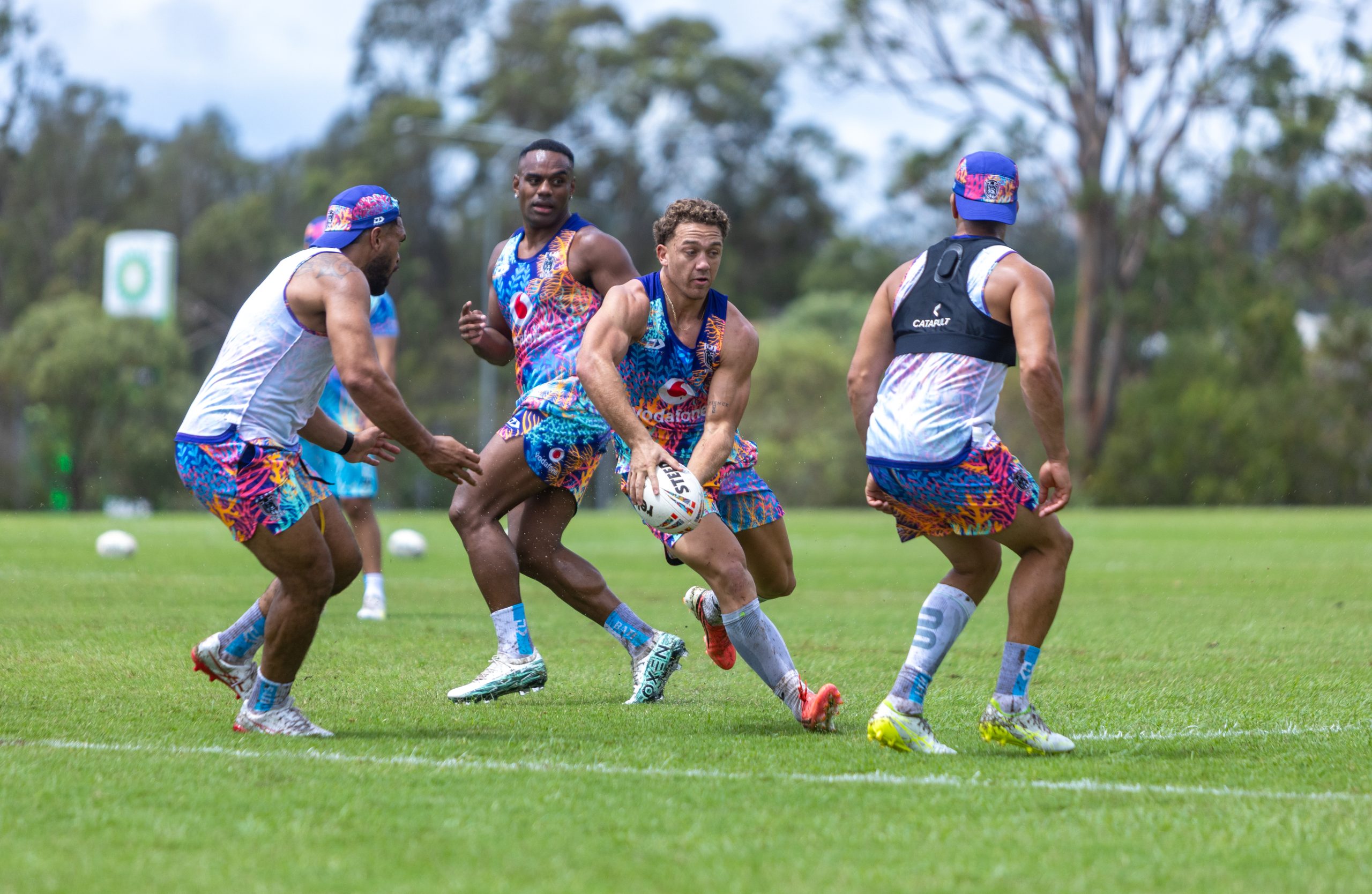
Bulikula create history!
Congratulations to the Vodafone Fiji Bulikula for creating history and qualifying for the semifinals of the 2026 Women’s Rugby League World Cup tournament. The Bulikula had a dream start to their first Women’s RLWC tournament, securing a spot in the top four in their maiden Women’s RLWC tournament. The Bulikula thrashed France 54-6 in a commanding and thrilling performance to set a date the tournament favourites Australia’s Jillaroos in the semifinal this Saturday! The semi-final will be a tough one, but the girls have proved that they can topple the tournament’s top seeds. Player of the Match, Latisha Smythe, Aliti Namoce, courageous captain Sereana Naitokatoka, Maria Paseka, Tahlia Marshall, Losana Lutu, Lorren Leli, Leilano Ahsam, Cassie Staples and Taina Naividi were too hot to handle. On the other hand, while the Bulikula won hearts for a sound performance, the Fiji Bati delivered a shocking performance as they were thrashed by New Zealand 78-0. After delivering a thunderous performance versus the Kangaroos, the Bati looked like a ship that was drowning and needed assistance to fight the adversity that surrounded it. The boys looked tired and demoralized as our opponents put on a fight worth watching. The Bulikula are through to the semis, while the Fiji Bati return home with a heavy drubbing. Rajnesh Ishwar Lingam Nadawa, Nasinu
Overhaul necessary
After the PAP’s AGM, the PM stated: “I have been enriched, empowered and re-energised to lead. I am a servant of your will” (FT 31/10/26). Whose will is he referring to? The Fiji people or the PAP members? The party-politics never fails and I believe that if it isn’t in alignment with the Fiji people’s will, it will always be the priority. Is that not where Fiji still remains after 56 years of independence? Is that why Mr Sayed-Khayum didn’t accept the referendum? Common sense I am certain, to an uncommon degree, is what the world calls wisdom. Without it, originality or moral courage is absent. And there is a huge difference between a truly “conquering leader” and a habitual “surviving leader”. The “footprint” always manifests itself. Samu Silatolu Nakasi
Congrats Nadro
Jetset Nadi, so near, yet so far away. “Voleka qai sega. Wisou, Nadi.” What a real pity. We had it in the bag. Indiscipline in the second 40 minutes let Nadi down so very badly. We gave away no less than eight penalties. Nadroga capitalised. Nadroga valiantly and gallantly came from behind to secure pure victory in the Skipper Cup final in Churchill Park, Lautoka yesterday, Saturday, October 31, 2026. You deserved the 24 – 22. Congrats! Hakwa Nadro. Sa lemutou na qaqa. Nadi had one last gasp to clinch victory after the hooter. Pity, Taliga’s kick did not find its mark. It wasn’t meant to be. Sadly, today’s “wai ni kana” does not taste as sweet. Respectfully, Nadi, bitter lessons must be learned … (it takes brains, not brawn in critical moments). Ronnie Chang Nadi
City crying
It is no secret that Lautoka is increasingly becoming a city where lawlessness appears to be gaining the upper hand. Residents are growing sick of the daily disturbances and unacceptable behaviour they are forced to witness. Despite numerous concerns being raised through The Fiji Times letters platform, the situation appears to have deteriorated rather than improved. Public drinking and drug use continue to be major concerns, particularly around the Pacific Energy Service station, opposite Hot Bread Kitchen, an area located just metres away from the Lautoka Police Station. Large groups of intoxicated individuals have effectively turned these public spaces into makeshift nightclubs. Profanity, physical altercations, public urination along shop corridors and harassment of early morning walkers has become increasingly common. There are even instances of half-naked individuals passed out on public walkways. A nauseating sight no doubt. Equally concerning is the continued operation of so-called “pari” taxis, which appear to operate boldly along these streets without fear of enforcement, despite questions surrounding their legality. One has to wonder, when will the relevant and rather useless authorities finally take corrective action? What strategies, if any, can police officers employ to combat this menace? What is particularly frustrating is seeing police vehicles drive past these drinking parties without any apparent intervention. When disturbances are taking place in full public view, residents naturally expect the police to enforce the law. Such apparent inaction only reinforces the perception that some people can do as they please without facing any consequences, and that’s exactly what they are doing. Another worrying development is the growing visibility of gambling activities involving youths and children around the city, particularly near parks and the bus stand. Some of these youngsters appear to be barely 11 or 12 years old. While violent robberies, grab and runs, drug use, glue sniffing and antisocial behaviour (mischief makers) continue to raise concerns, should we now be stressing about gambling becoming another growing social problem among our younger generation? Where do the parents fall in this equation? Are they even aware about their children’s involvement in such illegitimate actions? What sort of environment are they being raised in? And then we wonder why poverty and social problems are rampant in certain communities. When young people are exposed to such questionable deeds at an early age, well I can already predict what the future holds for them. Lautoka deserves better. Its residents deserve to feel safe walking through the city, whether during the day or early in the morning. Business owners deserve an environment free from intimidation and public disturbances, and children deserve public spaces where they can grow up without being exposed to antisocial behaviour. The Fiji Police Force, Lautoka City Council and other relevant agencies must work together and demonstrate a visible, sustained commitment to restoring law and order. They simply cannot continue to turn a blind eye to these concerns. How many more complaints must residents make before meaningful action is applied? It’s only a matter of time before Lautoka will be notoriously branded as a “lawless city”. Nishant Singh Lautoka
Stability and responsibility
Fatigued Fiji
The Commander of the RFMF recently made a statement that deserves serious reflection: “In the name of stability, we protected those who destabilised the nation. In the name of reconciliation, we silenced those who were wronged.” For me, it raises an even deeper question. What actually creates stability in Fiji? I believe one important part of the answer lies in the stability and confidence of the iTaukei people themselves. But stability cannot mean ownership without responsibility. We cannot continually demand ownership of our land, resources, institutions, culture and political future while refusing to accept responsibility for the decisions made in our name. True ownership comes with responsibility. Responsibility for ourselves. Responsibility for our leadership. Responsibility for the consequences of our political choices. And responsibility towards every other person who also calls Fiji home. For decades, whenever something has gone wrong, it has been tempting to find somebody else to blame. At different periods of our history, Indo-Fijians became convenient targets for anxieties that had much deeper historical, economic and political causes. But surely Fiji must now also be suffering from what I would call “Indian fatigue” — not fatigue with Indo-Fijians themselves, but fatigue with the repetitive political habit of blaming them for problems they did not create alone. For too long, “the Indians” have been brought into political arguments as though blaming another community somehow resolves our own failures of leadership, responsibility and accountability. It does not. At some point, that explanation wears thin. At some point, we have to stop pointing across the room and look at the four fingers pointing back at ourselves. When tensions became unbearable, Fiji resorted to coups. Again. And again. And again. Without a doubt we now have coup fatigue. We already know what coups give us: disruption, uncertainty, damaged relationships, weakened institutions and another generation trying to repair what the previous generation broke. So what happens when coups are no longer the answer? We start fighting through constitutions. One constitution replaces another. Another amendment is proposed. Another political structure is offered as the solution. And eventually we develop constitutional fatigue as well. Yet perhaps the uncomfortable question is this: What if the Constitution is not the real problem? A constitution can establish institutions, distribute powers and protect rights. But it cannot manufacture responsibility. It cannot force people to accept accountability. It cannot create unity where leaders continually exploit division. And it cannot make us confront ourselves if we are determined to blame somebody else. Now we are registering more political parties, proposing more political solutions and producing more competing visions for Fiji. There is nothing inherently wrong with that. Democracy should allow different ideas. But if every new party simply becomes another vehicle for another group blaming another group, we will eventually suffer from political-party fatigue too. So perhaps Fiji is moving through a cycle: Indian fatigue. Coup fatigue. Constitutional fatigue. Political-party fatigue. And yet underneath all of them may lie the same unresolved question: When do we take responsibility for ourselves? Perhaps Fiji’s next great political reform does not begin with another coup, another constitution or another political party. Perhaps it begins with something much harder: Looking in the mirror. For the iTaukei, that means protecting their identity, land, culture and resources while accepting the responsibilities that come with ownership. For political leaders, it means taking responsibility for the consequences of leadership rather than continually finding somebody else to blame. And for all of us who call Fiji home, it means recognising that our future cannot continually be built around the question: “Who caused this?” At some point we must ask: “What responsibility do I carry for fixing it?” That may be where real stability begins. Noleen Billings Savusavu
Truth and reconciliation
THE Fiji Times news on Truth and Reconcilliation (FT 24/10) is truly the way forward for peace, progress and prosperity for Fijians. ‘The way the world should be’, be maintained at all cost. Help us God. “If there is reconciliation first, there must be truth”. There is no God higher than truth. Tahir Ali Hamilton, New Zealand
United parties
The NFP is not only the oldest party in Fiji, but I believe they are also the most united party as well. By the same token, SODELPA is also a very united party as well. We will see that on display in parliament on both counts soon. Jan Nissar Sydney, NSW, Australia
Fiji Airways
To the Captain and officers of Flight FJ934, Melbourne-Nadi on Saturday, October 31, the smooth landing is worth commendation. he Purser and her team, the services in the economy class was superb. Keep up the good work. Daniel Urai Lautoka
Praise for Commander
I wish to commend the Commander of the Republic of Fiji Military Forces, Major-General Ro Jone Kalouniwai, for his honest and profoundly democratic submission to the Parliamentary Special Select Committee on the Constitution. By firmly reaffirming the military’s strict commitment to political neutrality, democratic governance, and service to the civilian population, Major-General Kalouniwai has shown exemplary leadership. His transparency provides a vital sense of security and reassurance to all citizens as we navigate these crucial constitutional reforms. The commander’s integrity sets a powerful benchmark for institutional accountability in Fiji, steering our security forces toward a stable, democratic future. He deserves our highest praise. Paula Kaloukocei Levuka, Ovalau
League effort
I had wanted to write about this before Fiji’s game against New Zealand in the Rugby League World Cup. I was going to say that I hoped Fiji did not start playing rugby union in that game. Worse still, I was hoping they did not start playing the Mickey Mouse 7s in that game. But looking at the scoreline, it appears they were playing T20 cricket instead! If Fiji wants to improve in any rugby code, I suggest the players should get garish tattoos all over their bodies instead of relying on divine intervention. It seems to work for players from Samoa, Tonga, New Zealand and to some extent Australia. Jan Nissar Sydney, NSW, Australia