
Wonders of humanity
IN the 21st century, gadgets have become a familiar sight in households and workplaces. With countless applications at our fingertips, one can learn almost anything — from languages and cooking to sewing, vehicle maintenance, and construction. These tools can even solve complex mathematical problems in the blink of an eye. It seems inevitable that one day, children may rely less on teachers when knowledge is available 24/7 through these devices.
Yet history reminds us of a different kind of learning — the “School of Hard Knocks.” Centuries ago, humanity produced breathtaking wonders: the Taj Mahal in India, the pyramids of Egypt and Sudan, the Eiffel Tower in France, the Leaning Tower of Pisa, the Colosseum in Rome, and the Statue of Liberty in New York. These masterpieces were built without the advanced technology we now take for granted. Even today, no one has been able to repair the Taj Mahal’s ancient leak.
Consider the inventions that transformed the modern world: automobiles and airplanes, ocean liners and electric trams, vacuum cleaners and dishwashers. All were born not from formal instruction but from passion, creativity, and curiosity.
Humanity’s greatness is not only seen in modern achievements but also in the wisdom of our forefathers.
Long before GPS and digital tools, they navigated vast oceans in dugout canoes, guided only by the stars and constellations. They healed wounds and diseases with herbal medicine, cooked in the lovo instead of stoves, and built bure while weaving mats and baskets without ever stepping into a classroom. They predicted the weather by observing the skies, birds, and plants.
These skills were not written in textbooks — they were lived, practised, and passed down through generations.
This is something we must reflect on: the very wonders of humanity that define us.
Sadly, many of us today, especially our young ones, know little of these skills.
As schools approach the third term, perhaps this is the perfect time to share and showcase traditional knowledge. Instead of children spending endless hours glued to screens, let them learn the wisdom of their ancestors — practical skills that shaped civilisations long before gadgets existed.
Passion and curiosity built the world we admire today. Let us ensure our children inherit not only modern technology but also the timeless knowledge that sustained generations.
Lavenia Malama Nabua Rd, Nabua, Suva
By the skin of their teeth!
OKAY, the Socceroos have qualified by the skin of our teeth into the Round of 32.
How well did they play? Overall, there were moments of brilliance but it was a lacklustre performance from the boys down under. I think Paraguay were a better looking side on attack and were unlucky not to score towards the end of the match.
Should the Socceroos come up against a slicker goal scoring machine, we will have our work cut out to be competitive. We still lack some of the finesse and finer ball skills of other top tier teams.
My prediction, and as much as I want them to win, is that we may have a real challenge getting through to the round of 16. But hey, I may be eating humble pie and have egg on my face while still celebrating the result of getting through to the quarterfinals as we’ve done once before.
Colin Deoki Australia
Immunity clause
Sakiasi Ditoka stated the consequences of removing the immunity clause as stipulated in the 2013 Constitution. Does it really matter? Who is he protecting? He seemed to be defending the very “cause” that has placed Fiji where it is today, in my view.
Lee Kuan Yew once said: “If 10 people are executed every day, so be it. Even one death is very kind.”
He was referring to the “destructive” implications of drugs, on Singaporean communities. Isn’t that what governments do to protect people?
Mr Ditoka seemed to be declaring the opposite, in my opinion. In fact, a practical “deterrence” is warranted, I believe, to illustrate the destructive measures “coups” reflected, to a country’s socio-economic development.
And I am certain, appropriate law is good order, as it promotes the “common good” and ensures the “powerful” are held accountable.
The Bible advised that nothing is secret, that shall not be made manifest, neither anything hidden, that shall be known.
Samu Silatolu Nakasi
Bread bandage
To you all our diabetic patients. If you have a wound that does not heal be advised that after cleaning the wound, you could use the white part of bread to put on before bandaging it. I guarantee you the wound would heal in a matter of weeks.
Hospital medication might not have worked but try this one and I am sure you will be happy with the result.
Sam Young. Norma’s Place, Nadi
The savings?
Does the 600-nurse shortage mean that the Government is making salary savings in that area?
Mohammed Imraz Janif. Natabua, Lautoka
Sports commentary
Listening to Radio Fiji 2 soccer commentary by Raymond Stoddart and his team, I feel we are well blessed and united wherever we are. Keep it up, be it rugby or soccer. It’s in our blood.
Go Fiji, go!
Tahir Ali Hamilton, New Zealand
Human rights
I refer to World News (FT 26/06) where a Pakistani anti-terrorism court has sentenced prominent civil rights activists Mahrang Baloch and Sibghatullah, another Balochi leader to life in prison.
These two women leaders who led the protest had nothing to do with the killing of the paramilitary soldier.
US and other Western countries are quiet on Pakistan’s human rights abuses as always.
Rakesh Chand Sharma Nadi
Tabuya trip
I don’t know whether the local news media covered it, but we see in the blog site FijiLeaks, photos of Minister Lynda Tabuya posing and strutting about in Paris.
Is that a third world phenomenon — a government minister doing stuff like that on an official overseas engagement?
Rajend Naidu Sydney, Australia
EFL concerns
Many questions are raised against EFL by the standing committee on economic affairs. I suggest the committee should push for a review of the Electricity Act. Therein lies the answers to their concerns.
Dan Urai Lautoka
Lacklustre 2026-27 Rabuka Budget DR SUSHIL K SHARMA LAUTOKA THE 2026–2027 Budget reads like a missed opportunity. It preserves popular subsidies and maintains the VAT at 12.5 per cent, yet it offers no meaningful relief for the workers and rural producers who are bearing the cost of this crisis. Government or public debt is projected to increase to around $12.6 billion by the end of July 2027, equivalent to 84.8 per cent of GDP. The Finance Minister says this budget contains no increase in income taxes for workers and no increase in corporate taxes for businesses. Those two sentences capture the budget’s central contradiction: promises of stability for revenue and business, but no concrete measures to protect incomes or reform the structures that hollow out household resilience. Workers on the current minimum wage of $5 per hour were offered nothing. The minister announced only a $100,000 review of the minimum wage, not the immediate increase to $8 per hour that many families need to keep pace with basic living costs. The business sector has been given repeated concessions and incentives in this Budget — tax holidays, expanded sponsorship deductions, and sectoral relief — yet there is no reciprocal obligation to ensure employers pay living wages, remit FNPF contributions, or end endemic wage theft. If incentives are to be the currency of policy, they must be tied to labour compliance and decent pay. Rural Fiji and the sugar belt were similarly short-changed. The budget maintains a guaranteed price of $85 per tonne for sugar, but makes no structural commitment to bridge the yawning gap between that price and the true cost of production. As a fourth-generation farmer, I know the documented cost of producing cane is now $131.15 per tonne — comprising mechanical harvesting ($2463), cartage ($3762), and field operations ($6890) per 100-tonne harvest. At the guaranteed price of $85 per tonne (unchanged since 2018), a grower loses $46.15 per tonne, or $4615 per 100-tonne harvest (FT 25/06/26). For a standard 500-tonne farm, this is an annual loss of $23,075. These figures do not account for the implicit family labour subsidy — the unpaid hours that would add approximately $37 per tonne, bringing the true production cost to nearly $168 per tonne. The Girmitiya farming model has always treated family labour as invisible, not as a business cost. This is economically indefensible and masks the industry’s true uneconomic condition. Public-sector pay anomalies and opaque senior salaries remain unaddressed. The budget promises a civil service review, yet offers only $400,000 for that exercise while leaving glaring salary distortions intact. If the state is serious about fiscal sustainability and fairness, it should start by normalising executive pay, empowering the Higher Salaries Commission, ensuring public assets and SOE boards deliver value rather than perpetuate privilege. This budget is heavy on studies, incentives for capital, and headline infrastructure projects — but light on imagination for the people who make Fiji work. Ordinary Fijians needed decisive measures: an immediate, enforceable minimum wage uplift; strengthened labour enforcement and FNPF compliance; and a credible, time-bound rescue plan for sugar growers. Instead they received promises and projections. I urge readers and policymakers to scrutinise the details and demand a budget that puts livelihoods before optics. The Coalition will leave $13 billion in debt, the highest for a small 900,000 population representing 85 per cent of GDP, when it hands over power in 2026-27. The incoming government will therefore have little fiscal headroom and will be forced to prioritise cost–cutting and large–scale rationalisations, leaving it with limited options beyond austerity measures. Consequently, Fiji risks entering another term dominated by fiscal consolidation rather than investment in livelihoods and essential services, and ordinary Fijians will continue to bear the pain for the excesses of past Bainimarama and Rabuka administrations. Whatever the case, Fijians who had such high hopes and had voted for change for this nation in 2022, will reflect on the wasted term of the Rabuka administration. They will mainly recall the years of gridlock and paralysis of the administration, and its inability to cease the great opportunity that had been given to it. Fijians wanted a change so desperately and earnestly in 1922 after the long period of pain and suffering from the previous regime, but alas were denied the fruits of their euphoria and high hopes.
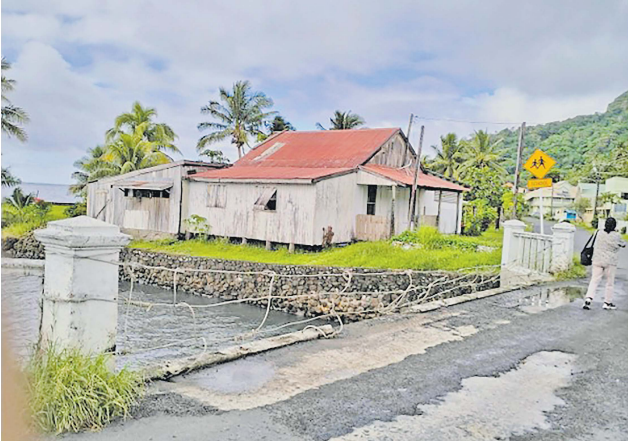
Hazardous Levuka Vaka Viti bridge SATISH NAKCHED SUVA THIS is to highlight the unsafe condition of the Levuka Vaka Viti bridge in Ovalau, where the original concrete balusters (spindles) the vertical posts supporting the handrail has fallen off the structure due to the regular non maintenance probably built around 1850s in the same era as the iconic Levuka Vaka Viti church and replaced with steel wires. The steel wires appears to serve as a temporary measure and are in adequate in ensuring the safety of pedestrians and vehicles crossing the bridge. The bridge itself is showing visible stress wear, corrosion and material breakdown. The heritage bridge is aging but urgently require repair works to reinstate it in its former glory state. The rails on both sides of the bridge needs attention and the drop into the river is about thirty feet. As there is no provision for the pedestrian walkway, one has to walk very close to the edge of the bridge to avoid the traffic that have a right of way .This situation poses a serious risk to public safety and is inconsistent with the standards expected of critical infrastructure. The bridge is a vital link for the community, and its current condition undermines confidence in the safety of all the users. Public safety must be prioritised, and temporary fixes such as steel wires are not acceptable substitutes for proper infrastructure. I hope the Fiji Road Authority have included this in the upcoming national budget and urge them to prioritise this restoration, balancing modern engineering standards with heritagesensitive design, similar to the recent Market bridge repairs.

