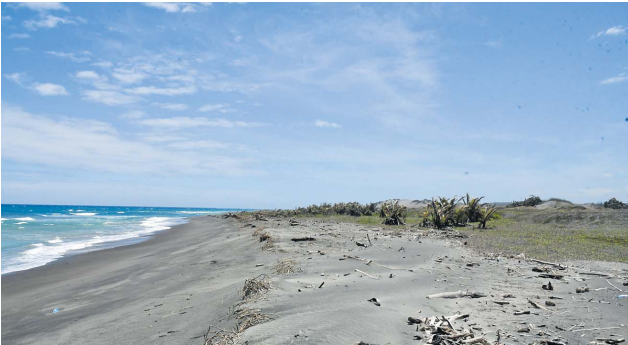
PERCHED on the jagged rocky outcrops behind the coast of Namama in Macuata, no one would have dreamt that the treacherous mountain side would become home to a distraught woman who became disowned by her own people.
This was the fate of Geta, whose descendants claim was the only sister of Degei, one of the first iTaukei who landed in Vuda on the western side of Fiji.
Degei is immortalised in Fijian legend as a god who appeared in a form of a big serpent with a big diamond on his forehead.
Legend has it that Degei’s sister was the mother of Rokomoutu, who is said to have sprung from her elbow.
However, the people of Namama have another version of the story which they say has been passed down from the woman they say was their ancestral god or vu.
The origins of Geta
Namama village elder and traditional herald to the Tui Macuata (paramount chief of Macuata), Vereti Veisamasama, said when the first wave of iTaukei migration left their original home they had to travel through a long stretch of water.
Mr Veisamasama said the name of the original home of their ancestors had been lost through the ages as all historical records were passed down in stories.
“Most of what I tell you now has been passed down to me through stories and I do not know how true they are but they are an explanation of how we came to be,” he said.
“On their (ancestors’) voyage through the oceans, the stories say that Degei and his party including his sister Geta had to rest for a while somewhere in the Asian sea with many claiming it was India.
“In India or wherever they berthed before they continued their trip, Geta conceived a child with many saying that it was through one of those foreigners at the port where their ship, the Kaunitoni, berthed.
“Others say she was impregnated by her own brother Degei which was why he treated her with so much bitterness.”
Banished by her own
Mr Veisamasama said despite her attempts Geta failed to hide her pregnancy from her brother and his crew as the bulge of her stomach became more pronounced as the days progressed.
“When the voyagers arrived at Vuda on the western side of Viti Levu, Degei who viewed the incident as an insult to his honour and his comrades turned his back on Geta and chased her,” he said.
“His original words to Geta were ‘mo lako sara ena dua na vanua au sega ni kilai kina’ (flee to a place where I am not known).
“According to stories passed down to us, Geta then travelled across Viti Levu, crossing the ocean to land on the coast of Namama.”
Etched in the rocks
Mr Veisamasama said at Namama, Geta gave birth to a son and they stayed in their hillfort of Koronivalu.
“Later Geta married and had her own children but the gods decided to immortalise her story by striking the rocks that became the foundation of their new home forming their effigies in the rocks,” he said.
“This was done to remind people of the sad story that befell Geta and her son.
“To this day, the rocks have gone through the process of weathering slowly losing their original shape but you can barely make out the figure of Geta and her son, whom she carries on her back.”
Descendants of Geta
Upon observation one can tell the features of the people of Namama separately from the standard iTaukei physique.
Another village elder, Iliesa Nakete, said people originally from the village bore Asian traits with wavy hair and light complexions.
Mr Nakete said many claim those were the traits carried on from the mysterious lover of Geta, who they believe was of Asian descent.
“To this day, there is one or two in a family that bear these traits and it is often a joke but maybe a reality which has its origins passed down through stories,” he said.
“Koromakawa, the original home of Geta and her son, remain in the mountains and a site often visited by the brave that can find their way over the rocky mountain side.
“After staying in Koromakawa, the ancestors moved down the mountain to a new home they called Natiko before moving to the coast for easy access to civilasation.
“Last year, we had a team from the Ministry of iTaukei Affairs who visited the mountaintop and Koromakawa and took pictures of the site.
“Upon their return from the site, they lost all their pictures and it is not the first time this has happened,” he said.
Mr Nakete said all visitors to the site who failed to seek permission from the village traditionally had some kind of bad luck that befell them.
Scaling the cliffs of Namama
Scaling the treacherous rocky cliffs of Namama to get to Nakoromakawa is not an easy task and I consider myself lucky to have made it back alive from Koromakawa.
Being escorted to the old village site by three primary school boys I laughed but worried at the same time when I saw my enthusiastic tour guides who would lead me to the old village site.
The climb to Nakoromakawa requires fitness and endurance, something I cursed myself for not acquiring before the visit.
I was warned before the climb by my mini tour guides that I need not speak as the only language spoken during the walk would be the Namama dialect as tradition dictated.
* Next week: Geta and her precious gift of water.