
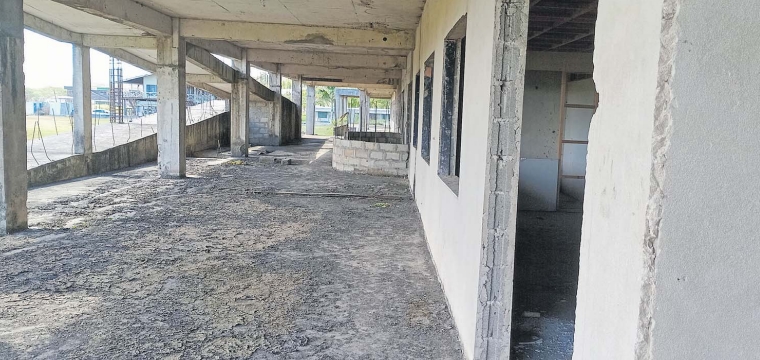
LAST week we introduced you to the Naiyaca Campus – a $40million project that was supposed to provide thousands of students in the Northern Division a cheaper option for tertiary education offered by the Fiji National University.
Construction on the project began in 2018 and since then progress of the work slowed down until it came to a full stop in 2020.
To this day the rotting iron frames of the would-be foundation of the campus remain.
Here, we look at the key players that oversaw the project until it came to an abrupt halt.
In April, 2018, FNU released a statement identifying Civil and Environmental Engineering Solutions Ltd (CEESOL) as the contractor that would be managing the project works, while Design Hut, Edison Consultants and Quantech Pacific provided technical support.
“Several sites were considered but the current location was selected due to its close proximity to the Labasa Town Centre and accessibility to public transport,” the FNU statement read.
“Civil works on the estimated $27million Government-funded project commenced in 2015 with filling and compacting works. After proper settling and geo-thermal testing, the green light has been given by the project consultants to commence with construction works.”
On the condition of anonymity, a contractor explained the different roles each contractor and subcontractor played in the construction of the Naiyaca campus.
“CEESOL was the main project manager, representing the client (FNU), and they were the ones who were supposed to get all the designs from all the contractors, coordinate the drawings and then execute the project,” he said.
“Architectural drawing was done by Design Hut. They design how the building will look like, how many rooms, theatres, where’s the tutorial rooms, all these kinds of things.
“Once Design Hut have done their drawings, the drawings are then given to the structural engineers and in this case, it was Engineered Designs.
“They will calculate the reinforcements which will be done, all the structural parts, size of the columns, size of the foundation, how the buildings will be erected – those kinds of things.
“The same drawing then goes to the services engineers as well, which was Edison Consultants.
“They’ll tell where the lights and all the services, like cold water, lighting system, generator and all those things are going.”
Quantech Pacific was the quantity surveyor, focusing on cost management and financial control. Their role included monitoring expenses and ensuring that the project remains within budget, contract administration and financial analysis, the contractor said.
The contractor said issues relating to drawing coordination caused delays in the progress of construction.
He said the contractor started the building with the architectural and structural plan, “which is basically the rule of construction”, but when it came to that part of the plan, it had to be put on hold because of the variations.
In another instance, the contractor said confusion arose when two different consultants gave different instructions for the level of the ground floor of some buildings.
“Basically, it was almost a $30m project,” the contractor explained.
“From that $30m, whatever the contractor was supposed to do and that he was able to do, he did it and he claimed the money.
“But almost 70 to 80 per cent of the things were on hold just because of design issues, like the security guard hut. FNU was unable to decide whether to put the guard hut at the place where the road is – at that level – or raise it higher.
“There was a plan of the road going up and FRA (Fiji Roads Authority) was supposed to give them (FNU) the confirmation whether they will bring the road up or they will leave it as it is – at that level.
“FRA was unable to make a decision and FNU was unable to make their decision as well and so the contractor is unable to do their part. So that is on hold. Finished.”
He said one of the main reasons these inconsistencies happened was the lack of communication between the contractors, especially with “the drawing coordination”.
“Basically, we can say that drawing coordination was an issue and it’s because of the lack of communication between all the consultants, which is through the drawing coordination.
“Coordination was not done. In other words, when it comes to the contractor, the contractor will say it’s a design issue, right? So, the design issue was one of the major factors for the project being delayed.”
In addition, he said there were also questions raised regarding the competency of one of the consultants to handle a project of that magnitude.
The same question has been raised by a second contractor who’s also spoken to The Fiji Times on conditions of anonymity.

